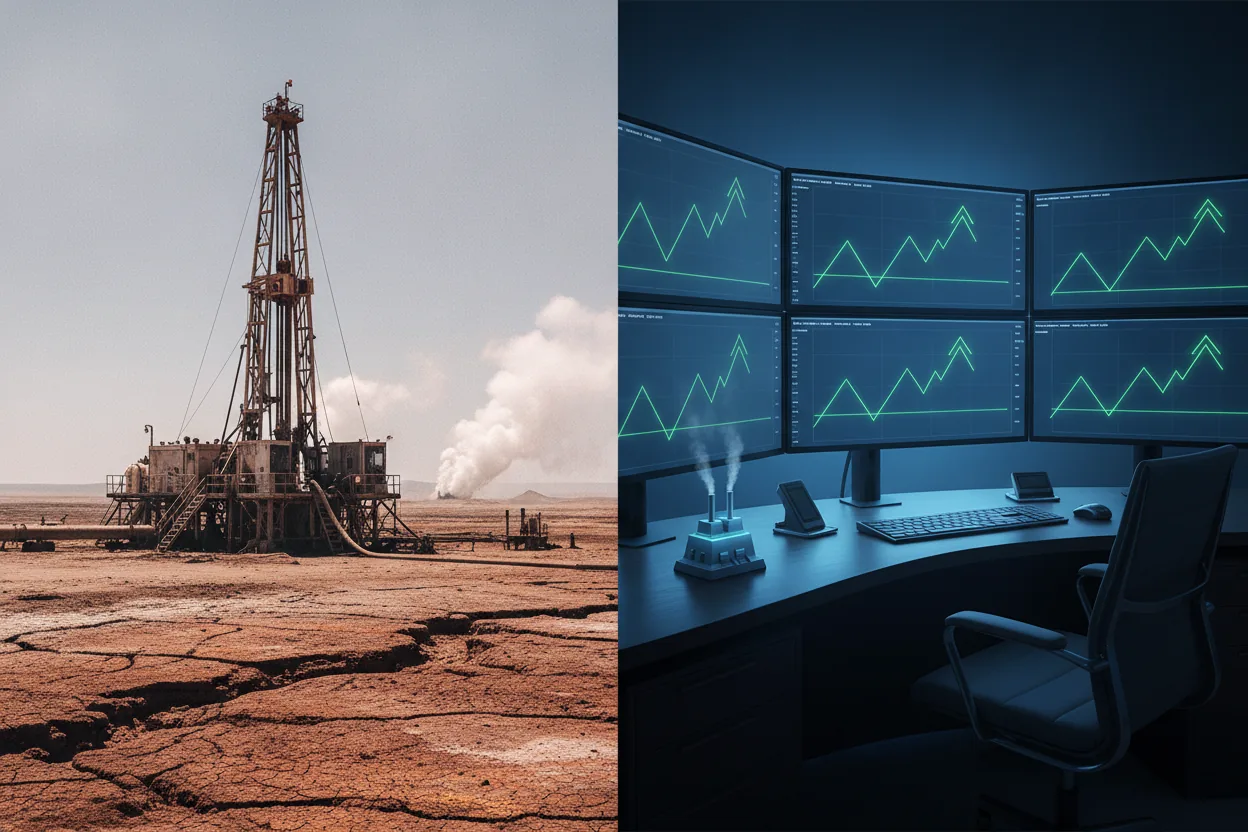
The Department of Energy just opened a $171.5 million funding opportunity for geothermal field tests, framed under an executive order called Unleashing American Energy. None of that money will touch a single revenue generating asset for seven to ten years. Retail investors read headlines like this as market signals, but the cash is earmarked for exploration drilling, the phase where private lenders still won't underwrite risk, not for anything a shareholder can own today. Ormat Technologies, the largest pure play geothermal stock in the country, won't move on this news. It shouldn't. So what is the $171.5 million actually buying, and who cashes in on it first?
On September 7, 2026, the Department of Energy opened a Notice of Funding Opportunity worth $171.5 million for next generation geothermal field scale tests, covering both electricity generation demonstrations and exploration drilling. Letters of Intent are due March 27, 2026, full applications April 30, 2026. The framing ties it to President Trump's Unleashing American Energy executive order, and that connection matters more than it sounds like it should, because it tells you this money is going to projects that fit a specific political and technical thesis: enhanced geothermal systems that borrow drilling techniques from the shale industry to reach heat resources that conventional geothermal can't touch.
My stance: this grant is a de-risking mechanism for exploration risk, not a return generator for anyone holding it directly. Confusing the two is where retail investors lose money chasing geothermal headlines.
Understanding What The Money Actually Buys
From Federal Grant to Public Equity: The Mechanical Chain
Retail investors sit at the very end of this chain, absorbing risk reduction years before any potential upside.
Source: Source: DOE Notice of Funding Opportunity, article analysis
Geothermal has a capital problem solar and wind don't share. A solar project's biggest uncertainty is weather variance and interconnection queues. A geothermal project's biggest uncertainty is what's actually underground, and you don't find out until you drill a well that can cost $5 million to $10 million with no guarantee of commercial flow rates or temperatures. This is exploration risk, or resource risk, and it sits earlier in the capital stack than anything a public equity investor typically touches.
The $171.5 million is earmarked for field scale tests and exploration drilling to characterize and confirm promising prospects. In plain terms: this is money for the drilling phase where private capital historically walks away, because the failure rate on exploratory wells is too high for a venture return profile and too illiquid for a project finance lender who wants predictable cash flow before breaking ground.
Companies like Fervo Energy, which has raised private capital from Devon Energy and other backers to develop enhanced geothermal projects in Utah and Nevada, exist partly because early stage federal grants and DOE loan guarantee programs absorbed enough resource risk to make later funding rounds possible. That's the mechanical function of a grant like this one. It doesn't generate revenue. It generates data, well logs, and confirmed resource estimates that make the next round of private capital cheaper and faster to raise.
Who benefits directly from the $171.5 million? Universities, national labs, and a shortlist of geothermal developers who win the competitive award process, likely fewer than twenty recipients based on typical DOE Geothermal Technologies Office award sizes running from $2 million to $20 million per project. Retail investors benefit only indirectly, and only years later, if the confirmed resource data eventually supports a project that reaches financial close. That lag is the whole story: the public absorbs the risk reduction years before it gets any shot at the upside.
Tracing The Path From Grant To Public Equity
The $171.5 Million Grant at a Glance
|
$171.5M
Total funding opportunity
|
<20
Likely number of recipients
|
|
$2M to $20M
Typical award size per project
|
7 to 10 yrs
Time before any revenue generating asset exists
|
Source: Source: DOE Geothermal Technologies Office Notice of Funding Opportunity, September 2026
Here's the mechanical chain retail investors need to hold in their heads. A DOE grant funds exploration and field testing in 2026 and 2027. If the wells confirm a commercial resource, the developer moves to project finance, typically a mix of tax equity, green bonds, and sometimes a DOE Loan Programs Office guarantee, which has backed geothermal before, including a $2.5 billion loan guarantee framework tied to Fervo's Cape Station expansion in Utah. Construction takes another two to four years. Only then does the project generate power purchase agreement cash flow that could theoretically support a public listing, a yieldco structure, or inclusion in a fund's underlying holdings.
That full cycle, from exploration grant to cash generating asset, commonly runs seven to ten years. Stack that against the holding period assumptions baked into most retail portfolios, and the mismatch jumps out immediately.
Public market exposure to geothermal specifically is thin. There's no dominant pure play geothermal ETF the way ICLN tracks broad clean energy or TAN tracks solar. Geothermal exposure mostly shows up as a minor allocation inside diversified clean energy funds, or through utilities and independent power producers like Ormat Technologies, the largest pure play geothermal operator publicly traded in the United States, with a market capitalization that has hovered in the $3 billion to $4 billion range through 2025 and 2026. Ormat's own project pipeline benefits from the same resource characterization research this DOE funding produces, even when Ormat itself isn't a direct grant recipient.
The practical read: a headline like $171.5 million for geothermal expansion doesn't move Ormat's stock price the day it's announced, and it shouldn't, because the money hasn't touched a single revenue generating asset yet. What it does is lower the long run cost of capital for the entire enhanced geothermal category by generating public resource data that private developers would otherwise have to pay for themselves. That's a slow, structural benefit, and it rewards patience over headline reading.
Separating Policy Durability From Political Weather
Key Dates and Figures in the DOE Geothermal Funding Process
| Item | Value or Date | Who It Affects |
|---|---|---|
| NOFO opened | Sept 7, 2026 | Developers, labs, universities |
| Letters of Intent due | March 27, 2026 | Applicants |
| Full applications due | April 30, 2026 | Applicants |
| Total funding pool | $171.5 million | Selected recipients only |
| Award size per project | $2 million to $20 million | Fewer than 20 winners |
Source: Source: DOE Notice of Funding Opportunity, article details
Every clean energy investor learned a hard lesson between 2021 and 2025: federal funding commitments aren't contracts. They're appropriations subject to the priorities of whoever controls the executive branch and the relevant congressional committees. The current administration frames geothermal funding under an energy dominance and energy security banner rather than a climate banner, and that's worth sitting with for a second. Geothermal is one of the few clean technologies that has managed to attract bipartisan support in Washington, largely because it can be marketed as baseload, dispatchable power rather than intermittent renewable generation, and because the drilling expertise transfers directly from the oil and gas workforce.
That framing gives geothermal funding more durability than, say, offshore wind subsidies have shown over the same period. Offshore wind projects on the U.S. East Coast faced permitting reversals and canceled leases as political winds shifted. Geothermal hasn't faced the same targeting, and this $171.5 million opportunity arriving under an executive order literally named Unleashing American Energy signals that the technology has found a political frame that survives administration changes better than solar or offshore wind subsidies have.
None of that guarantees the money converts into investable projects. DOE funding opportunities routinely see award timelines slip, project selections get contested, and appropriated funds get reprogrammed when Congress passes continuing resolutions instead of full budgets, which has been the recurring pattern for federal discretionary spending through 2025 and into 2026. Treating a NOFO announcement as equivalent to a signed, binding capital commitment is a category error, and the political framing makes that error easy to fall into, precisely because the language sounds so permanent.
Weighing The Real Opportunity Against The Real Noise
The honest opportunity in enhanced geothermal is a technology cost curve story, not a grant chasing story. The Department of Energy's own Geothermal Technologies Office has targeted a levelized cost of electricity reduction to roughly $45 per megawatt hour by 2035 for enhanced geothermal systems, down from figures often exceeding $100 per megawatt hour for early pilot projects. If that curve bends the way solar's did between 2010 and 2020, when utility scale solar LCOE fell more than 80 percent, the eventual equity value creation happens at the project developer and independent power producer level, not at the grant recipient level.
Retail access to that value creation currently runs through three channels: direct equity in Ormat Technologies, exposure via diversified clean energy ETFs like ICLN or QCLN that hold small geothermal adjacent positions, or private market access to companies like Fervo Energy that stays closed to most retail investors until an eventual IPO. None of these channels move on the day a DOE NOFO opens. All three move, eventually, if the underlying drilling economics keep improving and enough field scale tests convert into bankable projects.
The risk retail investors underprice is duration. Geothermal's investment thesis demands patience measured in years across exploration, permitting, and construction, in a market that has shown it would rather reward battery storage and solar stocks on quarterly earnings cycles. A fund manager building a five year clean energy narrative around geothermal is betting that political durability and cost curve improvement both hold steady long enough for the thesis to pay out. That's a longer bet than most retail portfolios are built to make comfortably.
What this DOE announcement really tells a sharp investor is where the de-risking is happening right now, in 2026, years before the investable moment arrives. That gap between public funding news and public market opportunity isn't a flaw in the system. It is the system. Understanding the lag is the only edge retail money has against capital that got there first.