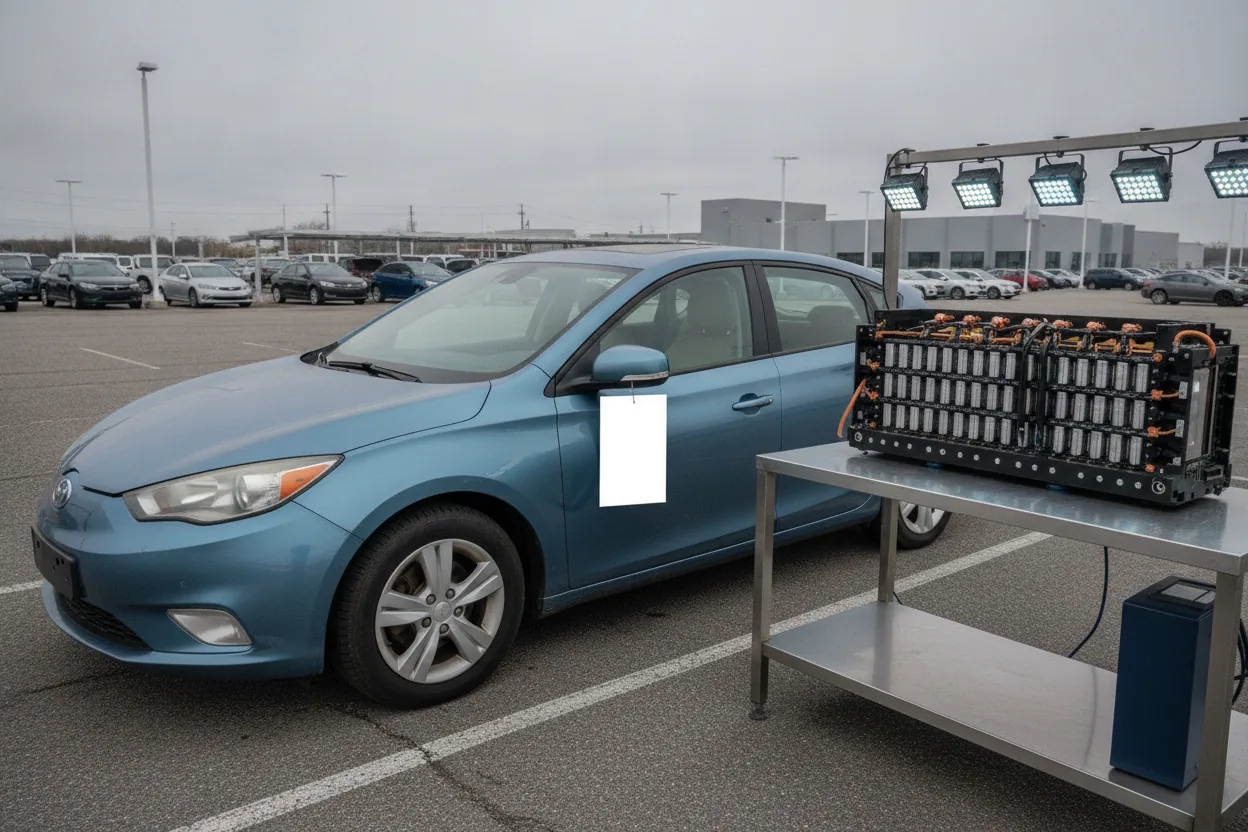
An electric vehicle loses about 49% of its value against its original sticker price within five years. Meanwhile, most of those same packs still hold a large majority of their original capacity after 100,000 miles, at least according to current estimates. That gap, a car treated as scrap while its core component tests as nearly new, isn't a verdict on the technology. It's a verdict on the financing structures and valuation infrastructure built around it. Leasing volume, tax credit design, and an unverifiable battery health score are colliding in the used market right now, and the fallout reaches every thematic fund holding EV and battery exposure. So why is capital pricing in a failure the data doesn't support?
This isn't really a story about cars. It's a story about capital, and specifically about what happens when a hyped growth narrative runs into basic supply and demand in a secondary market nobody bothered to price correctly. Retail investors who bought into the EV transition through equities, battery supply chains, or thematic clean transport funds are exposed to this mechanic whether they realize it or not. The used EV market is now behaving like a distressed asset class, and the reasons why tell you almost everything about how immature the financial infrastructure around clean transport still is. The rest of this piece traces that mechanic from its origin in lease financing, through the battery valuation gap it exposed, to what it signals for capital allocated across the clean transport value chain.
The Lease Glut Explains How Financing Structures Built Their Own Correction
The Valuation Gap: Sticker Price Loss vs Battery Health
Same Vehicle, Two Very Different Stories After 5 Years / 100,000 Miles
Resale Value Lost
49%
vs original sticker price within 5 years
Battery Capacity Retained
Large Majority
of original capacity after 100,000 miles
The gap between these two numbers is priced by financing structures, not by the hardware.
Source: Source: Article estimates citing Manheim and Cox Automotive data
The current EV depreciation shock was manufactured, in large part, by the financing structures automakers used to sell EVs in the first place. Over the past three years, leasing became the dominant on ramp for EV adoption in the United States, driven by a federal tax credit structure that made leased EVs eligible for incentives that purchased EVs often weren't. Automakers and captive finance arms, from Hyundai Capital to Stellantis Financial, leaned into this hard because it moved metal off lots fast and let manufacturers capture the credit value directly rather than handing the full negotiation to the buyer.
Here's the problem with a lease heavy sales strategy: every lease has a maturity date, and those dates are now arriving in bulk. Over the past eighteen months, hundreds of thousands of off lease EVs have flooded back into dealer networks at once, a wave that was entirely predictable the moment the leases were signed but rarely got priced into residual value forecasts at the time. Manheim and Cox Automotive have both flagged used EV inventory piling up faster than other powertrain segments, with dealers holding units longer and cutting prices again and again just to move them.
This is a textbook oversupply mechanic. It's not a referendum on the technology. A flood of same generation vehicles hitting the market at once, with the original buyers already having captured the tax benefit, leaves the secondary market to absorb the full brunt of price discovery nobody wanted to do first. Compare this to solar developers, who staggered PPA maturities across a portfolio specifically to avoid dumping capacity onto one settlement window at once. EV finance did the opposite: it concentrated risk instead of spreading it. Who actually eats the cost when a financing structure front loads incentives and back loads the reckoning? The oversupply explains why prices are falling. It doesn't explain why they're falling further than the underlying hardware justifies, and that second gap is where the battery itself comes in.
Battery Degradation Pricing Shows Why the Market Still Cannot Value the Core Asset
How the Lease Glut Created the Depreciation Shock
Step 1: Tax Credit Favors Leases
Federal credit structure made leased EVs eligible for incentives purchases often weren't.
Step 2: Automakers Lease Heavily
Captive finance arms capture the credit directly, moving metal fast off lots.
Step 3: Leases Mature in Bulk
Hundreds of thousands of off lease EVs return to dealers within an 18 month window.
Step 4: Oversupply Hits Used Market
Dealers hold inventory longer, cutting prices repeatedly just to move units.
Step 5: Secondary Market Absorbs Price Discovery
Original buyers already captured the tax benefit; resale prices carry the full correction.
Source: Source: Article analysis of EV lease financing and residual value mechanics
The used EV market has a valuation problem that used gas cars never had, and it centers on the battery pack itself. A gas engine's remaining useful life can be estimated with reasonable confidence using mileage and maintenance history, a system buyers and appraisers have refined over a century. A lithium ion battery pack degrades on a curve that depends on charging habits, climate exposure, and chemistry, variables that are basically invisible to a used car buyer standing on a dealer lot in Ohio in August 2026.
That uncertainty gets priced as a discount, and discounts compound. Kelley Blue Book and Recurrent, a company that specifically tracks EV battery health data, have both pointed out that buyers apply what amounts to a fear premium on used EVs, knocking offer prices down well below what the actual measured battery capacity would justify. Recurrent's own testing has suggested many EV batteries retain a large majority of their original capacity even after high mileage, a figure that almost never reaches the used car buyer in a form they trust. The market is discounting for risk it cannot verify, and that's a fundamentally different problem than discounting for risk that has already shown up.
This gap between measured battery health and perceived battery risk is where the real investable signal sits. Companies building standardized battery health certification, from Recurrent to insurance underwriters experimenting with battery specific warranties, are attacking exactly this information asymmetry. If that verification infrastructure matures, the discount narrows, and used EV values should partially recover independent of anything happening with new vehicle demand. Investors looking at battery recycling and second life storage names, including Redwood Materials and Li Cycle, are underwriting a related but distinct bet: that a degraded EV battery still has value as stationary storage even after it stops being a good vehicle asset. Does the market ever develop the same trust in a battery health score that it has in a Carfax report? And what happens to residuals the day it does? Both the lease glut and the battery trust gap are, at root, pricing failures rather than technology failures, and both feed directly into how capital allocated across the clean transport chain should be reading this moment.
What The Depreciation Curve Signals For Clean Transport Capital
Valuation Infrastructure: Gas Cars vs EVs
| Factor | Gas Vehicles | EVs |
|---|---|---|
| Core Component | Engine | Battery pack |
| Remaining Life Estimate | Mileage plus maintenance history, well established | Unverifiable battery health score |
| Sales Channel Structure | Mixed lease and purchase, no incentive skew | Lease heavy, driven by tax credit eligibility |
| Residual Value Forecasting | Priced in gradually, mature secondary market | Lease maturities concentrated, mispriced residuals |
Source: Source: Article comparison of used vehicle appraisal mechanics
Depreciation curves are forward pricing signals, and right now the EV curve is telling clean energy investors something specific about where the transition's financial plumbing is still broken. When an asset loses roughly half its value in five years, every downstream financial product built on top of that asset gets repriced too. Auto loan securitization, residual value insurance, and leasing economics all depend on residual value assumptions set years in advance, and those assumptions were calibrated during a period of EV scarcity that no longer exists.
This matters directly for thematic clean energy funds that hold EV manufacturers or battery suppliers as core positions. A fund like KARS, the KraneShares Electric Vehicles and Future Mobility ETF, or QCLN, the First Trust NASDAQ Clean Edge Green Energy Index Fund, holds exposure to companies whose revenue models increasingly depend on leasing volume and residual value guarantees rather than pure unit sales. If residuals keep falling, captive finance arms either eat the loss, raise lease payments to compensate, or tighten credit standards, and any of those three outcomes slows the sales velocity these companies need to justify their growth multiples.
Four pressures are compounding at once across the value chain. Weaker residuals are pushing future lease payments higher. Tighter underwriting is shrinking the pool of addressable buyers. Falling used EV prices are dragging down new EV pricing power. And underneath all of it, battery health uncertainty keeps suppressing trade in values in a way that touches every other line item.
None of these forces are fatal to the EV transition, and none of them mean the underlying decarbonization thesis is wrong. What they mean is that the financial architecture built around EV adoption, particularly the lease heavy sales model that dominated 2023 through 2025, priced growth without adequately pricing the maturity wave it was creating. The parallel in solar is instructive: early residential solar leasing companies made the same mistake a decade earlier, overpromising on system value transferability at resale, and that mispricing took years to work through titled home sales data before mortgage underwriters adjusted. EV residuals are now going through the same repricing process, just compressed into a shorter, more visible window because used car markets turn over faster than housing stock.
The investable question isn't whether EVs remain part of the clean transport future. That much is close to settled. The real question, the one this piece opened with, is why capital keeps pricing in a failure the underlying data doesn't support, and the answer is now specific rather than rhetorical: a front loaded lease structure concentrated a maturity wave into a compressed window, and an unverified battery health signal let fear stand in for measurement. Neither problem is a hardware problem. Companies building battery health verification, secondary market data infrastructure, and recycling capacity, from Recurrent to Redwood Materials, are the ones positioned to profit as that gap closes, while businesses that built their growth story purely on lease and incentive volume are the ones still standing at the wall this correction just hit.