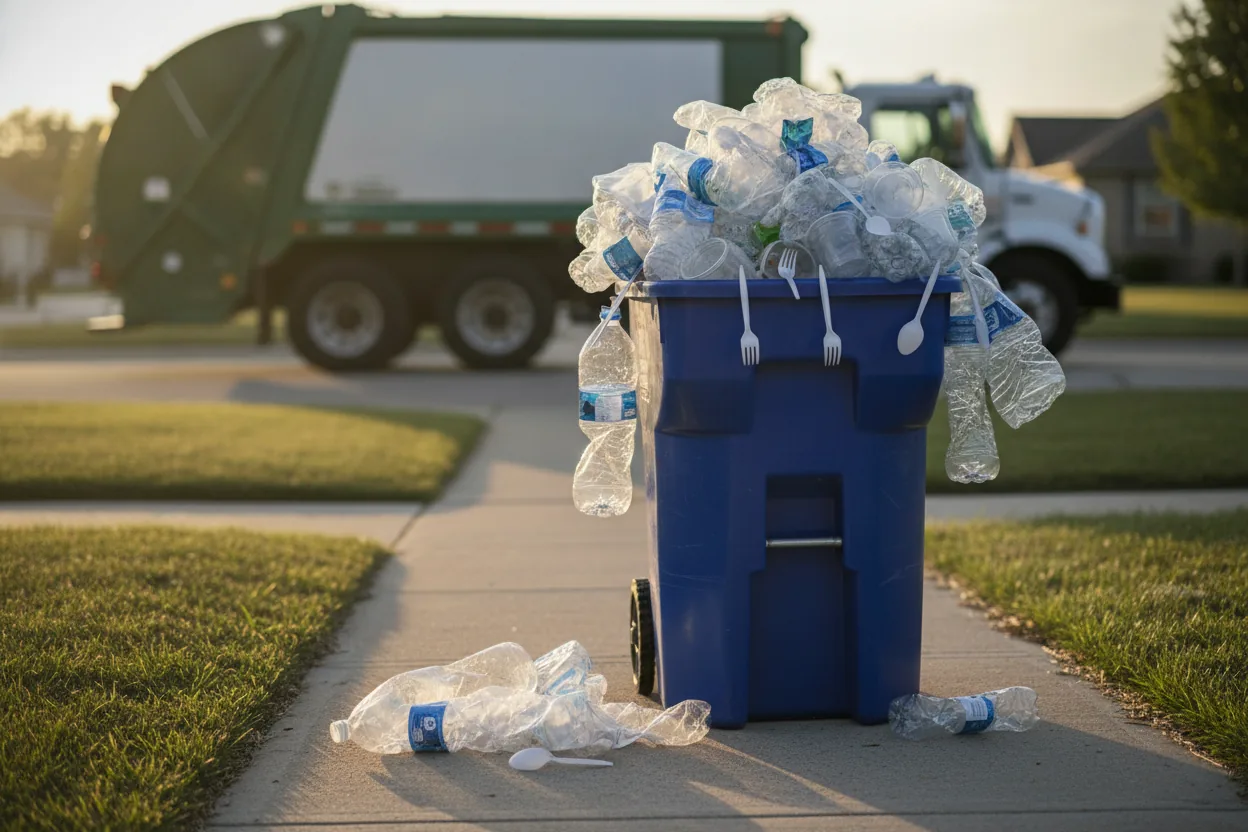
What curbside plastic recycling actually means
Only 5 to 9 percent of the plastic Americans put in curbside bins each year actually gets recycled. In New York City, the capture rate for plastic cups, plates, and cutlery drops even lower, to just 5 percent. So if careful sorting barely moves that number, the real question isn't whether you're sorting correctly. It's what actually determines what happens to your bin after it leaves the curb.
Curbside recycling runs through a chain of steps: collection, transport to a materials recovery facility (MRF), sorting by machine and by hand, baling, then sale to a processor that turns the material into something new. Plastic has to survive every single one of those steps intact. A yogurt cup with food residue stuck to the sides, a plastic bag wrapped around a sorting gear, a resin type with no buyer in the current market: any of these can knock a piece of plastic out of the stream at any point along the way.
The EPA, the Florida Department of Environmental Protection, and a University of Florida study have all looked at how much plastic placed in bins actually survives this chain. They land on roughly the same number: somewhere between 5 and 9 percent of plastic waste in the United States gets recycled. The rest gets landfilled, incinerated, or exported. Contamination, mixed material types, weak demand for recycled plastic, and recovery infrastructure that was never built for today's packaging volume all feed into that gap.
Plastic production keeps climbing while plastic's ability to be reprocessed stays stuck where it's always been. Most plastic can only be downcycled, meaning it loses quality every time it's reprocessed. Glass and aluminum don't have that problem; they can be recycled over and over without degrading. That gap in reprocessing limits is the real starting point here: a system built on good intentions still captures very little of what households sort every week. The next section gets into why.
Wish cycling undercuts the sorting process
Hillsborough County Sustainability Manager Danny Gallagher has a name for the habit that undercuts a lot of curbside programs: wish cycling. That's when someone tosses a greasy pizza box, a garden hose, or a plastic bag into the recycling bin and just hopes it works out. A meaningful share of what people intend to recycle never makes it through sorting, because it's contaminated: either too dirty, or never acceptable in a curbside bin in the first place.
New York City's own waste data shows the same pattern playing out at a different scale. The Department of Sanitation's Residential Waste Characterization Study found that a large share of recyclable material citywide fails to get properly captured, with much of it routed to landfills instead. But plastic tells the sharpest version of that story. Plastic dishware, including single-use cups, plates, and cutlery, has the lowest capture rate of any material the city tracks: just 5 percent of that plastic actually enters the recycling stream.
Even metal, which is usually far easier to recycle profitably, underperforms in New York's system. Only about 28 percent of collected aluminum cans end up captured in the metal/glass/plastic stream. Part of that comes down to scavenging: people pull cans out of bins before the trucks even arrive, because aluminum has real resale value on the street. Plastic doesn't have that kind of demand working in its favor, and the capture numbers show it.
Two different cities, same bottleneck. Sorting your plastic correctly is necessary, but it's not sufficient. The material still has to survive a system built around cost and resale value, not around good intentions. So the next question is the practical one: what can a household actually do differently, knowing that sorting right isn't enough on its own?
Three adjustments change what happens to your bin
Take a plastic clamshell container, the kind that holds strawberries or a rotisserie chicken. It's lightweight, usually food-stained, and made from a resin most MRFs can't resell to anyone. Multiply that by millions of households every week and you start to see why the EPA's 5 to 9 percent figure holds steady year after year instead of climbing.
- Check your local list before tossing. Hillsborough County's wish cycling problem exists because residents assume anything plastic belongs in the bin. It doesn't. Every municipality has its own accepted materials list, and anything outside it, plastic bags, polystyrene foam, whatever, usually gets pulled as contamination and sent straight to landfill anyway.
- Rinse before you recycle. Food residue is one of the biggest causes of contamination keeping otherwise-good plastic out of the stream. A quick rinse of a peanut butter jar or takeout container is enough to keep it from dragging down an entire bale of material that would've actually gotten recycled.
- Buy less single-use plastic dishware. New York's 5 percent capture rate for plastic cups, plates, and cutlery tells you this category is close to unrecyclable in practice, no matter how carefully you sort it. Reusable alternatives just sidestep the problem instead of leaning on a system that was never built to catch it.
None of this makes curbside recycling pointless. Glass and aluminum still get captured and reprocessed at far higher rates than plastic, and sorting correctly cuts contamination for the materials that actually have working markets behind them. The question this post started with was what actually changes what happens to your bin, and the answer splits in two: good sorting habits help the materials with real markets, but for plastic, the bin was never the finish line most people assume it is. Buying less single-use plastic dishware does more to change plastic's fate than any amount of careful sorting ever will.