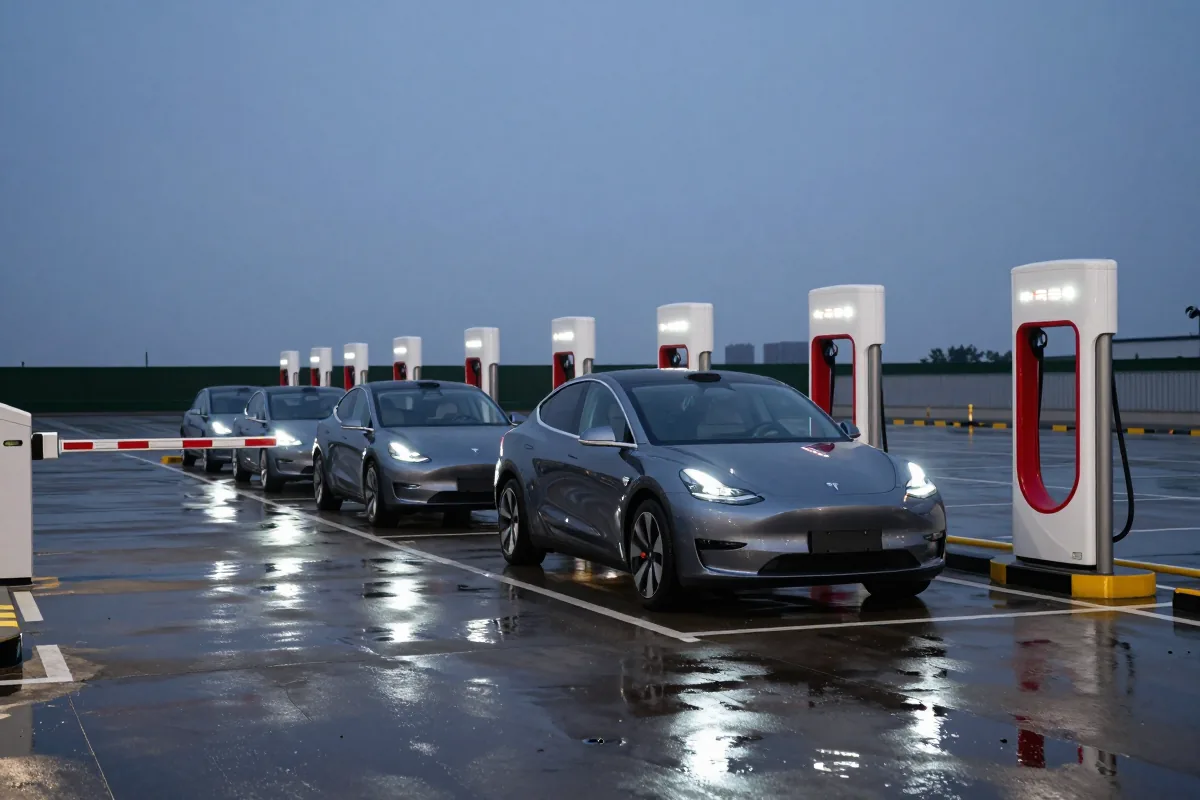
Congress put billions behind EV charging in places the market was never going to reach on its own, and three years later only a sliver of that money has actually turned into working chargers. If public funding is lagging that badly, who's actually building the chargers people are using right now, and what does that tell you about where to put money in this space?
Tesla Turned A Cost Center Into A Toll Road
How Tesla Turned Superchargers Into a Toll Road
From Cost Center to Revenue Stream
For most of the last decade, Supercharger stations sat on Tesla's books as a customer acquisition expense. The company spent heavily building out a massive network of stations and stalls globally, according to Tesla's own investor materials and charging trackers like Paren. Internally, that spending was justified as a sales tool: buy a Tesla, get a charging experience nobody else could match. The accounting never needed to show a standalone return, because the network's job was selling cars, not electrons.
Then came NACS. Ford and GM signed the first adapter deals, and within a year nearly every major automaker selling EVs in North America, Rivian, Hyundai, Honda, Nissan, had followed. That changes the math completely. Tesla now sells charging access as a product, not a perk. Non-Tesla drivers pay per-kilowatt-hour rates that run comparable to or slightly above what Tesla owners pay, with pricing that shifts by state and by time of day, according to rates posted on Tesla's app and tracked by third-party comparison sites. A fixed asset Tesla already depreciated is now being re-rented to a customer base it never had to spend a dollar acquiring.
Sit with that mechanic for a second. Tesla didn't announce some new infrastructure buildout to capture this revenue. It just opened a gate it already owned. Serving one more Mustang Mach-E at a Supercharger stall costs almost nothing once the stall exists, but the revenue from that session is real and it repeats. That gap between near-zero marginal cost and real marginal revenue is the entire investment case for Tesla's energy and services business. Not the car business.
Federal Charging Money Shows Who Actually Needs A Subsidy
Two Tiers of Charging Infrastructure Economics
Where Charging Economics Work vs. Need Subsidy
| Factor | Tesla-Funded Corridors | NEVI-Dependent Areas |
|---|---|---|
| Location Type | Interstate exits, retail centers, dense metro routes | Rural highway corridors, lower-income metro gaps |
| Utilization | High, self-justifying | Uncertain, low EV penetration |
| Federal Match Needed | No | Yes |
| Who Builds It | Private capital (Tesla) | Only with public money that sticks around |
Tesla's existing network explains why the company never needed public money to expand profitably. Federal programs exist for the parts of the country that don't have that advantage, and that's exactly where the subsidy picture gets interesting.
The National Electric Vehicle Infrastructure program and the broader Charging and Fueling Infrastructure grants were built in 2021 to seed a network in places the market wouldn't touch: rural highway corridors, lower-income metro areas, the gaps between interstates. By late 2026, only a small fraction of that money had turned into operational, publicly available chargers. Clean energy advocates and fiscal conservatives are both furious about that, for opposite reasons.
Tesla stepping back from NEVI funding isn't confidence talking. It's a statement about where the economics already work without help. Tesla builds Superchargers along the corridors that pay for themselves: interstate exits, retail centers, dense metro routes, where utilization justifies the capital with no federal match needed. The stations still waiting on subsidy money are the ones in low-EV-penetration areas with uncertain utilization, exactly the stations no profit-driven operator would build on its own dime.
That distinction matters if you're weighing charging infrastructure as an investment theme, whether through Tesla directly, through operators like ChargePoint and EVgo, or through clean transportation ETFs like KARS or DRIV. The market is splitting charging infrastructure into two tiers: corridors private capital will fund without any help, and underserved corridors that only get built if public money shows up and actually sticks around. Mixing the two when modeling future charging revenue inflates total addressable market numbers in investor decks far more often than it shrinks them.
The slow pace of disbursement says something about execution risk that rarely shows up in clean energy investment theses. Markets price in policy announcements almost instantly. Deployed capital takes years, grinds through state-level procurement, and gets revised down repeatedly. The distance between money authorized and money actually spent is the distance between headline and reality.
NACS Standardization Hands Pricing Power To One Company
NEVI Funding: Billions Pledged, A Sliver Delivered
Federal EV Charging Program, 2021 to Late 2026
Program Launched
2021
NEVI and CFI Grants Created
By Late 2026
Small Fraction
Of Funds Became Operational Chargers
Result: Both clean energy advocates and fiscal conservatives criticize the slow disbursement pace
The subsidy gap shows Tesla doesn't need federal help to build where it wants. The next question: what happens as every other automaker adopts Tesla's plug and becomes dependent on a network it doesn't control?
Standards wars in infrastructure tend to end one of two ways. Either an open consortium controls pricing collectively, the way CCS was governed in Europe, or one company's proprietary format becomes the market standard and that company keeps the lever. NACS landed squarely in the second camp. SAE International formalized NACS as an open standard, which sounds like it strips Tesla of control. It doesn't touch Tesla's control over the physical network.
Any automaker can now build a NACS port into a car without paying Tesla a licensing fee. That part really is open. What stays closed is everything about how the Supercharger network actually runs: pricing, access priority, operating rules, all set unilaterally by Tesla because Tesla owns the stalls. A Hyundai Ioniq 5 with a native NACS port gets the plug shape for free. It doesn't get a vote on what that plug costs to use, how queue priority works at 5pm on a Friday, or how well-maintained the stations stay in regions where Tesla owners are thin on the ground.
That's the detail missing from coverage treating NACS adoption as a simple convenience win. Agreeing on the shape of the gate means nothing if one company still holds every key. Compare it to gas retail, where Shell, Exxon, and a thousand independent station owners compete on price at every exit, and the asymmetry jumps out. EV charging under NACS looks less like gasoline retail and more like a utility with exactly one shareholder.
For investors holding Tesla stock as an energy infrastructure play as much as an automaker bet, that's the bull case stated plainly: network effects compound when your competitors adopt your format and you still set the toll. For investors in other EV-adjacent names, the same fact is a risk that almost never shows up in a filing. Ford and GM customers now depend on a network neither automaker controls, and neither automaker's margin improves when that network raises prices. One company's standard became the market's plumbing, and the plumbing has exactly one owner setting the rates.
Charging Margins Will Decide Which EV Bets Actually Pay Off
Pricing power over the plumbing is one side of this. The other side is how that advantage plays out financially against competitors who own no plumbing at all, and that's where the eco-investing angle widens past Tesla specifically.
Charging networks run on utilization economics closer to airlines than gas stations: heavy fixed costs in land, grid connection, and hardware, thin variable costs per session, and profitability that lives or dies on keeping stalls occupied during peak hours without queues long enough to push customers toward a competitor. EVgo and ChargePoint, both public and both trading well below their 2021 IPO-era valuations through 2026, have struggled because utilization in many of their markets simply isn't high enough to cover fixed costs. Tesla's Supercharger network, meanwhile, inherited years of built-in demand from its own owner base before a single non-Tesla car ever plugged in.
That inherited demand is the single biggest reason Tesla's charging economics look nothing like a pure-play charging stock. It's not a technology edge. It's a decade of built demand that no competitor can replicate by writing a check today.
Clean transportation ETFs complicate the picture further. KARS and DRIV both hold charging names alongside automakers and battery suppliers, so a thesis built purely on EV adoption rates can still underperform if the charging layer of that supply chain keeps compressing margins even as vehicle sales climb. Adoption of the vehicle and profitability of the infrastructure around it are two separate outcomes, and 2024 through 2026 made that separation hard to miss, with EV sales growth slowing in some quarters while charging network operators kept posting losses.
So who's actually building the chargers that exist, and what does it mean for anyone investing in the space? Tesla, almost by default, because it already owned the network and the demand before anyone else needed either. NACS fixed a real consumer problem, plug fragmentation that genuinely slowed EV adoption in North America, while consolidating commercial leverage in the hands of the one company that controlled the physical network the entire time. The standard worked. The toll collector never changed, and every EV-adjacent investment thesis now has to price that in.