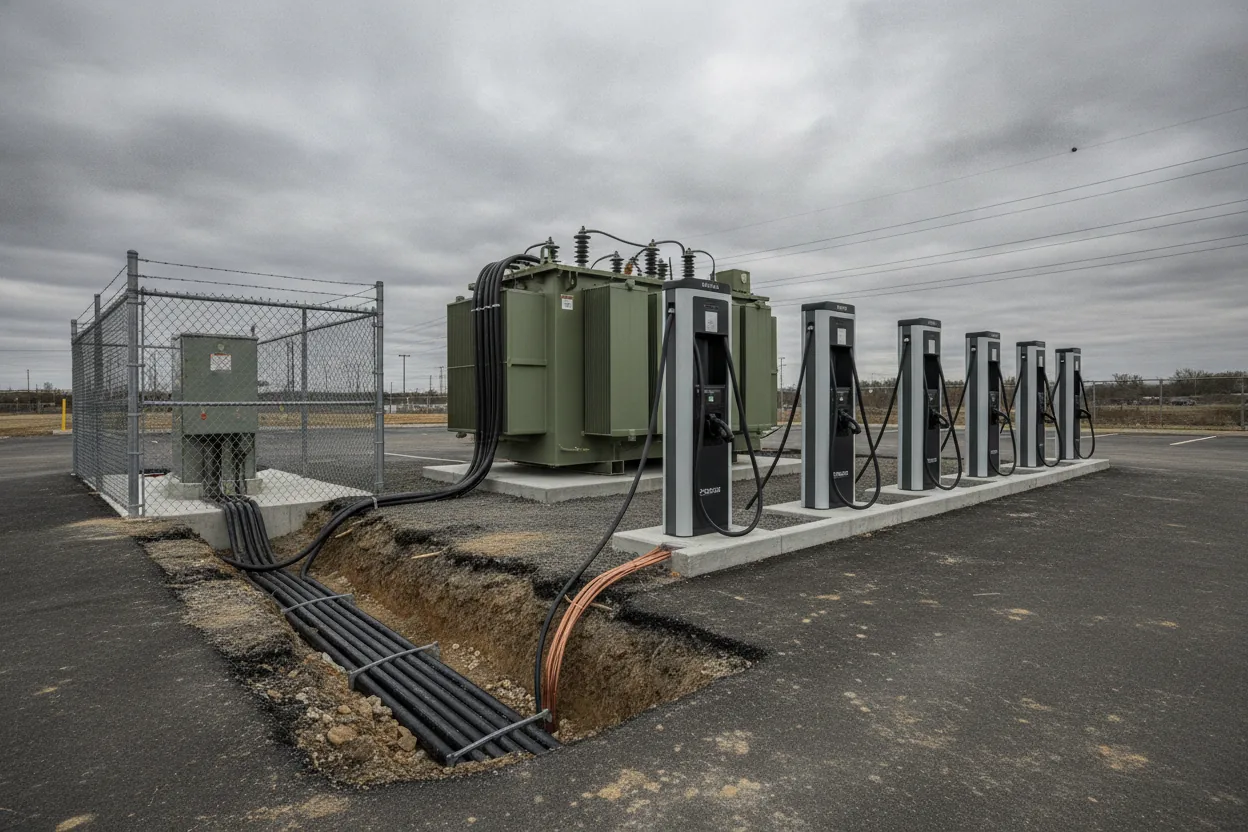
A single DC fast charging dispenser runs anywhere from $10,000 to over $200,000 in 2026. That $190,000 spread is not a hardware anomaly. It's a capital structure problem that most EV charging investment narratives bury in footnotes while leading with clean energy deployment numbers. Operator decks advertise equipment costs and headline utilization projections while quietly footnoting the transformer upgrades, medium voltage grid connections, and demand charges that can push a six-stall charging plaza past $1.5 million in total project cost. The investors funding this buildout through ETFs and direct equity positions are holding claims on utilization revenue that may be years from covering deployed capital, layered on top of subsidy capture mechanisms that introduce compliance and timing risk the top-line story never quite gets around to resolving.
The clean energy transition is real. The electrification of road transport is happening, and the charging infrastructure buildout is a necessary condition for it. But the financial mechanics of that buildout are being systematically underexplained to the retail investors funding it through ETFs, SPACs, and direct equity positions. The equipment cost range alone tells you that the unit economics of a charging network are brutally sensitive to which hardware tier an operator chose, where the sites are located, and who absorbed the installation cost.
Understanding that $190,000 spread is where you start understanding why some charging network operators are printing revenue while others are burning cash at a rate no utilization recovery curve can fix.
Why Power Level Is the Whole Argument
DC Fast Charger Hardware Cost Tiers by Power Level
DC Fast Charger Hardware Cost Tiers by Power Level
| Tier | Power Output | Cost Per Dispenser | Charge Speed |
|---|---|---|---|
| Entry | 24 to 50 kW | $10K to $30K | Slow, borderline inadequate for 2026 vehicles |
| Mid | ~150 kW | $50K to $80K | Meets current vehicle expectations |
| High | 350 kW | $150K to $200K+ | 80% charge in under 20 minutes |
Source: DC Fast Charging Costs in 2026 article
Source: Article: DC Fast Charging Costs in 2026
DC fast charging hardware splits into tiers by output power, and each tier carries radically different economics. Entry-level units delivering around 24 to 50 kilowatts sit at the low end of the cost range, roughly $10,000 to $30,000 per dispenser. Mid-tier units in the 150 kilowatt range commonly run $50,000 to $80,000. The high end, 350 kilowatt dispensers capable of charging a vehicle to 80 percent in well under twenty minutes, regularly exceed $150,000 to $200,000 per unit before a single cable is pulled through conduit.
The investment implication goes well beyond capex. Higher power units need heavier electrical infrastructure: larger transformers, thicker cabling, upgraded utility connections, and in many cases a dedicated medium voltage service that can cost as much as the hardware itself. A six-stall 350 kW charging plaza in a high-traffic corridor might carry a total project cost of $1.5 million or more once civil works, permitting, and grid connection are factored in. That figure tends not to appear in the opening slides of operator investor decks.
There's also a technology obsolescence risk embedded in this tier structure. A 50 kW unit installed in 2022 is already borderline inadequate for the current generation of vehicles that expect 150 kW or more. Operators who built networks at the lower power tier to reduce initial capex are now facing either upgrade cycles or customer satisfaction problems. The depreciation schedule on that hardware assumed a longer useful life than the market delivered.
This is where the power level decision becomes a strategic bet on fleet composition, and most operators made it with 2019 data on vehicle adoption curves. The gap between that bet and 2026 reality is showing up in utilization rates and network repositioning costs. Operators carrying large inventories of sub-100 kW hardware face the steepest write-down exposure, while those who overpaid for 350 kW capacity early are watching that capex get validated by rising average vehicle charge rates.
Reading the Capital Stack of a Charging Network
Estimated Total Project Cost Breakdown for a 6-Stall 350 kW Charging Plaza
Estimated Total Project Cost Breakdown
6-Stall 350 kW Charging Plaza, total cost over $1.5 million
Source: DC Fast Charging Costs in 2026 article
Source: Article: DC Fast Charging Costs in 2026
The equity story around EV charging infrastructure has been told primarily as a volume story: more vehicles, more charging sessions, more revenue. What gets less attention is the capital stack underneath each network, specifically how much of it is subsidized, how much is debt, and what the equity is actually exposed to.
Federal and state incentive programs in the US, including funding routed through the National Electric Vehicle Infrastructure program and the Inflation Reduction Act investment tax credits, have meaningfully reduced the net capex burden for qualifying deployments. The 30C commercial EV charging tax credit covers up to 30 percent of qualified equipment and installation costs, subject to wage and apprenticeship requirements, though the precise terms and applicability vary by deployment and should be verified against current IRS guidance. That changes the effective capex on a $200,000 dispenser installation considerably, but it also introduces compliance risk, timing risk on credit monetization, and concentration risk if the policy environment shifts.
Operators who built their financial models assuming full and timely realization of these credits are running a different business than their headline numbers suggest. The tax equity market for EV infrastructure is thinner than it is for utility-scale solar or wind, which means actually monetizing these credits involves counterparty relationships and transaction costs that compress the net benefit. Not fatal, but not free either.
So what does the equity investor actually own in a publicly traded charging network company? In most cases, a claim on future utilization revenue that is years away from covering the capital already deployed, sitting on top of a subsidy capture mechanism that requires ongoing regulatory compliance to function. The underlying hardware is depreciating. The sites are leased, not owned. Pricing power on a per-kilowatt-hour basis is constrained by competitive pressure and, in some jurisdictions, rate regulation. That's not a reason to dismiss the sector. It's a reason to read the balance sheet before the investor presentation. The operators best positioned for 2027 are those whose subsidy capture is already monetized and whose debt maturities don't front-run their utilization inflection.
Where the Margin Actually Lives
DC Fast Charging Technology Obsolescence Lifecycle
DC Fast Charging Technology Obsolescence Lifecycle
2019 to 2022: 50 kW Era, Entry Deployment
Operators build networks at $10K to $30K per unit using 2019 vehicle adoption data. Low capex seen as prudent capital allocation.
2023 to 2024: 150 kW Becomes Standard
New vehicle generation expects 150 kW minimum. Sub-100 kW hardware becomes borderline inadequate. Operators face customer satisfaction decline.
2025 to 2026: 350 kW Validates Premium Capex
Early 350 kW investors see capex validated. Low-tier operators face forced upgrade cycles, write-downs, and network repositioning costs.
Investor Impact: Sub-100 kW Inventory Faces Steepest Write-Down Exposure
Depreciation schedules assumed longer useful life than the market delivered.
Source: DC Fast Charging Costs in 2026 article
Source: Article: DC Fast Charging Costs in 2026
The operators with the clearest path to positive unit economics are not necessarily the ones with the most dispensers. They're the ones with the best site selection, the most favorable utility rate structures, and the highest average session revenue per stall. Those three variables interact in ways the top-line charging network narrative rarely captures.
Site selection in 2026 is significantly more sophisticated than it was three years ago. The early land-grab phase of network deployment produced a lot of charging locations optimized for visibility and brand presence rather than utilization. Highway corridor locations with captive traffic, fleet depot charging contracts, and destination locations with dwell times of two hours or more are producing meaningfully better economics than urban street-level installations where session duration is short and grid demand charges are punishing.
The demand charge problem deserves its own paragraph. In many US markets, commercial electricity customers pay a demand charge based on peak kilowatt draw in a billing period, not just total kilowatt hours consumed. A 350 kW dispenser that fires at full power during a peak demand window can generate a demand charge that exceeds the revenue from the charging session itself. Battery storage integration at the site level addresses this, but adds meaningfully to capital cost per site depending on capacity. Some operators are absorbing that cost. Some are passing it through in session pricing. Both responses have consequences for utilization, and neither is a clean answer.
The margin story in EV charging infrastructure is ultimately a real estate and energy procurement story wearing a technology narrative. Operators who have locked in long-term power purchase agreements, secured favorable ground leases at high-traffic sites, and structured their capital deployment around verified utilization data rather than projected adoption curves are in a structurally different position from the ones who built fast and are now repricing. The equipment cost range between $10,000 and $200,000 is not just a hardware question. It's a proxy for the quality of the capital allocation decision underneath it, and that is what separates the networks that will compound from the ones that will consolidate.