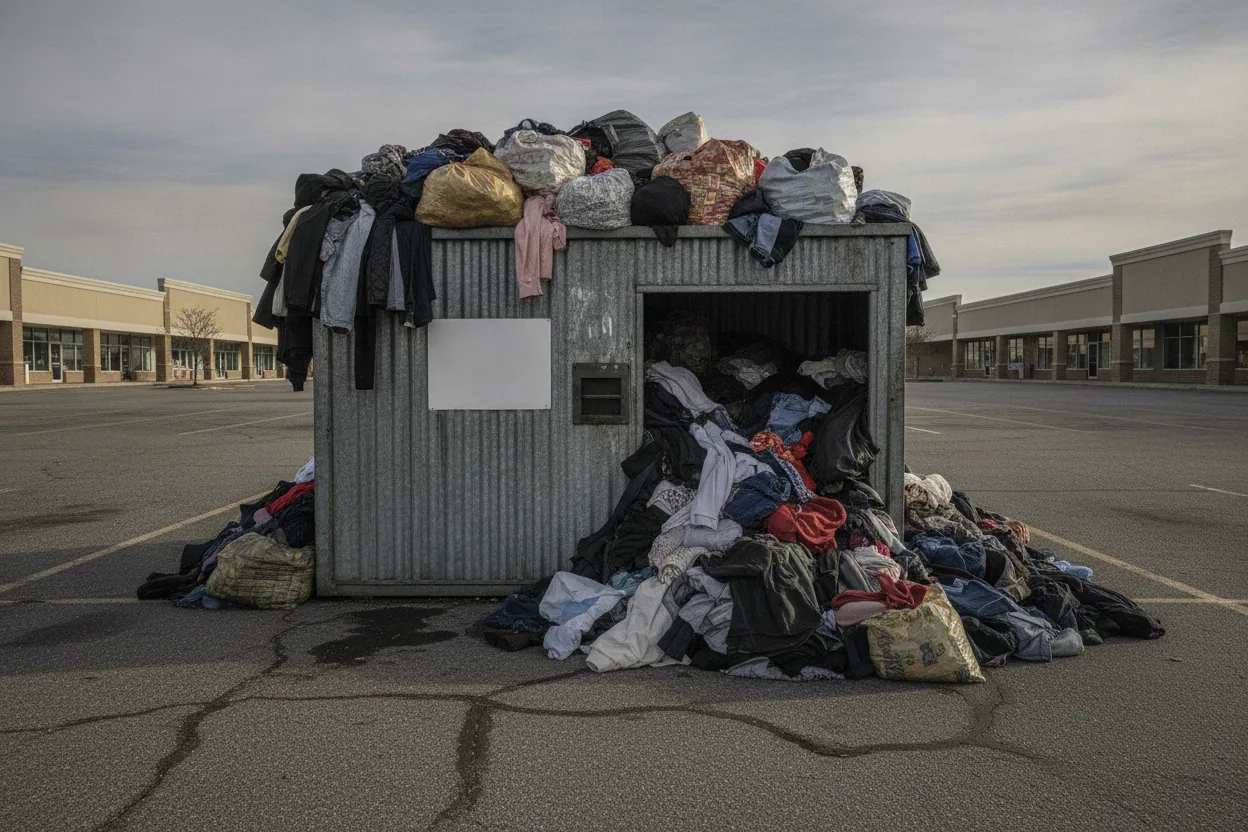
A shopper's donated t-shirt rarely becomes a new garment
Roughly one garment out of a thousand dropped into a store take-back bin actually becomes new clothing fiber. Some analysts put that closed-loop recycling rate as low as 0.1%. So when you hand over a bag of old t-shirts expecting real recycling, what actually happens to it? And is there a program out there that can prove it does better?
The mechanics explain why this happens. Sorting, cleaning, and breaking down mixed-fiber garments costs more than just manufacturing a brand-new polyester blouse from scratch. That cost imbalance kills the financial incentive for retailers to build real circular systems. So donated items get routed toward whatever destination is cheapest: resale abroad, downcycling into insulation or rags, or straight disposal.
The U.S. sends over 11 million tons of textile waste to landfills every year, and a meaningful share of that tonnage passed through a donation bin first. People assume donated means diverted. The data says otherwise for the vast majority of pieces: independent research on after-use clothing (garments already worn and discarded by consumers) puts the closed-loop recycling rate at under 1%, with some analysts arguing the real number is closer to 0.1%. The other 999 out of 1,000 garments get resold, downcycled, exported, or dumped, and each path looks pretty different in practice:
- Resold or donated: the best-case outcome, but still not recycling.
- Downcycled: turned into insulation, wiping rags, or industrial padding.
- Exported: shipped to secondhand markets in the Global South, where excess volume often ends up in illegal dumpsites.
- And then there's the final stop: landfilled or incinerated. This is where contaminated, low-value, or mixed-fiber items end up once nobody else wants them.
Transparency is the problem running underneath all four of those outcomes. Brand messaging tends to lean on vague language like "we resell your clothing" or "a small percentage goes to our upcycling partners," paired with imagery of sewing machines and repair work that implies far more circularity than the actual percentages support. Subset previously ran an underwear and sock take-back program said to include a no-export policy, and some people pointed to it as a genuine attempt at transparency. But Subset has since partnered with Trashie for its recycling program, folding into a larger, less item-specific system. That single shift says a lot about how hard it is for even well-intentioned small programs to stay independent of the broader resale-and-downcycle pipeline. The number to remember is 0.1%: the realistic share of your discarded clothing that becomes new fabric. The question worth asking next is whether any large-scale program actually beats that number, and by how much.
Trashie's Take-Back Program claims a 90% landfill diversion rate
Trashie says its Take-Back Program diverts the large majority of collected items from landfill. The company attributes that figure to a sorting system that separates usable goods for resale or donation from non-wearable goods sent to downcycling and textile-to-textile recycling partners, with widely cited figures pointing to partners like Renewcell, Ambercycle, and Circ. That figure matters because it's specific and measurable, not the vague "we resell your clothing" language most brands hide behind.
Naming those partners matters for a specific reason: it's the piece most take-back programs skip entirely. Downcycling a cotton shirt into insulation beats a landfill, sure, but it's nowhere near the same as reclaiming the fiber to spin new yarn. Programs that name specific fiber-recycling partners give you something to actually verify. Programs that just say "recycling partners" without naming anyone give you nothing.
For readers deciding where to send old clothes, the practical filter is disclosure. A program worth using should publish, or at least be able to answer, four things:
- Percentage breakdown: how much gets repaired/resold, donated, recycled, downcycled, landfilled, or incinerated.
- Total weight processed: a concrete tonnage figure, not just thousands of items.
- Contamination rate: how much of what comes in is too damaged or mixed-fiber to process.
- And named recycling partners. Companies like Renewcell or Circ, actual names, not a vague nod to "our partners."
Beyond disclosure, how a program handles sorting before shipping matters more than most people realize. Sending unsorted bags of returns straight to nonprofits overwhelms organizations that are often already stretched thin. Nonprofits do better when they receive only high-quality, wearable goods, while lower-quality items go directly into recycling or downcycling channels instead of getting exported or landfilled after a nonprofit can't place them.
The honest takeaway for anyone using a clothing bin: assume most of what you hand over gets resold or downcycled, not recycled into new fabric. That's the accurate baseline, not the optimistic one, and it's what this whole picture keeps pointing back to. If a program is willing to publish a landfill-diversion rate like the one Trashie cites, or name specific circularity partners, that's a meaningfully higher bar than the industry standard. The gap between a stated diversion rate and an actual fiber-to-fiber recycling rate is where most of the greenwashing lives, and closing it starts with brands treating transparency as a feature worth building, not a liability worth hiding.