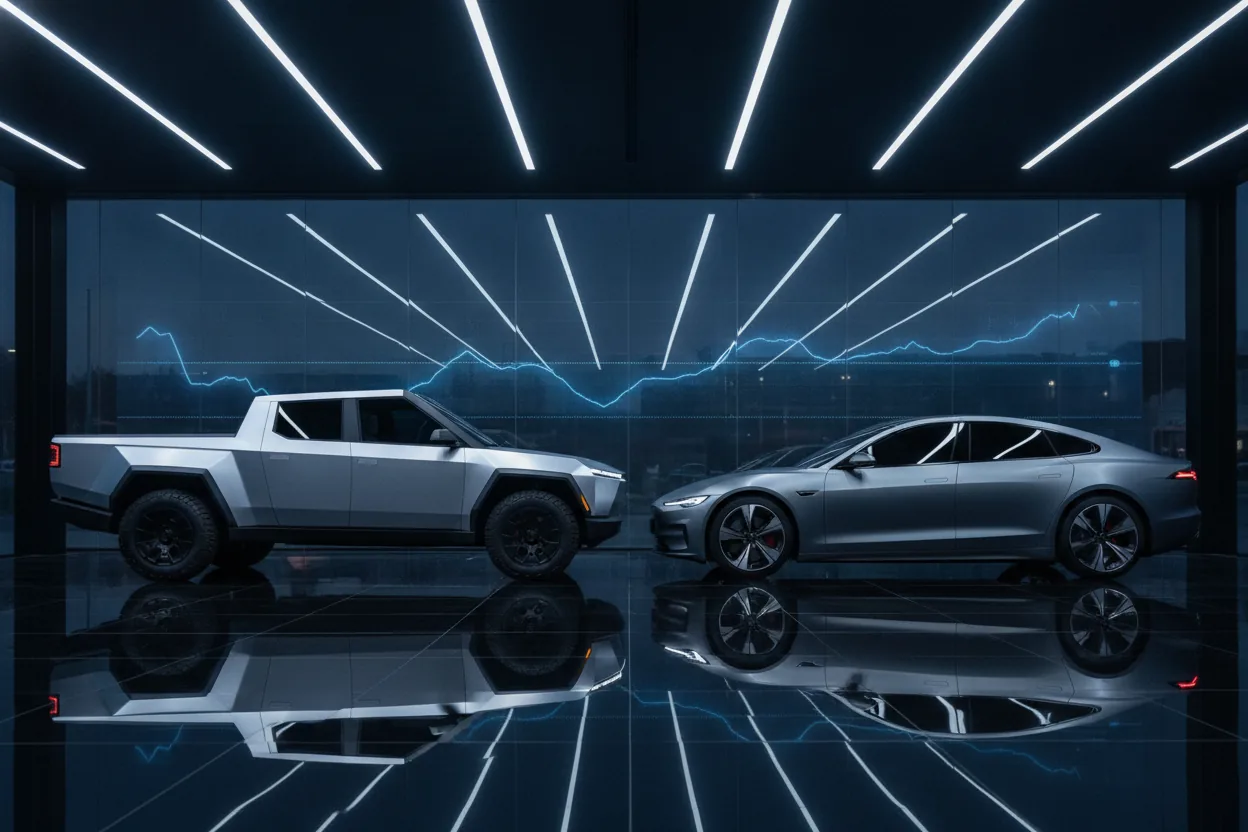
Rivian's quarterly net loss narrowed compared to last year, and the headlines called it progress because, well, the loss was smaller than before. But is a smaller loss actually progress, or just a slower rate of decline wearing a turnaround costume? That's the question the rest of this piece has to answer.
Here's my stance: comparing Rivian and Tesla on valuation multiples alone is a category error dressed up as due diligence. Financial media keeps framing this as a head-to-head matchup, and that framing obscures how capital actually gets allocated in the EV transition.
Rivian's Narrowing Loss
Rivian vs Tesla: Scale and Profitability Snapshot
| Metric | Rivian | Tesla |
|---|---|---|
| Annual Deliveries | Tens of thousands | 1.7M+ units |
| Net Income | Negative | Billions, positive |
| Gross Margin | Recently turned positive | Established, positive |
| Production Facilities | 1 active, 1 under construction | 4 fully ramped globally |
| Revenue Diversification | Mostly R1 series, R2 preorders | Vehicles, energy, credits |
Source: Based on figures cited in article (recent annual periods)
Rivian narrowed its net loss year over year, and every headline treated that as validation. But narrowing a large quarterly loss isn't the same signal as approaching breakeven. It tells you the rate of cash destruction slowed. It doesn't tell you the business model works. Rivian has been burning through its balance sheet since its 2021 IPO, when it raised roughly $12 billion, one of the largest IPOs in US history at the time. Four years later, the company still depends on outside capital infusions, including a $5.8 billion joint venture with Volkswagen Group announced in 2024 to co-develop EV software and future platforms.
Here's why that matters: the metric investors are told to watch, net loss trajectory, is backward-looking and says nothing about unit economics at scale. Rivian's gross margin only recently turned positive on a quarterly basis, meaning the company is finally selling vehicles for more than it costs to build them, before you account for R&D, SG&A, and capital spending on new manufacturing capacity, including the Georgia plant construction that has already faced its own delays and cost revisions. A positive gross margin is a real milestone. It's also a very low bar. Treating it as proof of an eventual path to profitability skips over everything that happens between gross margin and net income, the stretch where most EV manufacturers have historically gotten crushed.
Worth naming here, since not every quarterly figure can be verified down to the decimal against a live feed: the market has a habit of reporting loss narrowing as momentum regardless of the base rate. Fisker narrowed losses before it collapsed into bankruptcy in 2024. Lordstown Motors did the same before its 2023 bankruptcy filing. Narrowing losses is necessary but nowhere near sufficient. A retail investor who reads one quarter's improvement as a turning point is pricing in a story, not a balance sheet. That's the trade being sold here.
Valuation Multiples That Mislead
Rivian's Capital Lifeline: Key Funding Events Since IPO
2021 IPO
$12B
Raised, one of largest US IPOs ever
2021 to 2024
Cash Burn
Balance sheet depletes, Georgia plant delays
2024 VW Deal
$5.8B
Joint venture to co-develop EV software
Four years after IPO, Rivian still depends on outside capital infusions to fund operations.
Source: Based on figures cited in article (2021 IPO through 2024 Volkswagen JV)
The loss trajectory is one half of how Rivian gets misread. The other half is how it gets compared to Tesla on price. Rivian trades at a lower price-to-sales ratio than Tesla, and the standard line is that this makes Rivian cheaper. Cheaper relative to what, exactly? Price to sales is a useful screen when you're comparing companies with roughly similar margin structures and capital intensity. Tesla and Rivian share neither. Tesla has posted full-year net income in the billions for several consecutive years and operates at a production scale, over 1.7 million units in recent annual periods, that gives it fixed-cost leverage Rivian isn't close to reaching. Rivian's annual deliveries are still measured in the tens of thousands.
Tesla's got multi-billion-dollar annual net income, slowing revenue growth, and four fully ramped global factories. Rivian's net income is negative, its gross margin is improving, and it's running one primary production facility with a second under construction. Tesla's revenue is diversified across energy storage deployment and regulatory credit sales. Rivian's revenue sits almost entirely in the R1 series and early R2 preorders, which is a much narrower bet than Tesla's spread.
A low price-to-sales ratio on a company burning significant cash every quarter isn't automatically a discount. It can just as easily be the market correctly pricing in dilution risk, since Rivian has repeatedly issued new equity and leaned on partner capital to fund operations, which mechanically suppresses per-share value even if the enterprise itself survives. Tesla's higher multiple reflects a company that already crossed the valley Rivian is still walking through, plus a premium for Elon Musk's involvement in Optimus robotics and the Cybercab robotaxi program. Those are speculative bets with nothing to do with car manufacturing margins, but the market prices them as if they were call options on the entire company. The honest comparison isn't price to sales. It's cash runway versus capital need versus production curve, and that comparison doesn't fit in a headline.
Where The Real Risk Sits
Narrowing Losses Did Not Prevent These EV Bankruptcies
|
FISKER Narrowed losses Bankrupt 2024 |
LORDSTOWN MOTORS Narrowed losses Bankrupt 2023 |
Rivian's narrowing net loss follows the same pattern that preceded both collapses, loss narrowing is necessary but nowhere near sufficient as a signal.
Source: Based on examples cited in article (Fisker 2024, Lordstown Motors 2023)
If price to sales is the wrong tool for comparing these two companies, the right one is capital structure: who's funding each company, and why. Volkswagen didn't put $5.8 billion into Rivian because Rivian's stock looked cheap on a sales multiple. It invested because Rivian's software architecture solved a problem Volkswagen's own engineering teams had struggled with for years, and partnering was cheaper than building that capability in-house. That's strategic capital, priced on technology access, not retail capital priced on quarterly loss trajectories. Retail investors buying RIVN shares on the open market aren't getting the deal Volkswagen got. They're buying equity exposure to a company whose survival increasingly depends on partners like Volkswagen continuing to see strategic value in the relationship.
Tesla carries a different structural risk, and it's not primarily a manufacturing risk. Elon Musk's attention is split across SpaceX, xAI, Neuralink, and Tesla itself, and execution risk on Optimus and Cybencab, two product lines still largely unproven at commercial scale, weighs on the stock's premium. Add intensifying competition from BYD, which has outsold Tesla in global EV unit volume in multiple recent quarters, plus regulatory scrutiny over Full Self Driving claims in the US and Europe. None of this means Tesla's core auto business is fragile. It means Tesla's valuation increasingly prices in businesses that don't yet generate meaningful revenue, a different kind of risk than Rivian's cash burn, but a risk all the same.
The clean energy and EV transition is real capital reallocation, arguably the largest of its kind in financial history, and it's happening regardless of which individual stock wins this particular comparison. But framing EV stocks as a binary choice between two tickers consistently rewards investors who understand capital structure and punishes investors who react to headline loss figures and simple valuation ratios. Rivian isn't a bad company because it loses money. Tesla isn't a good investment purely because it makes money. The smaller loss that opened this piece was never the real signal. What actually matters is whether each company's capital structure can survive its own growth curve: Rivian's dependence on partners like Volkswagen, Tesla's dependence on businesses that don't yet generate meaningful revenue. That question gets answered in balance sheets and joint venture terms, not in a single quarter's net loss comparison dressed up as a verdict. Investors who skip that step are pricing a narrative rather than a company.