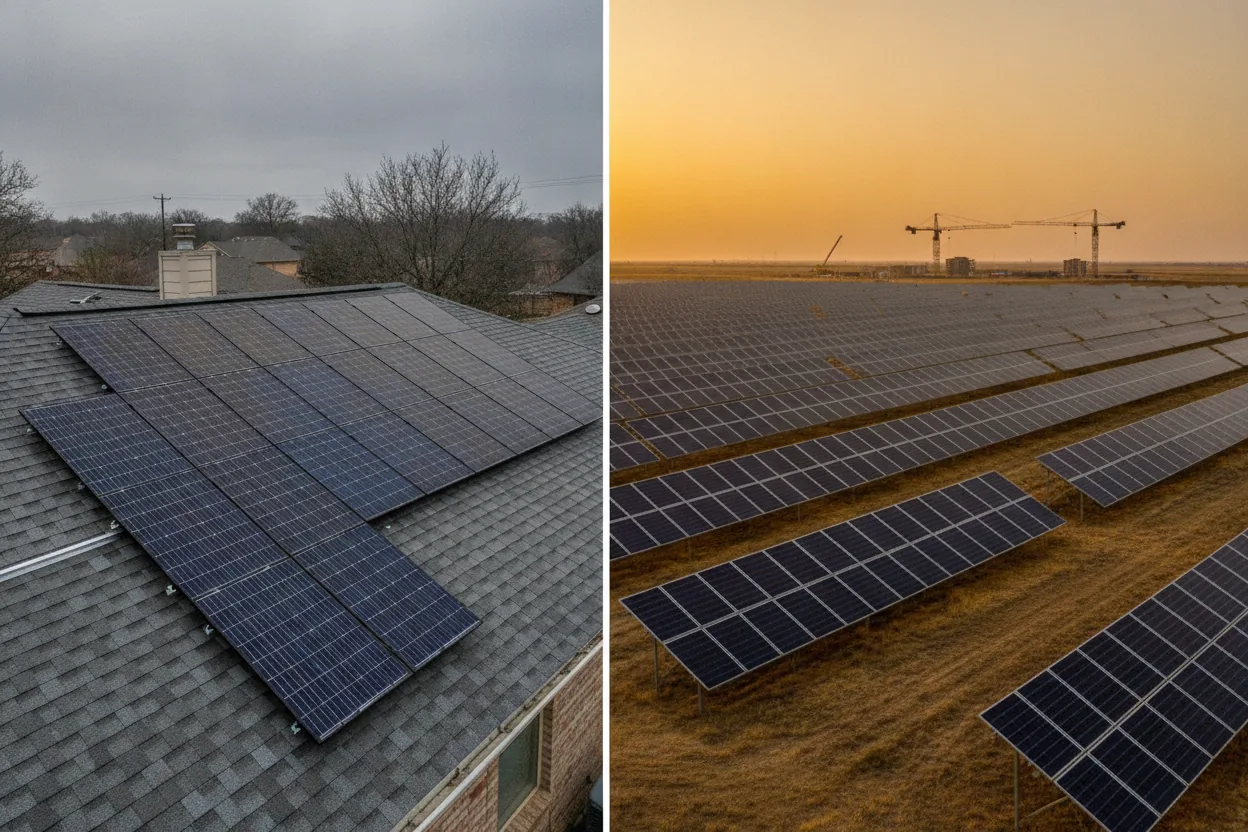
Zero percent. That's the federal tax credit a homeowner gets for installing solar in 2026, down from 30 percent. Meanwhile a developer building a utility scale solar farm in Texas can still stack that same credit plus bonus adders. Most coverage of this expiration treats it as clean energy policy retreating across the board, but that's not what happened. The residential credit died while the commercial one lived on a different schedule entirely. That asymmetry redirected where capital in the solar value chain wants to sit, and installer stocks priced for the old rules haven't caught up yet.
This isn't a footnote in a larger clean energy story. It's a structural break in how residential solar economics work in the United States, and it changes the calculus for every ETF, YieldCo, and installer stock that priced in a subsidy environment that no longer exists. What survives this expiration, and who gets to keep the good version of the incentive while everyone else absorbs the cost: that's the question this post answers.
Twenty Years of Tax Credit History Built an Industry Sized for Permanence
Timeline of the Solar Investment Tax Credit
2006
30% ITC enacted for residential and commercial solar
2022
IRA locks 30% through 2032, steps to 26% in 2033, 22% in 2034
2025
Congress changes post 2025 treatment of residential solar
2026
0%
Section 25D residential credit expires, no homeowner ITC available
Source: Source: Investment Tax Credit legislative history; Inflation Reduction Act of 2022
The Investment Tax Credit did its job by any honest measure. Congress enacted it in 2006 at a 30 percent rate for both residential and commercial solar, and the industry's own numbers show more than 10,000 percent growth in installed capacity over roughly two decades. That's not a marketing number. Module prices fell, installer networks scaled, and residential solar went from a hobbyist purchase to a mainstream home improvement line item with financing options attached.
The 2022 Inflation Reduction Act extended that structure rather than reinventing it, locking the credit at 30 percent through 2032 under the original schedule before stepping down to 26 percent in 2033 and 22 percent in 2034. That's the plan investors underwrote. Residential installers like Sunrun and SunPower built customer acquisition models assuming a decade of predictable federal support. Then Congress changed the law after 2025, and the residential piece got cut short years ahead of that original schedule.
- 2006: original 30 percent ITC enacted for solar
- 2022: Inflation Reduction Act extends 30 percent through 2032
- 2025: lawmakers change the post 2025 treatment of residential solar
- 2026: Section 25D residential credit expires. No homeowner ITC available, full stop.
Twenty years of policy continuity built an industry sized for a subsidy that assumed its own permanence. So what happened to the commercial side of the credit while this residential timeline was collapsing? The two didn't move together, and that's the part most coverage glosses over.
Commercial Solar Kept Its Subsidy While Homeowners Lost Theirs
Residential vs Commercial Solar Credit Rules After 2026
| Feature | Residential (25D) | Commercial (48/45Y) |
|---|---|---|
| 2026 Status | Expired, 0% | Active |
| Phase Down Basis | Flat expiration date | Tied to emissions targets |
| Domestic Content Adder | Not applicable | +10 percentage points |
| Energy Community Adder | Not applicable | +10 percentage points |
| Third Party Ownership Route | Not available to homeowner | Leases and PPAs qualify |
Source: Source: IRS Section 25D and Section 48/45Y guidance, Inflation Reduction Act restructuring
Here's the mechanism retail investors tend to miss: the expiration applies specifically to Section 25D, the residential ownership credit. The commercial and utility scale Investment Tax Credit under Section 48, now technically the Clean Electricity Investment Credit after IRA restructuring, follows a different phase down schedule tied to emissions targets rather than a flat expiration date. A homeowner buying a rooftop system in Ohio in 2026 gets nothing. A developer building a 200 megawatt solar farm in Texas can still claim a substantial credit, plus stack bonus adders for domestic content and location in an energy community.
That asymmetry reshapes where capital wants to sit in the solar value chain.
- Section 25D: residential ownership credit, expired for 2026 installations
- Section 48/45Y framework: utility and commercial credits, phased by emissions and labor standards, still active
- Third party ownership: leased and power purchase agreement systems can still route through commercial credit structures
- Domestic content adder: additional 10 percentage points for qualifying U.S. manufactured equipment
- Energy community adder: another 10 point bonus for projects sited in fossil fuel dependent regions
This is why leasing, where a third party company owns the system and sells the homeowner electricity under a long term contract, becomes structurally more attractive than direct ownership after 2025. The lessor is a commercial entity and can still access credit pathways closed to individual taxpayers. Enphase and SolarEdge, the two dominant inverter and microinverter manufacturers, sit downstream of both markets, and that's exactly why their exposure to this shift isn't straightforward. Equipment sales don't disappear when a subsidy disappears. They migrate toward whichever ownership structure still gets paid to install the equipment.
That migration toward leased and third party owned systems is a structural shift in demand. Whether it shows up cleanly in installer revenue, or instead compresses margins as competition concentrates in the surviving ownership channel, depends on which companies are positioned to capture that channel. That's where retail investor exposure actually lives.
Why Retail Exposure Runs Through Installers, Not Just Panel Makers
Same Federal Credit, Two Different Outcomes in 2026
|
Homeowner, Ohio Rooftop 0% Federal tax credit available in 2026 |
Developer, 200MW Texas Farm 30%+ Base credit plus stackable adders |
+10 pts
Domestic content adder
+10 pts
Energy community adder
Source: Source: Section 25D expiration analysis; Section 48/45Y credit stacking rules
Most retail investors who want solar exposure reach for a clean energy ETF like iShares Global Clean Energy ETF (ICLN) or Invesco Solar ETF (TAN), both of which hold a mix of panel manufacturers, inverter companies, and project developers across multiple countries. That diversification matters more now than it did in 2023, because the policy risk in this expiration is almost entirely a U.S. residential phenomenon. European and Chinese solar demand runs on different incentive structures entirely, and TAN's holdings in names tied to utility scale and international markets are largely insulated from the 25D expiration specifically.
The names most exposed are the pure play U.S. residential installers, where a large share of revenue came directly from customers who financed systems around the expectation of a 30 percent credit reducing their net cost.
- TAN (Invesco Solar ETF): global holdings dilute single country policy risk
- Sunrun: heavily weighted toward U.S. residential lease and loan originations
- Enphase Energy: microinverter revenue tied to both residential and commercial installs
- 25 to 30 percent: typical reduction in effective system cost the expired credit used to provide
- Payback periods stretch too. Estimates suggest the typical residential solar payback period lengthens by a couple of years without the credit, though the exact number varies widely by state and system.
Extending the payback period by two to three years doesn't kill residential solar as a purchase decision, but it changes who buys. A system that pays for itself in seven years sells to a homeowner planning to stay put. A system that takes ten years sells to a much smaller pool. That compression in addressable market is the real transmission mechanism from tax policy to installer stock revenue, and it happens well before any earnings report shows the damage in a clean line item.
That transmission mechanism is also the answer to the question this post started with. The 30 percent credit didn't disappear from the solar market, it moved. It moved from homeowners to developers, from direct ownership to leased and third party structures, from Section 25D to Section 48. Installer stocks priced for a world where that credit sat with the homeowner haven't repriced for a world where it doesn't, and the next two quarters of installer bookings data are the moment that gap either closes or gets discovered for real.