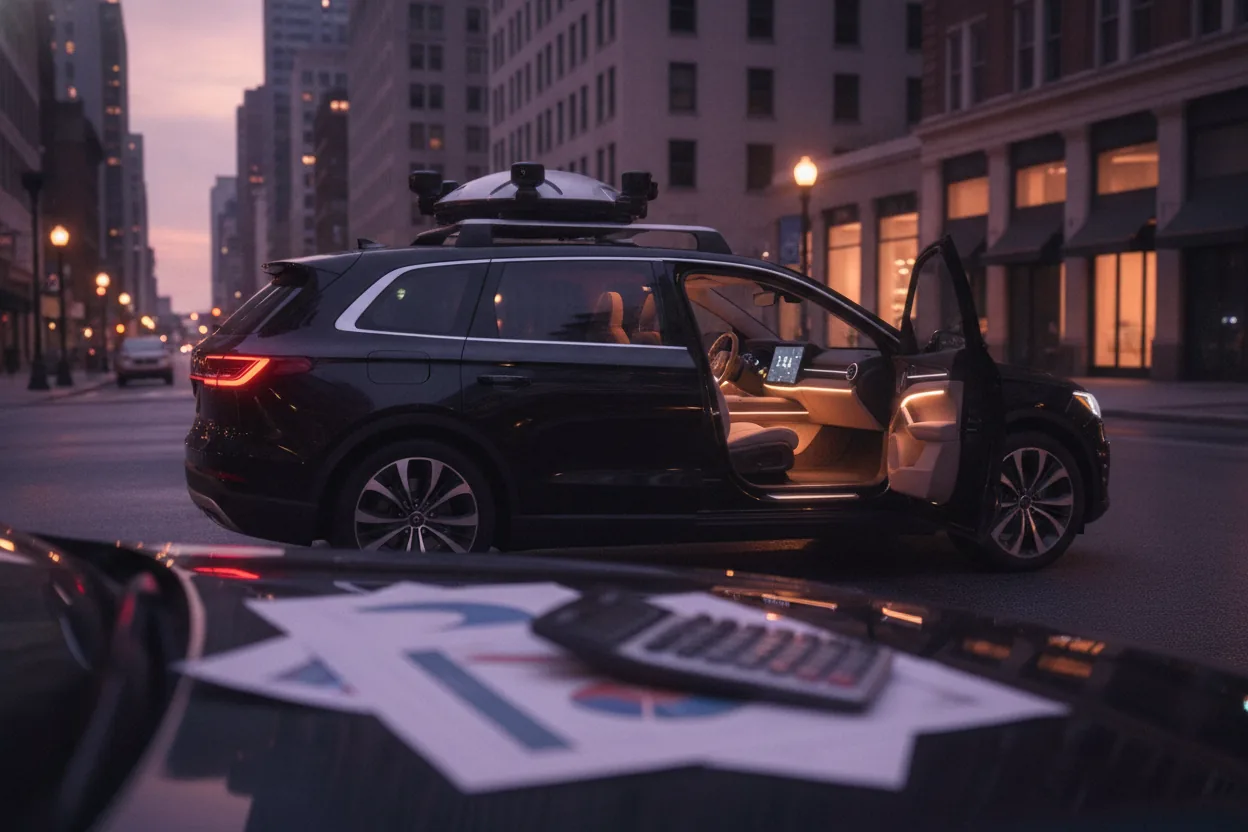
Zero. That's how many major automakers were running driverless commercial passenger service without a safety driver back in 2018, the year ARK Invest first started projecting robotaxi revenue built on gross margins north of 80 percent per ride. Eight years and 100 million autonomous miles later, the technical proof is done. But the driver's cost didn't disappear when the driver did. It just moved into lidar arrays, remote operations centers, and insurance premiums that bullish models tend to underweight. So the real question isn't whether robotaxis work. It's whether anyone in the value chain has actually proven they can capture that margin, and as of September 2026, nobody has.
Tasha Keeney, who directs autonomous technology research at ARK, opens the firm's 2026 autonomous vehicle segment with a flat declarative: robotaxis are available to the public today in select cities in the US, China, and the Middle East. True and verifiable. What follows in ARK's broader thesis, though, the revenue multiples and total addressable market figures that have defined ARK's public materials since the Tesla robotaxi projections of 2018, deserves the same scrutiny investors would apply to any green infrastructure pro forma. Autonomous vehicles sit inside the clean transportation reallocation story because most of the fleets in question, Waymo's Jaguar I PACE and Zeekr vehicles, Baidu's Apollo RT6, Zoox's purpose built pod, are electric. The capital flowing into this sector is capital that would otherwise flow into charging infrastructure, grid storage, or traditional EV manufacturing. Where it actually goes, and who captures the economics, is the part retail investors rarely see modeled correctly. The rest of this piece works through that gap in three parts: the cost structure hiding behind the margin claim, the electrification layer underneath the automation layer, and the question of who in the value chain is actually positioned to capture the profit once it exists.
The Gap Between Technical Proof And Financial Proof Is Where Retail Money Gets Misallocated
Rideshare Revenue Split: Human Driven vs. the Robotaxi Cost Shift
Where the "removed" driver cost actually goes
|
Human Driven Rideshare 75% to driver, before platform take rate, insurance, vehicle costs |
ARK's Robotaxi Claim 80%+ gross margin per ride once driver is removed |
But the cost relocates, it does not disappear:
| Lidar arrays $5,000 to $10,000+ per vehicle |
Remote ops centers recurring cost |
Insurance multiple of standard commercial rates |
Source: Source: Article analysis based on Uber/Lyft driver payout structure and ARK Invest robotaxi margin claims
Technical proof is done. Alphabet's Waymo surpassed 100 million autonomous miles in 2024 and, as of early 2026, operates robotaxi services across roughly 10 U.S. metro markets, according to figures the company has disclosed publicly through its own investor updates and regulatory filings. That's a real number, not a projection. Financial proof works differently, and this is where ARK's Big Ideas framework tends to blur the line. ARK's historical robotaxi model assumed platform operators could eventually capture gross margins north of 80 percent per ride once vehicle depreciation and driver costs were removed from the ledger. The mechanics behind that number matter more than the number itself.
A human driven rideshare trip on Uber or Lyft splits revenue roughly 75/25 in the driver's favor before platform take rate, insurance, and vehicle costs get netted out. Remove the driver and that cost line doesn't vanish, it relocates. Vehicle depreciation on a purpose built robotaxi like the Zoox pod or Waymo's custom Zeekr platform runs materially higher than a consumer EV because of the sensor suite. Lidar arrays alone can add several thousand dollars to a vehicle's build cost even after the price declines of the last five years, and robotaxi-grade systems can still run from five to ten thousand dollars or more per vehicle. Remote operations centers, the humans who monitor fleets and step in when an edge case appears, are a real and recurring cost that bullish models keep underweighting. Insurance for a commercial autonomous fleet, particularly after the scrutiny Cruise faced following its 2023 San Francisco incident and the shutdown of its robotaxi operations that followed, runs at a multiple of standard commercial auto rates.
None of this means the unit economics can't eventually work. Waymo's own public commentary from Alphabet's 2025 and 2026 earnings calls suggests per ride costs have fallen meaningfully as fleet size and route density scale up, the same learning curve dynamic that dropped solar module costs by roughly 90 percent between 2010 and 2020. But investors buying into this theme through ARK's ARKQ fund, or through direct Tesla and Alphabet exposure, are underwriting a bet on a cost curve, not a proven margin. That distinction gets lost in report titles that read like certainty and sound like revenue. The costs just described, lidar, remote operations, insurance, don't sit in isolation. They sit on top of a drivetrain layer with its own separate financial mechanics, and that layer is where this analysis needs to go next.
Electrification Is The Quiet Engine Inside Every Robotaxi Valuation
Robotaxi Fleets: Vehicle Platform and Electrification Status
| Operator | Vehicle Platform | Electric? |
|---|---|---|
| Waymo | Jaguar I-PACE, Zeekr | Yes |
| Baidu | Apollo RT6 | Yes |
| Zoox | Purpose built pod | Yes |
| Waymo (miles) | 100M+ autonomous miles (2024) | ~10 U.S. metros |
Nearly all major robotaxi fleets are electric, meaning autonomy capital directly competes with charging infrastructure and grid storage investment.
Source: Source: Article details on Waymo, Baidu, and Zoox fleet composition, 2026
Every commercially operating robotaxi fleet of scale today runs on an electric drivetrain. Waymo's fleet, Baidu's Apollo Go fleet, Zoox's fleet, and Tesla's nascent robotaxi rollout in Austin all avoid the marginal fuel cost problem that would make dense urban ride hailing uneconomical at internal combustion mileage rates. A robotaxi in continuous urban service can log 150 to 200 miles a day, several multiples of what a personally owned EV accumulates in a year. That mileage profile changes the economics of battery degradation, charging infrastructure utilization, and grid demand in ways that ripple into adjacent green investment products.
Charging infrastructure operators benefit directly from fleet electrification, at least on paper. A company like ChargePoint or EVgo gets more value from predictable, high utilization commercial accounts than from unpredictable retail charging behavior, since a fleet operator signs multi year contracts for depot charging at negotiated rates rather than showing up sporadically at a public fast charger. But the retail investment vehicles built around this theme, EV focused ETFs like KARS or DRIV, hold charging infrastructure names as a small sleeve inside a much larger basket dominated by automakers and battery suppliers. The fleet electrification thesis is real. Whether it moves the needle on a diversified thirty stock ETF's annual return is a separate and much less certain question.
Battery suppliers face their own version of this dynamic. CATL and LG Energy Solution both supply cells into commercial autonomous fleet vehicles, and fleet contracts carry different margin profiles than consumer contracts because of volume commitments and duty cycle specifications. A battery designed for 150 daily commercial miles across three to five years needs a different chemistry and warranty structure than one designed for a suburban commuter doing 30 miles a day. That's a real technical distinction, one that shows up in supplier contracts and almost never shows up in the retail facing narrative about clean transportation growth. The gap between contract level detail and retail narrative reappears, in sharper form, once the question shifts from who builds the fleet to who gets paid for running it.
Who Actually Captures The Margin Once The Driver Is Removed
From Technical Proof to Financial Proof: The Unresolved Gap
|
2018 Zero automakers running driverless commercial service. ARK projects 80%+ margins. |
→ |
2024 Waymo passes 100 million autonomous miles. Technical proof achieved. |
→ |
Early 2026 Service live in ~10 U.S. metros, plus China and Middle East cities. |
September 2026
Financial proof: nobody in the value chain has yet captured the projected margin.
Source: Source: Article narrative on ARK Invest's robotaxi thesis timeline, 2018 to 2026
This is the question that determines whether ARK's autonomous vehicle thesis is an investment case or a narrative case, and the honest answer as of September 2026 is that nobody has fully answered it yet. Three distinct entities sit in the value chain for every robotaxi ride: the vehicle and sensor manufacturer, the fleet operator running the software stack, and the platform distributing rides to customers. In Waymo's case, all three roles sit inside Alphabet, which means Alphabet captures the full stack margin if the unit economics ever mature, a vertically integrated structure similar to how NextEra Energy captures margin across generation, transmission, and retail in parts of the Florida power market.
Tesla's model is different and considerably more exposed to execution risk. Tesla manufactures the vehicle, is building the software stack, and intends to operate the platform, but hasn't yet demonstrated commercial scale outside a limited Austin deployment that began with safety monitors present in the vehicle. The company's stated ambition, repeated across shareholder letters and earnings calls through 2025 and into 2026, is a fully owned stack similar to Waymo's structure. Investors pricing Tesla stock partly on robotaxi optionality are pricing a call option on execution that has, as of this writing, not cleared the milestones that would make the underlying economics verifiable at scale.
Baidu took a third structural approach, licensing its Apollo autonomous driving stack to partner fleet operators in some markets while operating Apollo Go directly in others. It's a hybrid model that spreads capital risk but also caps the margin capture on the licensed side, and it resembles how solar developers sometimes license proprietary tracking technology to third party installers rather than building every project themselves, trading upside for reduced balance sheet exposure. None of these three structures has produced a publicly disclosed, audited, per ride profit and loss statement that a retail investor could underwrite independently. Everything currently priced into these stocks is forward looking.
What does exist, and what deserves more attention than it gets, is regulatory risk sitting directly on top of the margin question. California's Public Utilities Commission, the Texas Department of Motor Vehicles, and municipal authorities in cities like Los Angeles and Atlanta each set their own permitting requirements for driverless commercial operation. Any one of them can tighten rules after an incident, the way California did after the Cruise shutdown, and remove revenue overnight from a fleet operator regardless of how strong the underlying unit economics look on paper. That regulatory exposure doesn't show up in a discounted cash flow model. It shows up in a single news cycle, and it lands hardest on the fee structures investors pay to access this theme in the first place.
ARK's Product Wrapper Adds A Fee Layer On Top Of An Already Uncertain Bet
ARK's ARKQ fund, the Autonomous Technology and Robotics ETF that carries much of this autonomous vehicle thesis into retail portfolios, charges an expense ratio of 0.68 percent, roughly twenty-three times the 0.03 percent charged by a broad market fund like Vanguard's VTI. That fee differential isn't inherently disqualifying, active thematic funds have always charged more than passive index products, but it does mean an investor holding ARKQ is paying a premium specifically to access a research thesis, the one Tasha Keeney presents in the Big Ideas report, rather than to access the underlying companies directly.
Here's the mechanical question worth asking before paying that premium: does ARKQ's holding structure actually concentrate exposure to the autonomous vehicle names driving the thesis, or does it dilute that exposure across a broader robotics and automation basket? As of ARK's most recent public disclosures, ARKQ holds Tesla as a top position alongside industrial automation names, drone technology companies, and space adjacent holdings that have little direct connection to robotaxi economics. An investor who wants concentrated exposure to the Waymo, Baidu, Zoox side of this story can't get it through ARKQ alone, because Alphabet and Baidu sit at weights determined by ARK's broader robotics thesis, not by their specific relevance to autonomous ride hailing.
This is a recurring pattern across thematic ETFs generally, not a criticism specific to ARK. A green tagged or future tagged fund wrapper sells a narrative, Big Ideas, autonomous mobility, the electrification of everything, and the fee gets paid regardless of whether the narrative's specific driver ends up being the fund's actual return contributor. ARK's own performance history makes the point without much need for elaboration: ARK Innovation ETF, the firm's flagship fund, returned over 150 percent in 2020 on thematic enthusiasm and then gave back most of those gains through 2022 as rates rose and growth valuations compressed. Thematic conviction and investment return are not the same variable, and the autonomous vehicle theme is currently testing that distinction in real time.
None of this means the autonomous vehicle transition isn't happening. Waymo's mileage numbers and Baidu's ride volume in Wuhan aren't projections, they're operating history. The question this piece opened with was whether anyone in the value chain has proven they can capture the margin ARK's models assume, and the answer hasn't changed across manufacturers, fleet operators, or platforms: not yet, not with audited numbers, not at scale. What retail investors are actually pricing when they buy into this theme through a thematic ETF is a bundle: real technological progress, unresolved unit economics, regulatory exposure that can shift by jurisdiction and by news cycle, and a fee structure charged upfront regardless of which part of that bundle ends up driving returns. The mileage is real. The margin is still a forecast, and the fee is the only number in the entire chain that's guaranteed.