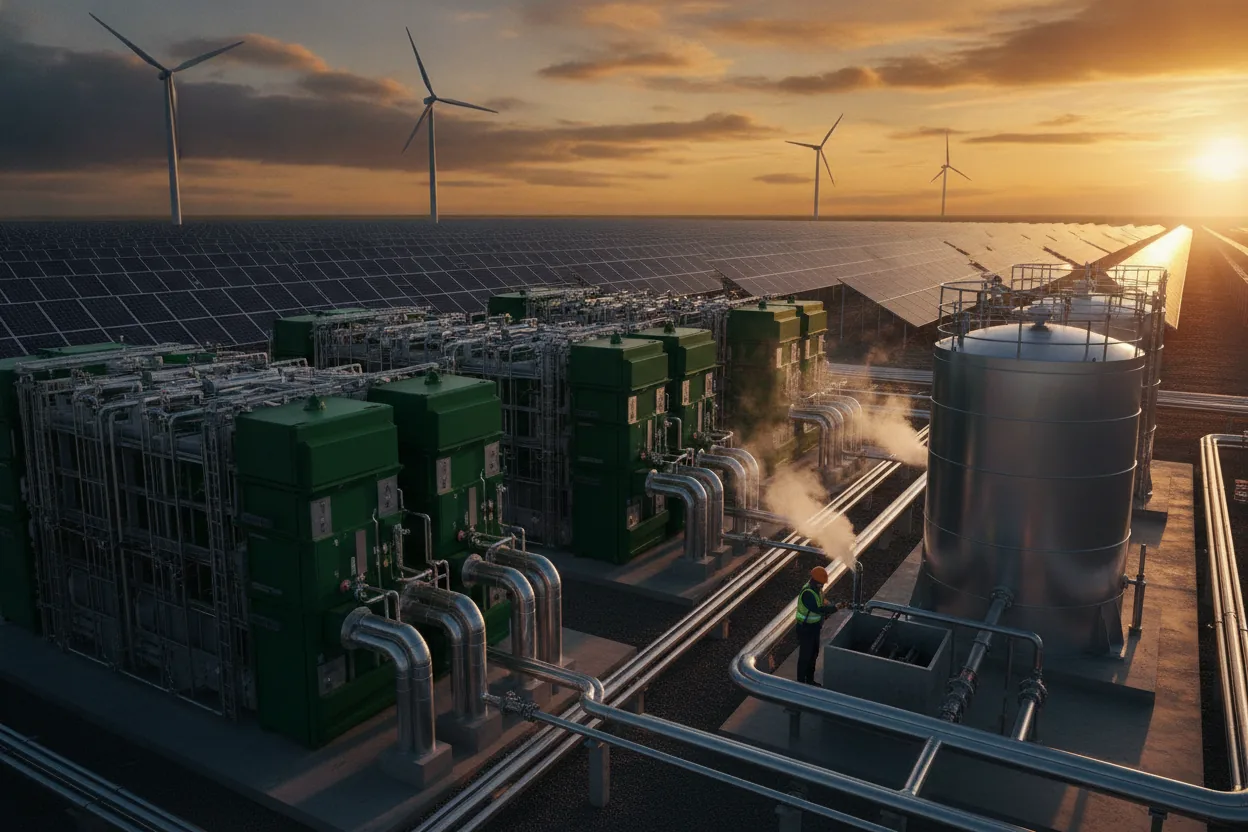
Estimates suggest unsubsidized green hydrogen costs roughly $5 to $6 per kilogram to produce today, against a gray hydrogen benchmark widely cited as sitting somewhere around $1 to $2. Every major forecaster, from Bank of America to the IEA, has pushed back its parity timeline at least once since 2022. The gap keeps widening, and not because the technology stalled. The policy scaffolding underneath it keeps shifting shape instead. Saudi Arabia's NEOM project proves the economics can work at scale, backed by a multibillion dollar investment financed through a syndicate of local, regional, and international banks and investment firms, not a sovereign financing package that private developers simply cannot access. So what exactly are retail investors buying when a hydrogen ETF promises exposure to that same success story? Worth answering carefully, because the gap between NEOM's economics and a retail investor's actual options turns out to be the whole story.
Policy Whiplash and What It Does to a Discount Rate
Green Hydrogen Cost Gap vs Gray Hydrogen
|
Green Hydrogen
$5 to $6
per kg, electrolytic
|
Gray Hydrogen
$1 to $2
per kg, fossil based
|
Source: Estimates cited in article, 2026
Hydrogen is the eco investment sector where every forecast ages the fastest. Bank of America, Goldman Sachs, and the International Energy Agency have each walked back parity timelines at least once since 2022. That's consistent enough to call it a feature of the asset class rather than a forecasting failure: green hydrogen cost curves keep sliding right, and the reason is almost always policy, not physics. Right now, U.S. and EU policy is the clearest example of that pattern in motion.
The United States hydrogen production tax credit, Section 45V, was supposed to be the backbone of the domestic buildout. Under the original Inflation Reduction Act framework, qualifying green hydrogen producers could claim up to $3 per kilogram for ten years, a subsidy large enough to make electrolytic hydrogen roughly competitive with gray hydrogen on paper. The One Big Beautiful Bill Act, signed into law in July 2025, moved up the deadline for projects to begin construction, according to some analysts, compressing what had been a longer runway into a scramble. Projects that cannot break ground and lock in eligibility before that date lose the credit entirely.
Call it what it is: a subsidy cliff, not a subsidy cut. And cliffs change how capital behaves in a way gradual phase downs don't. A gradual phase down lets a developer model declining support over a ten year curve and adjust the capital stack accordingly. A cliff forces every project in the pipeline to hit the same construction deadline at once, which means every project competes for the same electrolyzer manufacturing slots, the same EPC contractors, and the same grid interconnection queues in the same eighteen month window. Plug Power, Air Products, and several joint ventures backed by NextEra Energy have all adjusted project timelines or scaled back announced capacity since the OBBBA passed. The credit itself didn't disappear. The certainty around who gets to use it did.
Meanwhile the European Union's Carbon Border Adjustment Mechanism enters its financial phase in 2026, meaning importers of steel, cement, fertilizer, and hydrogen derived products into the EU now have to buy certificates reflecting the embedded carbon in what they ship. CBAM is supposed to be the demand side lever that IRA style subsidies are the supply side lever for: it makes carbon intensive imports more expensive, which should make green hydrogen derived ammonia or green steel more competitive by comparison. In practice, EU regulators have pushed and narrowed CBAM implementation repeatedly since its 2023 transitional phase began, and the certificate price mechanism is still thinner and more volatile than the EU carbon price it references. A demand signal that keeps getting redesigned isn't one a project financier can underwrite at a fixed IRR.
Put the two together and you get a transatlantic mismatch: American subsidy support compressed into a narrow window, European demand support diluted by implementation delay. A developer trying to build a bankable model today has to pick a jurisdiction, then bet on which policy regime is more likely to hold its shape through a seven year construction and ramp period. That bet is now a bigger driver of project IRR than the electrolyzer capex curve itself. Policy volatility has replaced technology risk as the primary variable in green hydrogen underwriting, and that shift favors sovereign backed and strategically hedged players over independent developers who cannot absorb a subsidy cliff. NEOM shows exactly what that advantage looks like in practice.
NEOM Shows What a Sovereign Balance Sheet Buys
How the Section 45V Subsidy Cliff Squeezes Project Pipelines
Source: Article analysis of the One Big Beautiful Bill Act, 2025
The NEOM Green Hydrogen Company project in Saudi Arabia, a joint venture between ACWA Power, Air Products, and the Saudi sovereign wealth fund NEOM, is the clearest existing proof that green hydrogen at scale is buildable today. The project is targeting production of several hundred tonnes per day of green hydrogen, according to widely cited figures, feeding a green ammonia facility, with commercial operations now targeted around 2026 to 2027 after construction delays pushed the original 2025 target back. Financing closed in 2023 at a figure multiple sources put in the billions of dollars, one of the largest green hydrogen project finance packages ever assembled. What makes NEOM work isn't a hydrogen breakthrough. It's a cost of capital advantage that private developers structurally cannot replicate.
A private green hydrogen developer in Texas or Rotterdam is financing a project against merchant risk, offtake uncertainty, and a subsidy regime that can change with a legislative session, exactly the kind of regime shift described above. NEOM is financed by a sovereign wealth fund with a multi decade time horizon, backed implicitly by a state that has already committed to the broader NEOM city project regardless of any single subproject's standalone economics. That changes the entire risk calculus lenders apply. Project finance debt for NEOM Green Hydrogen came in at rates reflecting investment grade infrastructure risk, not merchant commodity risk, even though the underlying offtake contracts depend on a green ammonia market that barely exists yet at scale.
Here's the mechanism retail investors need to sit with: sovereign backing doesn't eliminate market risk, it just relocates who absorbs it. Saudi Arabia is functionally underwriting the demand risk itself, because Air Products has committed to purchase the ammonia output under a long term offtake agreement, and the Saudi state has enough fiscal flexibility to treat a multi year ramp delay as a rounding error rather than a covenant breach.
Now compare that to how a retail investor actually accesses this theme through public markets. There is no clean, liquid, pure play way to buy NEOM style exposure. The closest proxies are diversified industrials like Air Products and Chemicals, which trades hydrogen exposure alongside a much larger industrial gas business, or hydrogen focused ETFs like the Defiance Next Gen H2 ETF, HDRO, which holds a basket of electrolyzer manufacturers, fuel cell companies, and infrastructure names whose fortunes are far more volatile than any single sovereign backed project. HDRO's holdings include names like Plug Power and Ballard Power Systems, companies whose share prices have moved sharply in either direction within twelve month windows as hydrogen policy sentiment has swung, according to some analysts. The fund gives you the theme. It doesn't give you NEOM's balance sheet.
- Sovereign wealth backing and multi decade fiscal patience
- Investment grade project finance rates on commodity risk
- Long term offtake contracts absorbing demand uncertainty
- And political commitment functioning, in effect, as an implicit guarantee that no private balance sheet can offer.
Those four structural advantages explain the entire cost gap between what NEOM can underwrite and what a venture backed electrolyzer startup in Europe or America can underwrite, and no basket of public equities replicates that gap. When a retail product markets hydrogen exposure as a bet on the same economics that make NEOM work, it's quietly asking buyers to accept startup risk while pricing in sovereign confidence. The sovereign balance sheet is the actual product being sold in green hydrogen's flagship success story, and retail investors buying electrolyzer stocks or hydrogen ETFs are purchasing a much riskier, unhedged version of the same thesis, minus the state guarantee that makes the flagship version investable. That leaves one open question: could the underlying technology ever close this gap on its own, without a sovereign balance sheet standing behind it?
What Would It Take to Actually Reach Price Parity?
Transatlantic Policy Mismatch: US Supply Side vs EU Demand Side
| Dimension | US: Section 45V | EU: CBAM |
|---|---|---|
| Lever type | Supply side subsidy | Demand side cost signal |
| Key change | Deadline moved up by OBBBA, 2025 | Financial phase starts 2026, rules narrowed repeatedly since 2023 |
| Support structure | Up to $3 per kg for 10 years, if deadline met | Certificate price tied to volatile EU carbon price |
| Effect on capital | Cliff forces rushed, crowded construction window | Thin, redesigned signal, hard to underwrite at fixed IRR |
| Net result | Compressed subsidy window | Diluted demand support |
Source: Article analysis of Section 45V and CBAM, 2026
Green hydrogen production cost comes down to three real levers: electrolyzer capital cost, electricity price, and utilization rate, meaning how many hours per year the electrolyzer actually runs rather than sitting idle waiting for cheap renewable power. Electrolyzer costs have fallen meaningfully, with alkaline and PEM systems both seeing manufacturing cost declines as Chinese and European manufacturers scale production. But electricity input remains the dominant cost driver in almost every model, typically estimated at a majority share of levelized cost depending on the region.
This is where the parity math gets uncomfortable for anyone underwriting a project against grid connected renewables rather than a dedicated, oversized generation asset. Running an electrolyzer only when solar or wind power is cheap and abundant maximizes electricity cost savings but tanks utilization rate, often to a low percentage, which means the fixed capital cost of the electrolyzer gets spread across far fewer kilograms of hydrogen produced. Running the electrolyzer around the clock on grid power improves utilization but exposes the project to average grid electricity prices, and in most markets those prices aren't cheap enough to hit parity math at all. NEOM solves this with a dedicated large scale renewable generation complex built specifically to feed the electrolyzer at high utilization, a capital intensity solution available to a sovereign fund and essentially unavailable to a mid sized independent developer.
Most credible industry estimates now point to green hydrogen reaching cost parity with gray hydrogen in favorable geographies, meaning regions with very cheap renewable power and strong policy support, sometime toward the end of this decade or early into the next. That window itself has slid later with almost every annual update since 2021. Any parity date beyond about three years out functions as a moving target rather than a fixed forecast, because that's been the empirical pattern for half a decade now. The technology isn't stalled. The subsidized economics that were supposed to bridge the gap keep getting redesigned before the gap closes on its own.
Which brings us back to the question this post opened with. A hydrogen ETF doesn't buy exposure to NEOM's success story. It buys exposure to unresolved electricity and utilization math, minus the sovereign balance sheet that let NEOM solve that math with brute capital. Price parity is a function of policy stability and access to dedicated low cost generation more than electrolyzer innovation, which means the investable green hydrogen thesis for the next several years is really a bet on which jurisdictions and balance sheets can absorb subsidy uncertainty long enough to reach scale, not a bet on which company builds the better electrolyzer.