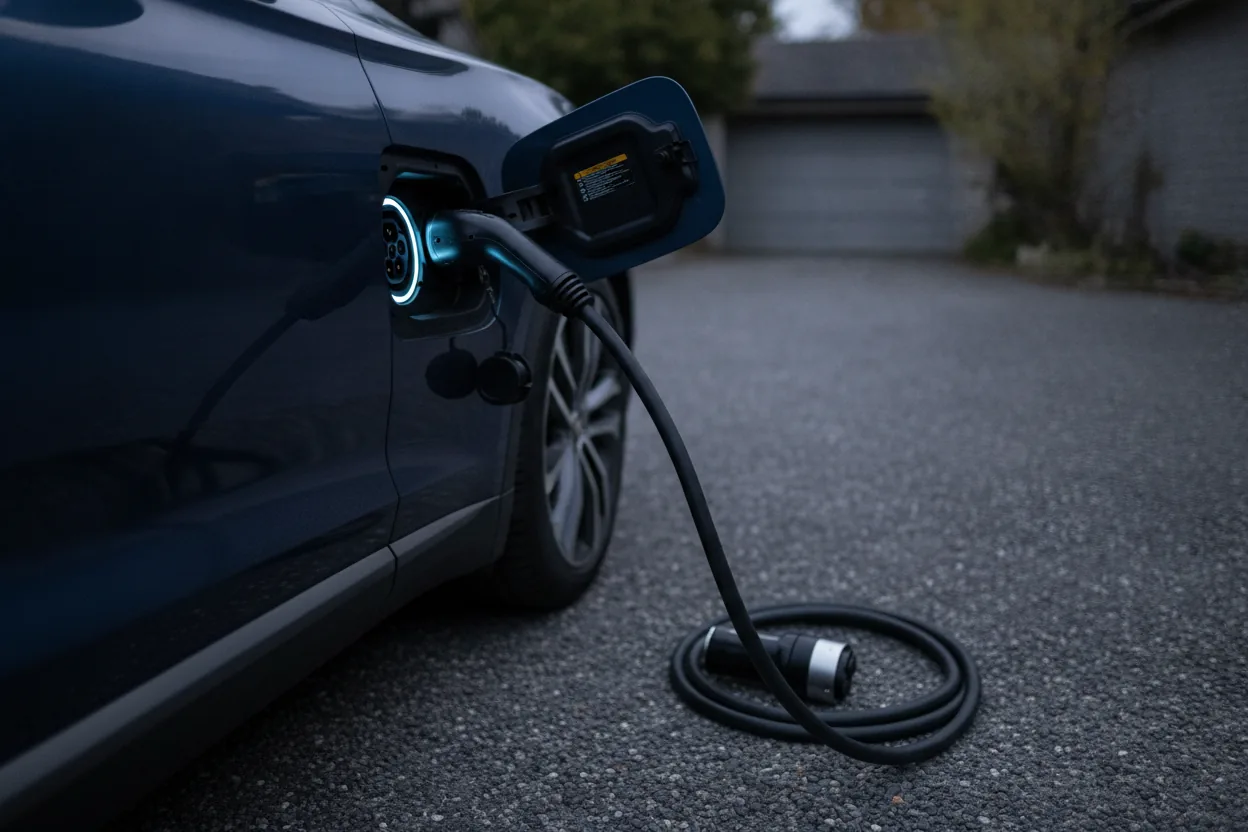
What separates a plug-in hybrid from a full EV?
Consumer Reports found that a Hyundai Tucson PHEV driven on an empty battery gets 4 fewer miles per gallon than the standard hybrid version of the same vehicle. That's a premium climate purchase quietly turning into a worse deal than the cheaper model sitting on the same lot. So does that plug-in hybrid in your driveway earn its price tag, or only if you actually plug it in every single night?
The International Energy Agency's real-world data shows PHEVs run on electric power far less than their official ratings claim. Regulatory testing standards assume drivers recharge more often and drive shorter distances than they actually do, and that assumption inflates the efficiency numbers stamped on window stickers and marketing materials. The gap between lab assumptions and driveway habits is the entire story here.
An engine that kicks in constantly because the battery is empty behaves like a heavier, less efficient gasoline car. Treat those sticker efficiency numbers as a ceiling, not something you'll actually hit.
Is the claim that rarely charging is just as good actually true?
That gap between sticker numbers and real driving raises an obvious follow-up: does it matter if you rarely charge, or does the engine just pick up the slack without much cost? It matters a lot, and the data on private versus company car usage makes the pattern obvious. Research reviewed by data scientist Hannah Ritchie shows private PHEV owners charge more consistently and cover a meaningful share of their miles electrically. Company-car PHEVs, often chosen for tax benefits rather than daily charging habits, log dramatically lower electric-mile shares in real-world driving.
The IEA's modeling, cited in Ritchie's analysis, confirms that for an average driver's travel distance and behavior, a full battery electric vehicle emits significantly less over its lifetime than a PHEV. There's a narrow exception: a driver who charges daily and stays within a relatively short electric range might see emissions from driving that land broadly similar between the two vehicle types, though not identical, since battery efficiency and vehicle weight still differ. Most people don't drive that way, so that narrow case doesn't describe most garages.
The U.S. Environmental Protection Agency's Beyond Tailpipe Emissions Calculator lets drivers plug in a zip code and a specific EV or PHEV model to see projected CO2 output based on their local electricity grid. It's one of the few tools that turns this abstract debate into a number specific to where you actually live.
Before assuming a PHEV parked in a driveway is doing its climate job, ask whether it's spending most of its miles on battery power or running the engine because nobody plugged it in last night. Checking that ratio against your own commute beats trusting any window sticker.
What does this mean for someone deciding between a PHEV and an EV?
Charging frequency, not the badge on the trunk, decides whether a PHEV performs like a clean vehicle or a heavy gasoline car with extra baggage. The practical test is your own charging discipline, not the sticker on the car. Consumer Reports found that a Hyundai Tucson PHEV driven with an empty battery gets 4 fewer miles per gallon than the standard hybrid version of the same vehicle. A PHEV owner who skips charging can end up paying hundreds of dollars more per year in fuel than if they'd just bought the cheaper hybrid, on top of the PHEV's higher upfront price.
Alex Knizek, associate director of auto test development at Consumer Reports, points out that PHEVs stay quicker and quieter than gas-only versions of the same model regardless of charging habits, so there's a real driving-experience upside even for inconsistent chargers. That comfort benefit sits in a totally different column from the emissions math, though, and shouldn't get confused with genuine climate performance.
Consumer Reports' Fisher puts it plainly: the more you plug in a PHEV, the more gas and money you save, and the inverse holds just as strongly. No garage, no driveway, no reliable charger access, or trips that regularly exceed 50 kilometers? Then a PHEV stops behaving like a low-emission vehicle and starts behaving like a heavier gasoline car dragging around an underused battery.
Before buying a PHEV, be honest with yourself about how many nights a week you'll actually plug in and how far your typical commute runs. That answer determines whether you're buying a clean transitional vehicle or an expensive gasoline car with extra steps.
Does battery manufacturing cancel out the benefit anyway?
Even a driver who charges faithfully every night eventually runs into a different objection to electrification altogether: the battery itself. Skeptics love raising this one, but it doesn't hold up the way they think, and it applies to both PHEVs and full EVs. The EPA confirms that manufacturing an EV battery does require more upfront energy and carbon than building a gasoline car, and some studies show the initial manufacturing footprint of an EV can exceed that of a comparable gas vehicle.
That upfront gap closes fast once the vehicle hits the road. EVs produce zero tailpipe emissions and run significantly more efficiently during operation, so the EPA states total lifetime greenhouse gas emissions, covering manufacturing, charging, and driving combined, typically land lower for EVs than for gasoline cars. The same logic applies to PHEVs, but only in proportion to how much of their driving actually happens on battery power rather than gasoline.
Here's where the two threads of this whole argument tie together: a PHEV that rarely gets charged carries a battery it barely uses, absorbing a chunk of that upfront manufacturing footprint without ever earning back the operational savings that would justify it. A full EV, driven normally, recoups its manufacturing footprint through years of zero-tailpipe driving. A PHEV left unplugged in the garage gets stuck with the worst of both setups: a manufacturing cost partially wasted and a fuel economy penalty stacked on top.
So the Tucson PHEV losing 4 miles per gallon on an empty battery was never really about that one Hyundai model. It comes down to whether the plug actually gets used. A PHEV charged nightly and driven on short trips can approach the climate case for going electric. A PHEV left unplugged is just a heavier, pricier gasoline car carrying dead weight around town. The sticker never answers that question. Only your driveway habits do.