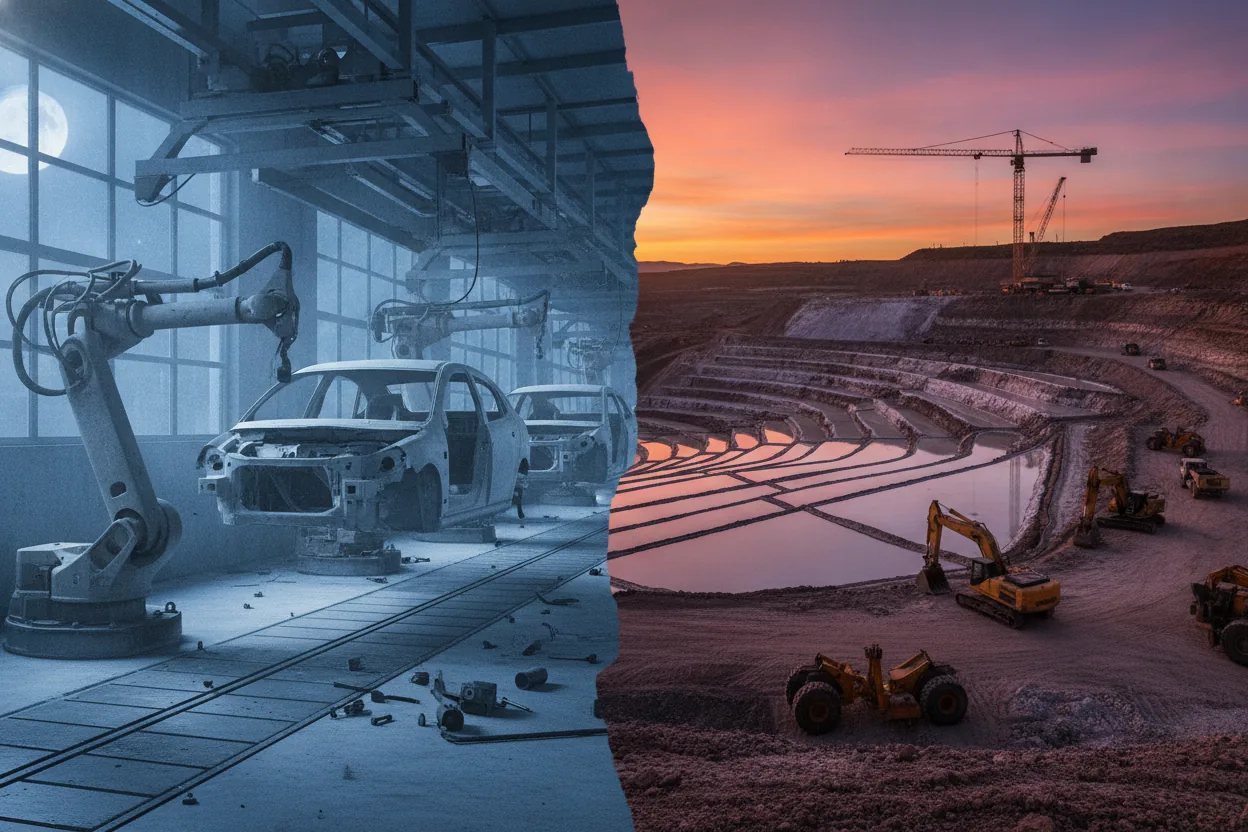
GM took a $7.6 billion writedown on EV assets, then turned around and committed capital to a lithium mine that won't ship meaningful volume for several more years. Both numbers get folded into the same story about domestic battery independence, as if a writedown and a long-dated supply bet were evidence of the same thing. They're not. One is an admission that EV demand came in slower than planned. The other is a bet on a mine still working through permitting and water rights disputes. The real question is whether either number tells retail investors anything about what GM stock is actually worth holding for.
Here's where I land: the GM Lithium Americas deal is a real, structurally sound bet on domestic mineral supply. But the broader GM EV reshoring story being sold to retail investors conflates industrial policy success with equity upside, and those are not the same trade.
Retail investors watching GM's stock or scouting battery supply chain ETFs are being handed a narrative about de-risking and independence. The mechanics underneath that narrative tell a messier story, with real winners, real losers, and a timeline that doesn't match the urgency of the press releases. Let's start with what the Lithium Americas deal actually does.
Tracing How The Lithium Americas Deal Actually Works
Lithium Carbonate Price Collapse, 2022 to 2026
Source: Source: Article data, China spot lithium carbonate prices
GM's $625 million investment in Lithium Americas is not a simple equity purchase. It's structured around an offtake agreement tied to the Thacker Pass project, which holds what the U.S. Geological Survey has described as one of the largest known lithium deposits in North America. GM gets priority access to lithium carbonate equivalent production once the mine ramps, and in exchange it took a direct ownership stake in the project entity instead of just signing a supply contract.
The appeal for GM is obvious on paper. Lithium prices went through a brutal cycle: spot lithium carbonate prices in China fell from highs above $70,000 per tonne in late 2022 to around $10,000 to $11,000 per tonne by 2024, before stabilizing in a lower band through 2025 and 2026. That crash gutted the economics for junior miners and slowed project financing across the sector, Lithium Americas included. GM's capital injection works as patient, strategic money filling a gap that public lithium equity markets wouldn't fill at depressed prices.
What matters more than the headline number is what it does to the mine's timeline. Thacker Pass has faced permitting litigation, water rights disputes in the Humboldt River basin, and construction timelines that have already slipped multiple times since the project was first proposed. GM's money de-risks financing. It does not de-risk permitting, construction cost inflation, or the multi-year gap between breaking ground and shipping battery grade lithium. Investors who read $625 million as proof the supply chain problem is solved are pricing in execution that hasn't happened yet.
The deal is good industrial policy and a reasonable strategic hedge for GM. It is not evidence that GM's EV unit economics have improved. Those are two separate claims wearing the same press release, and conflating them is how retail capital ends up overpaying for a narrative instead of a cash flow. The writedown below is the clearest evidence of that gap.
Reading The $7.6 Billion Writedown Correctly
Two Numbers, Two Different Stories
Source: Source: Article data, GM financial disclosures and Lithium Americas deal terms
GM's writedown on EV assets wasn't caused by one failed battery plant. It reflects a broader repricing of how fast the mass market EV transition will actually move in North America, something GM and most of its peers overestimated between 2021 and 2023. The writedown touched joint venture battery capacity, production tooling, and in at least one case the scaling back of a planned EV model line, alongside the well documented pause of two separate EV manufacturing projects that had been announced with considerable fanfare.
Why does a writedown this size matter for someone evaluating eco investment exposure rather than GM stock specifically? Because it's a direct, quantifiable admission that the demand curve automakers priced into their 2021 era capital plans didn't materialize on schedule. U.S. EV sales growth slowed materially through 2024 and into 2025, with dealer inventory of unsold EVs climbing well above gas vehicle inventory in several major markets. GM isn't an outlier here. It's a visible, numbers backed example of a pattern playing out across the sector.
The IRA tax credit structure compounds this. Full credits under the Inflation Reduction Act require increasing percentages of battery components and critical minerals to be sourced domestically or from free trade partners, with the thresholds tightening on a defined schedule through the decade. Miss those thresholds and a vehicle that once qualified for the full $7,500 consumer credit can lose eligibility entirely. That's not a rounding error on a mass market vehicle's margin. It's the difference between a competitive price point and a vehicle that needs a discount to move.
Four things sit underneath the $7.6 billion figure: writedowns on battery joint venture capacity, paused manufacturing projects, slower than modeled EV demand curves, and IRA sourcing thresholds tightening on schedule. One of those, the paused manufacturing projects, got the most press coverage and tells you the least about long-term strategy; the sourcing thresholds are the one actually worth watching. Put together, they describe a company adjusting a growth plan to match a slower reality, not a company abandoning electrification. The distinction matters because equity markets tend to punish the adjustment and reward the original aggressive guidance, which is exactly backward from how a disciplined investor should read it. This is also why the Thacker Pass deal needs to be judged on its own terms rather than as an offset to the writedown.
Separating Industrial Policy Wins From Shareholder Returns
Thacker Pass Lithium: From Deal to Delivery
Source: Source: Article data, Lithium Americas and GM offtake agreement structure
EV sector commentary keeps treating domestic supply chain independence and shareholder value creation as the same outcome. They're not. A mine coming online in Nevada reduces U.S. reliance on Chinese and Australian lithium processing, which matters for national resilience and for IRA credit eligibility across the entire auto sector, not just GM. That's a real public benefit with real geopolitical weight, particularly given that China still controls a large majority of global lithium refining capacity. None of that automatically flows through to GM's EV unit margins in the near term.
Battery grade lithium from Thacker Pass, assuming the project stays on its current construction schedule, won't reach meaningful commercial volumes for several more years. Until then, GM still buys the bulk of its lithium and refined battery materials through existing contracts, many of which run through intermediaries with exposure to Chinese processing capacity regardless of where the raw ore was mined. Localizing the mine is not the same as localizing the full value chain, and that distinction gets flattened in most coverage of these deals.
There's also a question of who captures the value if Thacker Pass succeeds. GM's equity stake entitles it to offtake pricing and a share of project economics, but Lithium Americas shareholders and the mine's other financing partners capture meaningful upside too. Retail investors looking for EV supply chain exposure through GM common stock are buying a diluted, indirect claim on a project where GM is one stakeholder among several, layered under GM's existing EV unit losses and legacy combustion business economics. Owning that is a very different risk profile than owning Lithium Americas directly, or owning a basket of critical minerals equities through something like the Amplify Lithium and Battery Technology ETF.
The investor takeaway here is structural, not directional. GM benefiting from Thacker Pass eventually is plausible. GM stock benefiting from Thacker Pass specifically, on a timeline that matters to most retail holding periods, is a much weaker claim, and that gap is where the trade actually lives. How long that gap stays open comes down to execution risk.
Pricing The Execution Risk Retail Investors Keep Missing
Execution risk is the variable that gets erased every time a supply chain deal gets covered as a solved problem. GM's own framing acknowledges this directly: the company has stated that its competitive position depends on bringing new domestic mineral and processing facilities online on schedule, and that falling behind risks losing both competitive position and IRA credit eligibility. That's a conditional statement, not a guarantee, and conditional statements are where most eco investment theses quietly fail.
Permitting timelines for U.S. mining projects have historically run long. The average time from discovery to production start for a new U.S. mine has stretched to about 29 years, according to an S&P Global analysis cited by the National Mining Association, with permitting alone often taking a decade or longer, driven by environmental review processes, litigation, and local opposition. Thacker Pass has already absorbed years of legal challenges from tribal groups and environmental organizations before construction meaningfully began. Investors pricing GM's lithium independence narrative on a 2027 or 2028 timeline are betting on permitting and construction discipline that the broader U.S. mining sector has rarely delivered on schedule.
There's also a policy durability question sitting underneath all of this. IRA tax credit structures and critical minerals sourcing requirements are federal policy, subject to the normal volatility of U.S. legislative and regulatory cycles. A sourcing threshold that looks generous today can be tightened, loosened, or restructured by future administrations and future Congresses. GM's entire domestic supply chain thesis assumes a reasonably stable policy environment through the rest of this decade, an assumption every investor in this sector is implicitly making whether they realize it or not.
None of this makes the GM Lithium Americas deal a bad decision. It makes it a long duration, execution dependent bet dressed up in press coverage that reads like an already completed victory. The gap between those two framings is exactly where retail capital tends to get mispriced, buying the narrative at the moment of announcement rather than at the moment of actual production, when most of the real value gets realized or destroyed. That gap answers the question this post opened with: the $625 million and the $7.6 billion are not evidence of the same thing, and GM stock today is a claim on legacy combustion earnings and an unresolved EV transition, not a claim on a Nevada mine that won't ship product for years. Investors who want lithium exposure should price that mine directly. Investors who want GM should price GM, and stop letting one number do the other's job.