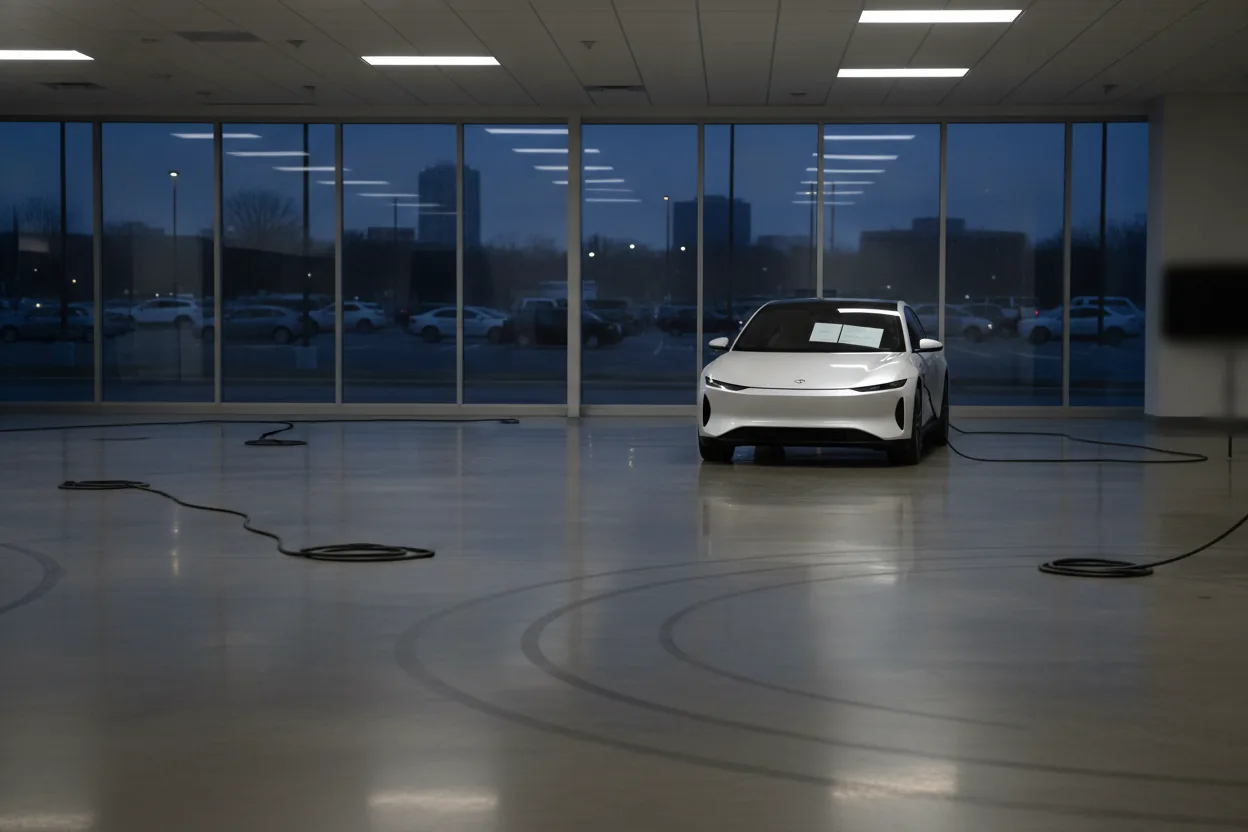
The average new EV transaction price has barely budged over the past two years, sitting close to $50,000 through late 2026. In that same window, a steep tariff hit Chinese made EVs, a substantial tariff hit most other imports, the federal tax credit dropped from $7,500 to zero, and a number of models vanished from US showrooms entirely. Sticker prices barely moved while the policy stack taxing them got dramatically harsher. So the cost went somewhere other than the price tag. Finding where it landed is the only way to know what EV exposure in a clean energy fund is actually worth right now.
The clean transportation transition was supposed to run on falling battery costs and expanding model choice. Instead it's running through a tariff structure that taxes imported cars at a notable rate, taxes Chinese EVs even more steeply, and removed a federal tax credit that used to offset a chunk of the purchase price. There's no price spike at the consumer level. There's a supply contraction, a margin squeeze on automakers, and a reshuffling of where EV manufacturing capital actually gets deployed. That reshuffling is the real investment story here, and most retail investors in clean energy ETFs aren't pricing it correctly.
How the Tariff Stack Actually Works
The EV Tariff Stack by Origin
| Origin | Tariff Type | Rate |
|---|---|---|
| China | Section 301 | 100% |
| Most imports (baseline) | Section 232 | 25% |
| EU, Japan, South Korea | Negotiated rate | 15% |
| UK | Quota capped | 10% |
| Federal tax credit | Expired (was $7,500) | $0 |
Source: Section 232 and Section 301 tariff schedules, as cited in article
There isn't one EV tariff. There are at least three layers stacked on top of each other, and which layers apply depends on where a car and its parts are built. The stack matters more than any single headline number, because the stack is what decided which models survived 2026 and which got discontinued.
- 25% baseline Section 232 tariff on imported vehicles and most imported parts
- 15% rate for the EU, Japan, and South Korea under negotiated trade deals
- 10% rate for the UK, capped under a quota arrangement
- 100% Section 301 tariff specifically targeting Chinese made EVs
- $0 federal EV tax credit remaining after its expiration, versus the prior $7,500 ceiling
Layer those together and the pattern explains three specific decisions. Hyundai paused the Kona Electric, built in Korea, for the 2026 model year. Kia discontinued the Niro EV, also Korea built, after 2026, with its 2027 successor going hybrid only. Volvo pulled EX30 production out of its planned China build and moved it to Belgium, which pushed the car past the $40,000 threshold where it stopped making commercial sense for the US market. None of these are random corporate decisions. Each is a direct response to a specific tariff line item. For an investor, that's the useful signal: tariff policy is now a production location variable, and production location is becoming a bigger driver of EV unit economics than battery chemistry.
Where the Cost Actually Lands
How the Tariff Stack Forced Model Decisions
1. Korea built Kona Electric
Hit with 15% negotiated tariff rate
Hyundai pauses Kona EV
for 2026 model year
2. Korea built Niro EV
Same 15% tariff exposure
Kia discontinues Niro EV
2027 successor goes hybrid only
3. EX30 planned for China build
Would face 100% Section 301 tariff
Volvo moves EX30 to Belgium
Price pushed past $40,000 threshold
Source: Article reporting on Hyundai, Kia, and Volvo 2026 production decisions
That production location shift explains which models disappeared, but it doesn't explain why the average transaction price barely moved. If tariffs were simply passed through to consumers, that number would look very different given a steep tax on a meaningful share of imported vehicles and components. It hasn't moved much, which means the cost is landing somewhere else first, before it ever reaches the window sticker.
Automakers are absorbing tariff costs into margins rather than fully passing them to buyers, at least so far. That's a corporate finance decision, not a pricing accident, and it has consequences for anyone holding automaker equity or EV supply chain exposure through a thematic fund.
- Battery cell costs rising indirectly as Chinese supply is priced out of competing directly in the US
- Model discontinuations instead of price increases, removing a number of EVs from US availability
- Belgium relocation of Volvo EX30 production, trading a much higher China tariff exposure for a lower EU rate
- Margin compression at the manufacturer level, not yet fully visible in retail pricing data
- And US consumers get zero access to BYD and other Chinese EVs that remain priced competitively everywhere else in the world.
Anyone holding a broad clean energy ETF with EV manufacturer exposure should be paying attention here, whether through ICLN's industrial holdings or a more EV specific vehicle like KARS. Margin absorption isn't free. It shows up eventually, either in capital expenditure cuts on next generation EV platforms or in reduced R&D spend on battery technology. The transition isn't canceled, it's being financed by automaker balance sheets instead of consumer wallets, and that financing has a limit nobody has tested yet.
Who Gains and Who Absorbs the Risk
Flat Sticker Price, Rising Policy Cost
|
Avg EV transaction price ~$50,000 barely changed, late 2026 |
Federal tax credit $7,500 to $0 fully eliminated |
Where the cost actually went
Manufacturer margins absorbed the gap: discontinued models, relocated production, and compressed margins, rather than higher sticker prices.
|
100% tariff on China made EVs |
25% baseline on most imports |
12+ models pulled from US showrooms |
Source: Article data on average EV transaction price and tariff and tax credit changes, 2024 to 2026
If automakers are financing the tariff stack out of their own margins, the next question is which automakers are better positioned to keep doing that. Tariff policy always produces winners, and 2026's EV tariff stack is no exception. The winners aren't where most retail investors are looking, because the obvious trade, buying domestic EV manufacturers on the theory that tariffs protect them from Chinese competition, misreads what's actually happening to those same manufacturers' input costs.
- South Korean and Japanese automakers get a 15% rate instead of 25%, a 10 point advantage worth real margin on every unit shipped
- UK built vehicles get the most favorable 10% quota rate among major trading partners
- US based battery and component suppliers gain pricing power as Chinese cell competition is excluded, though this raises costs for everyone downstream
- Belgium and other EU assembly sites become more attractive relocation targets for automakers fleeing the 100% China rate
- And BYD, along with other Chinese EV makers, is locked out of the single largest EV buying market in the world, even while remaining the price leader everywhere else.
Who loses is more straightforward. US consumers lose model choice and lose access to some of the more affordably priced EVs built elsewhere. Retail investors in EV themed funds lose clarity, because tariff exposure is now a material variable in automaker earnings that most fund fact sheets don't disclose at the holding level. The broader electrification narrative loses momentum too, since unit volume growth in the US is being constrained by policy rather than by demand or battery cost curves, the thing that had actually been the primary bottleneck for most of the last decade.
The mechanism worth watching going forward is used EV pricing, since tariffs apply to new vehicle imports and parts rather than resale transactions. That means the secondary market could become the place where actual price discovery happens, while the new vehicle market stays artificially stable through margin absorption and model discontinuation. If that gap between new and used EV pricing widens, it's the clearest answer to where the sticker price's missing cost actually went, and it will tell investors more about real tariff cost transmission than any manufacturer earnings call is likely to admit directly.