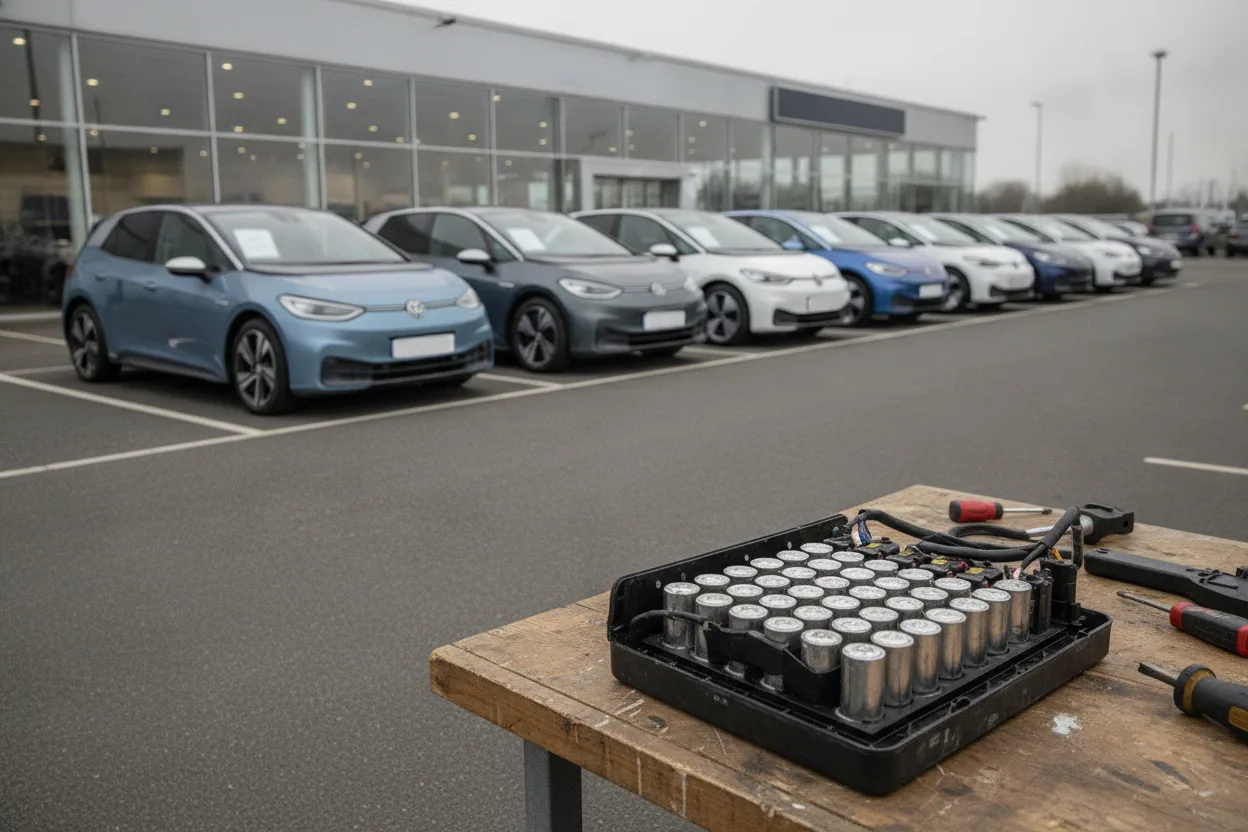
Lithium carbonate prices have fallen sharply from their 2022 peak, and a three year old Volkswagen ID.3 that sold new for £32,300 now trades for around £10,000. Buying guides frame both facts as consumer good news: cheap batteries, cheap cars, EVs for everyone. Nobody writing those guides asks who priced the leases, bonds, and mining equity on the assumption that neither number would move this far, this fast.
I've spent the past decade watching capital chase the energy transition, and the pattern repeats every time. The physical asset deflates faster than the financial product built on top of it can adjust. Consumer journalists are writing cheerful buying guides about £5,000 electric cars, and nobody in that audience asks the obvious follow-up. If a three year old EV has lost a quarter to a third of its value, what does that do to the leasing companies, the fleet operators, the battery supply chain investors, and the bond structures that priced those vehicles as collateral?
My stance: the used EV price crash in the UK isn't evidence that EV ownership failed. It's evidence that the market mispriced depreciation for years, and retail eco investors are now holding the end of that mispricing through products they didn't realize were exposed to it. The next three sections trace that mispricing through leasing contracts, the commodity market underneath battery costs, and the charging infrastructure funds that assumed a different demand curve than the one that actually showed up.
Volkswagen ID.3 Resale Collapse Exposes Lease Pricing Errors
Volkswagen ID.3: New Price vs Used Price After Three Years
Source: Article data on UK used Volkswagen ID.3 pricing
Take a 2023 Volkswagen ID.3 or a comparable mid range Tesla Model 3 from the same production year. Both are now trading used in the UK at a discount of roughly 20 to 28 percent against where dealers and finance companies penciled them in just twelve months ago. Fleet leasing contracts, which underpin a large share of UK company car provision, are built on residual value forecasts set at the point of origination, often three to four years out. When the actual secondhand market price falls faster than the forecast, the leasing company eats the gap. Not the driver.
This matters to eco investors because leasing and fleet finance arms sit inside publicly traded auto groups, inside private credit funds marketed as green infrastructure plays, and inside some ESG labeled asset backed securities that bundle vehicle receivables. A meaningful miss on residual value assumptions across a large fleet of vehicles isn't a rounding error. It's a balance sheet event. Several UK leasing providers have already adjusted residual value tables downward through 2025 and into 2026, a pattern suggested by the scale of discounting now visible in the used market rather than confirmed by any single disclosed figure, since leasing companies rarely publish residual forecast revisions directly.
Battery health adds a second layer that most lease pricing models still treat crudely. A used EV buying guide telling consumers to check battery state of health before purchase is implicitly admitting that battery degradation is unpredictable enough to require individual inspection, car by car. That unpredictability is exactly what actuarial residual value models struggle with. A clean depreciation curve assumes two vehicles of the same age and mileage will hold similar value. Two EVs of identical age and mileage can have meaningfully different remaining battery life instead. Funds that bought into EV fleet receivables assuming battery degradation would behave like a predictable depreciation schedule are finding out it behaves more like weather.
The investor lesson here isn't that EVs are bad collateral. It's that any product using vehicle residual value as a return driver, lease backed bonds, fleet finance funds, auto focused green bond issuances, deserves one specific question before purchase: whose assumptions set the residual curve, and when were they last tested against actual secondhand transaction prices? The answer determines whether a fund's stated yield reflects current market reality or a forecast three years out of date. The leasing side only explains part of the price collapse, though. The deeper driver sits further up the supply chain, in the commodity that determines what a new EV costs to build in the first place.
Lithium Price Collapse Reveals A Hidden Commodity Bet
Used EV Price Discount vs Dealer Forecast, Same Model Year
Source: Article estimates for 2023 Volkswagen ID.3 and Tesla Model 3 UK resale values
Lithium carbonate prices fell from a 2022 peak above $80,000 per tonne in China to levels under $12,000 per tonne through most of 2024 and 2025, and that collapse is the single biggest reason new EV prices have come down, which in turn drags used EV prices down behind them. Most used EV buying guides never mention this, because it isn't a consumer story. It's a commodity story wearing a consumer costume.
Every EV focused ETF, every battery metals fund, every critical minerals play pitched to retail investors over the past four years was built on an assumption that lithium, cobalt, and nickel prices would stay elevated or climb further as EV adoption scaled. Instead, massive capacity expansion out of Australian spodumene mines and Chinese refining capacity flooded supply faster than demand grew. Battery pack costs have fallen considerably since 2022 on a per kilowatt hour basis, by various cost tracking accounts. New EV sticker prices followed. Used EV prices got dragged down in sympathy, because the resale market always prices against the current new car cost, not the price the original buyer paid.
Here's the part that should concern anyone holding a diversified clean energy ETF like ICLN or a more battery metals concentrated vehicle like Global X's Lithium and Battery Tech ETF, ticker LIT. These funds were marketed on a scarcity narrative: the idea that critical minerals demand would outstrip supply for a decade. The used EV price crash is downstream proof that the scarcity narrative broke on the supply side well before anyone expected. LIT is down sharply from its 2022 highs, and the mechanism is the same one putting cheap used Nissan Leafs on UK forecourts: too much lithium, too fast, chasing demand growth that arrived on schedule but not at the pace the mining buildout assumed.
- Lithium carbonate prices have collapsed sharply from their 2022 peak.
- Battery pack costs have declined noticeably since 2022.
- New EV prices have been cut across UK and European markets through 2025 and 2026, and used EV resale values have followed, down 17 to 28 percent on popular models.
Read that chain and the used EV bargain hunter and the battery metals fund investor turn out to be on opposite ends of the same price move. The UK consumer buying a cheap used ID.3 benefits directly from a commodity price collapse that is simultaneously eroding returns for anyone who bought into the mining and refining side of the battery supply chain. Cheap EVs and weak critical minerals funds are the same story told from two different seats at the table, and the seat that loses money is the one holding the mining equity. Leasing contracts and lithium prices explain why the car itself got cheaper. The next place that mispricing shows up is in the infrastructure built to keep these cars running, where the problem isn't falling prices but a demand curve that never arrived on schedule.
UK Charging Network Growth Masks A Fee Extraction Layer
Who Absorbs the Residual Value Shortfall
Source: Article analysis of UK leasing and fleet finance structures
Public charge point numbers in the UK have grown substantially in recent years, continuing a steady upward trend from a much smaller base around 2020. That's a real infrastructure build out, and it's the kind of physical growth that eco infrastructure funds like to put on a slide. On basic coverage grounds, the buying guides calling EV ownership "practical" now are fair.
What those slides tend to skip is the economics underneath the plug count. A meaningful share of UK rapid and ultra rapid charging capacity has been built and is operated by a small number of networks, several of which are owned or part owned by oil majors, utilities, and infrastructure funds that raised capital specifically on a green infrastructure thesis. Charging margins depend on utilization rates that are still well below what was modeled at financial close for many of these sites, because EV adoption, while real, hasn't filled charging bays at the density early infrastructure models assumed. Per kilowatt hour pricing at public rapid chargers in the UK has in several cases run well above typical UK home electricity rates. That's the operator covering fixed costs against lower than modeled throughput.
This is where the retail investor exposure sits. Infrastructure funds and green bonds that financed charge point rollout priced their returns on utilization curves. If used EV adoption accelerates because prices crashed, utilization could eventually catch up to those models, a genuine win for both EV buyers and infrastructure investors at once. But if utilization stays thin while plug count keeps growing because operators are still chasing coverage targets set by UK government policy rather than demand signals, margins stay compressed and infrastructure fund yields stay below prospectus.
Charging infrastructure maturity is a real achievement and a real fee layer at the same time. Coverage solves range anxiety for the consumer. It doesn't automatically solve utilization economics for the investor who financed the coverage. Those are two different problems wearing the same statistic, and the gap between them is exactly where management fees on infrastructure funds keep getting collected regardless of which problem gets solved first.
Go back to the £10,000 ID.3. The buying guides are right that it's a good deal for the driver. What they leave out is who's absorbing the other side of that deal: the leasing company that modeled a higher residual value, the lithium fund that modeled a scarcer commodity, and the infrastructure fund that modeled a busier charging bay. None of those three mispricings means the energy transition is failing. It means the financial products built on top of it priced physical assets as if depreciation, commodity supply, and utilization would move on the timeline the prospectus needed, not the timeline the market actually delivered. The question for any eco investor holding EV linked leases, battery metals funds, or charging infrastructure bonds isn't whether EVs are succeeding. They plainly are, at the price the used market now sets. The question is whether the yield in front of them was built on that price, or on the one from three years ago.