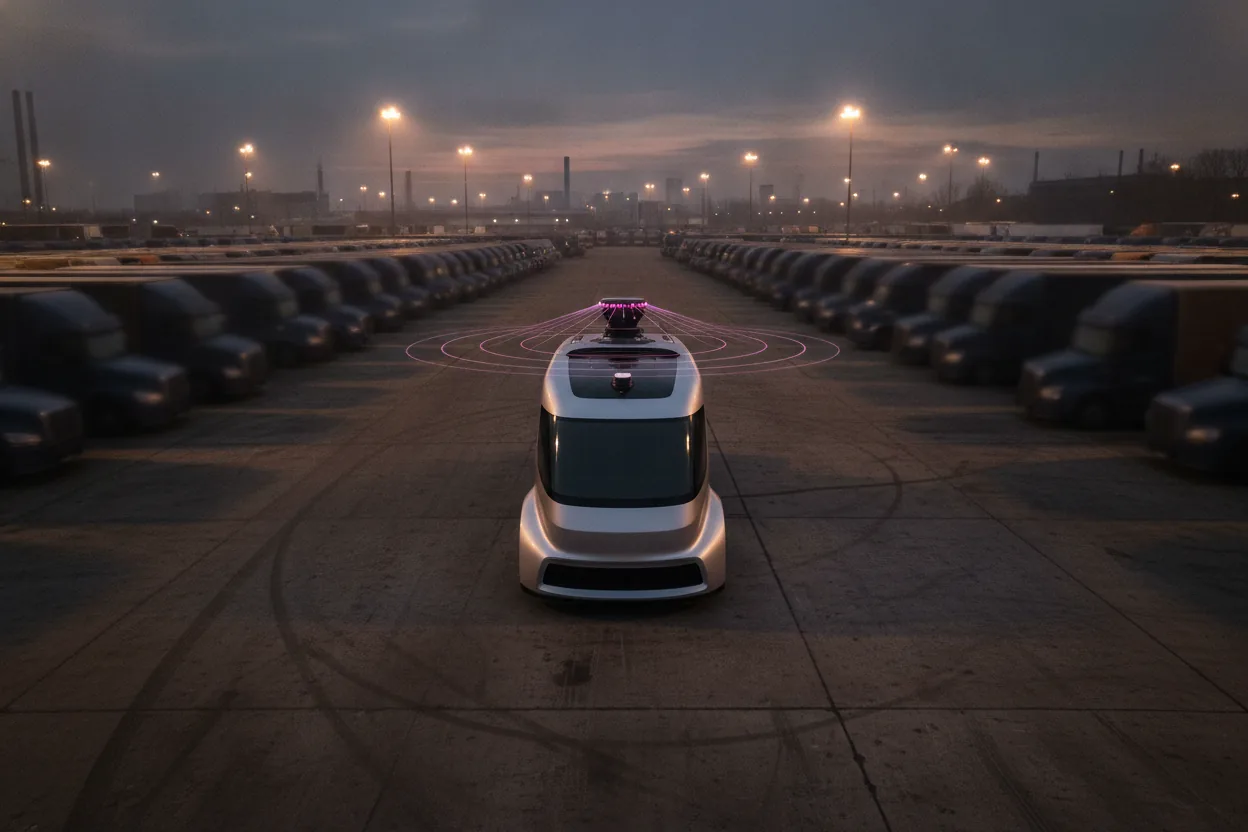
Innoviz Technologies just became the lidar backbone for a joint venture between Daimler Truck and Torc Robotics. Small deal, but it matters more than its size suggests, because the lidar sector, which had dozens of competing companies back in 2021, has thinned out considerably since then. Meanwhile the fund marketed to retail investors as autonomous vehicle exposure, DRIV, charges a 0.68% expense ratio while spreading money across more than 70 holdings. Nvidia alone often outweighs the entire lidar sub sector combined. The money in this ecosystem flows to compute and sensor suppliers sitting underneath the automakers, not to the car companies whose names end up on the vehicle. So why are retail investors still buying the chassis instead of the layer underneath it?
KPMG recently framed the autonomous vehicle ecosystem around four layers: compute, sensors, mapping, and software. Less a technology diagram, more a map of where margin actually sits in the EV adjacent economy. The money in autonomous vehicles isn't going to the car companies. It's going to the compute and sensor suppliers sitting underneath them, and the investment products built around AVs mostly miss this distinction entirely. The sections below work through that layer by layer: who captures margin, who survives on hardware alone, who owns the data, and what that means for the funds retail investors actually buy.
Compute Suppliers Capture Margin While Automakers Capture Headlines
DRIV Fund: Diversification on Paper, Concentration in Reality
Source: Article data on DRIV fund composition
Every AV partnership announced in the last eighteen months has the same shape. An automaker or robotaxi operator supplies the vehicle and the brand, and a chip company supplies the thing that actually makes autonomy possible. Nvidia's position in the Stellantis deal makes this clearest. Nvidia isn't just selling chips there. It's selling the entire Drive platform Stellantis needs just to attempt Level 4 ambitions by the end of this decade.
- Nvidia trades at a forward price to earnings multiple north of 30.
- Stellantis's market cap is considerably smaller than Nvidia's.
- Foxconn collects assembly margin rather than IP margin.
- Uber brings network and demand aggregation to the table, and that's exactly the kind of thing new entrants can replicate.
The retail investor instinct is to buy the car company because the car company's name is on the vehicle. But the margin structure of this ecosystem rewards whoever owns the compute layer, not whoever owns the chassis. The smartphone industry already taught anyone paying attention this lesson between 2010 and 2015, when component suppliers like Qualcomm quietly out-earned several of the handset makers running their chips. Compute and silicon suppliers capture the structural premium here. Automakers absorb the capital expenditure risk.
Lidar Economics Reward Specialization Over Vertical Integration
The Four Layer AV Ecosystem: Where Margin Actually Sits
Source: KPMG framework as described in article
If compute is the layer where suppliers capture margin by owning the platform, lidar is the layer that shows what happens without that kind of leverage. Innoviz Technologies winning the lidar contract for Daimler Truck and Torc Robotics is a small deal in dollar terms but a meaningful one structurally. Trucking is where autonomous vehicle economics make the most sense right now, because highway driving is a narrower, more predictable problem than urban robotaxi navigation, and the labor cost being displaced, long haul trucking wages, runs high enough to justify expensive sensor packages.
Lidar as a category has been brutal for investors over the past five years. Velodyne and Ouster merged in 2023 after both companies traded down more than 90% from their SPAC-era highs. Luminar Technologies spent 2025 and 2026 restructuring and cutting costs after a string of disappointing quarters, and its stock still sits at a fraction of its 2021 valuation. Against that backdrop, Innoviz landing a named role with an established truck manufacturer and a serious autonomy developer in Torc Robotics isn't a guarantee of profitability. But it's a sign that lidar consolidation is sorting winners from what was once a crowded field.
- Velodyne and Ouster merged after a market value collapse exceeding 90%.
- Luminar Technologies went through multiple restructuring rounds through 2025 and 2026.
- Torc Robotics operates as a Daimler Truck subsidiary focused on freight corridors.
- The lidar category was considerably more crowded at its 2021 peak than it is now.
Sensor hardware is a brutal, capital-destructive category unless a company secures a true commercial anchor customer, not a pilot program, not a letter of intent. Innoviz has that anchor now. Most of its former competitors don't.
Data Ownership Determines Future Pricing Power
Lidar Sector Carnage: Five Years of Investor Pain
Source: Article data on Velodyne, Ouster, and Luminar
An anchor contract explains why Innoviz survived where others didn't, but it doesn't explain who wins over the next decade. That answer depends on a layer KPMG's framework separates out from both compute and sensors: data. KPMG frames the AV partnership risk around protecting intellectual property and maintaining data accountability across joint ventures, and that's not a legal footnote. It's the actual battleground determining who extracts long-term value from this ecosystem. Every mile an autonomous vehicle drives generates perception and planning data that improves the underlying model, and whoever owns that data builds an advantage that's much harder to compete away than any single piece of hardware.
That's why the Waymo and Uber arrangement is structured so carefully around data sharing limits, and why automakers entering multi-party partnerships with chipmakers and mobility platforms increasingly negotiate hard over who keeps rights to the driving data their vehicles generate. A company that supplies hardware but hands over all data rights to its partner is, functionally, a contract manufacturer with extra steps. A company that keeps data rights while partnering for compute and distribution holds onto a long-term asset even if the partnership eventually falls apart.
- Waymo has logged tens of millions of fully autonomous miles as of 2026.
- Tesla leans on its owned fleet data as its primary argument against lidar-based competitors.
- Mobileye, spun out partially from Intel, licenses perception data and software rather than owning fleets.
- The four layers, compute, sensors, mapping, and software, each carry distinct data ownership dynamics.
Retail investors evaluating AV-adjacent stocks rarely ask the data ownership question, but it's the one that determines pricing power five years out. A supplier with proprietary data compounding in the background is a fundamentally different investment than a supplier selling a commodity sensor at a fixed margin.
ETF Exposure To Autonomous Vehicles Remains Diluted Positions
Compute suppliers capture margin, lidar suppliers need an anchor customer to survive, and data holders build an advantage that outlasts any single contract. None of this shows up in the products retail investors actually buy. There's no clean, pure-play autonomous vehicle ETF trading in the United States or Europe today. What exists instead are thematic funds like the Global X Autonomous and Electric Vehicles ETF, ticker DRIV, which blends AV technology exposure with broad EV manufacturing and battery supply chain holdings. That blending is the core design issue retail investors need to understand before putting money in.
DRIV holds more than 70 positions, and a meaningful share of assets sits in large, diversified technology and automotive names where autonomous vehicle revenue is a small fraction of total company revenue. Apple, Nvidia, and Tesla-style mega caps dominate weighting in most thematic EV and AV funds, which means an investor buying the theme is often buying the same handful of large companies they'd own anyway through a broad market index, with a thin layer of AV narrative on top.
- DRIV carries an expense ratio of roughly 0.68% annually.
- 70-plus holdings dilute any single AV winner to typically under 3% of fund weight.
- Innoviz, Luminar, and Mobileye often sit at a fraction of a percent of fund assets.
- Nvidia alone frequently outweighs the entire lidar sub sector combined.
The fee is a known, fixed cost. The commercialization timeline for robotaxis and autonomous trucking at real scale is not, and it's already slipped multiple times since 2018. An investor paying 68 basis points a year for a basket that's secretly 40% mega-cap technology exposure is paying an active-management-style fee for what functions as a closet index fund with an AV label stuck on it.
That's the answer to the question this post opened with. Retail investors keep buying the chassis instead of the layer underneath it because the available products are built to sell the chassis: a diversified fund with a recognizable automaker name attached is easier to market than a position in a compute platform or a data pipeline. Read the KPMG partnership map honestly and it's a warning against buying the ticker that sounds most like the future. Waymo isn't publicly traded. Innoviz is a small cap with real execution risk despite its new anchor contract. Nvidia is already priced for a dominant position across multiple industries, not just autonomous vehicles. The advantage in this ecosystem is going first to data holders and compute platform owners, second to specialized hardware survivors, and the diversified thematic funds sit somewhere further down the list, collecting a fee for exposure that was always going to be diluted by design.