Wildfire catastrophe bonds have been paying elevated annual coupons for a risk that insurance models priced near zero two decades ago. That gap isn't the market being generous. It's the clearest evidence we have that private insurers gave up trying to price wildfire risk altogether, choosing instead to exit entire counties and leave California's state backed insurer of last resort holding over $600 billion in exposure. Green finance narratives like to treat resilience spending, say, the sizable sum Butte County put into forest thinning, as something that should eventually lower premiums and stabilize property values. The data says otherwise. Insurers aren't consistently rewarding that spending, and that's the exact mechanism investors in cat bonds, insurance linked REITs, and resilience bonds are quietly betting will someday start working. So here's the question worth sitting with: if mitigation spending and insurance pricing have stopped talking to each other, what exactly are investors in these instruments being paid for?
The mechanics are blunt. Wildfire losses have climbed fast enough that insurers can't price the risk and still sell the product at a volume regulators or markets will tolerate. The OECD's recent work on wildfire risk financing lays out the core tension plainly: mandatory insurance requirements only reduce losses if paired with real investment in risk reduction, and attempts to cap premiums tend to push insurers out of a market rather than make coverage cheaper. The retreat of private insurance from wildfire zones isn't a temporary market hiccup. It's a repricing event, and repricing events create both exposure and opportunity for anyone holding real assets, REITs, or insurance linked securities in the affected geographies.
What Happens When Insurers Walk Away From A Market?
California's Insurer of Last Resort Now Holds Outsized Wildfire Risk
The Public Backstop Is Absorbing What Private Insurers Won't
FAIR Plan Total Exposure (2025)
$600B+
Growth Factor in Under a Decade
~4x
Combined 2024 to 2025 Insured Wildfire Losses vs Prior Decade
Exceeded Full Prior Decade in Several Regions
Source: Source: California FAIR Plan data, as cited in article
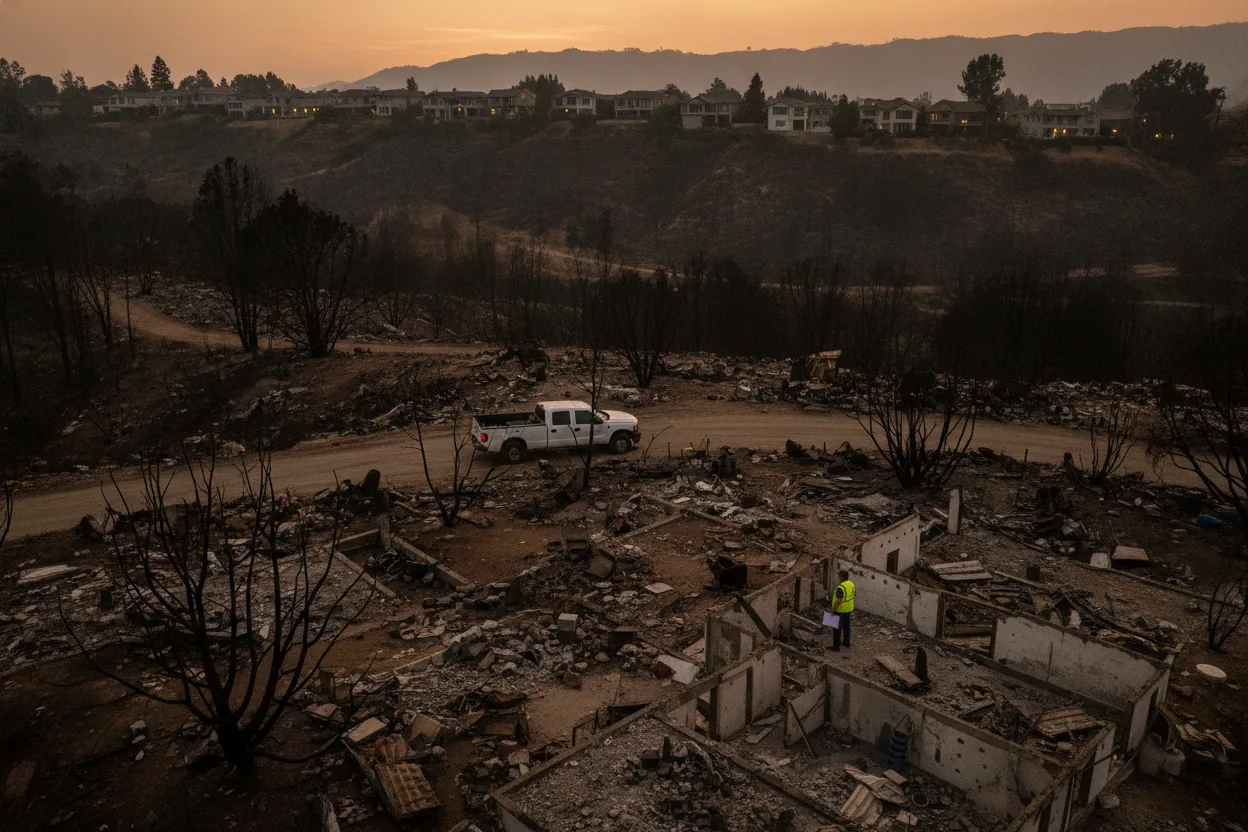
Paradise, California never got its insurance market back after the 2018 Camp Fire. Years later, large portions of that community remained uninsurable through standard carriers, pushed instead into the state's FAIR Plan, a residual market mechanism built as a last resort, not a functioning insurance product. The FAIR Plan's exposure in California ballooned past $600 billion in total insured value by 2025, roughly quadrupling in under a decade. That's not a healthy market absorbing risk. It's private capital refusing to hold risk it believes is mispriced relative to premium.
The pattern generalizes. In France, Spain, and parts of Greece, wildfire adjacent property markets are seeing similar dynamics play out through state backed reinsurance pools rather than FAIR Plan equivalents, but the underlying signal is the same. Swiss Re and Munich Re have both been explicit on investor calls that wildfire loss trends are now running ahead of actuarial models built even five years ago. Munich Re's 2025 natural catastrophe review flagged wildfire as one of the fastest growing loss categories globally, with insured wildfire losses in 2024 and 2025 combined exceeding the total for the entire previous decade in several regions.
For an investor, the relevant question isn't whether wildfires are getting worse. That's settled. The relevant question is who absorbs the gap between actual loss and insurable premium, and what that does to asset values in the meantime. When a carrier exits a county, property values there don't crash overnight, but the cost of financing, insuring, and eventually selling property there rises in ways that show up slowly, in cap rates, in mortgage underwriting standards. California's state backed insurer of last resort is now holding $600 billion in risk the private market wouldn't touch. That number is the clearest measure we have of how much risk has shifted from private carriers to the public backstop. The next question is how private capital markets are stepping in to take on pieces of that same risk directly.
How Do Investors Actually Get Exposure To This Risk?
FAIR Plan Exposure Has Quadrupled Over the Past Decade
Approximate total insured value held by California's residual market mechanism, illustrating the trajectory described in the article (not official year-by-year audited figures)
$150B
~2016
$225B
~2019
$375B
~2022
$600B+
2025
Source: Source: California FAIR Plan total insured value estimates, as cited in article
Catastrophe bonds are the cleanest instrument here, and wildfire specific cat bonds have grown from a niche corner of the roughly $61 billion global cat bond market into a recognizable subsector. These instruments let insurers and reinsurers transfer wildfire risk directly to capital markets investors, who collect a coupon, often running well into double digits annualized depending on attachment point, in exchange for taking first or second loss exposure if a qualifying wildfire event triggers payout. Pension funds and specialist cat bond funds like those run by Nephila or Fermat Capital have been active buyers, drawn to returns that move independently of equity markets.
The appeal is real. Cat bonds don't move with the S&P 500 or with interest rate cycles, which is exactly why institutional allocators have been increasing allocations since 2023. But the risk isn't abstract. A wildfire cat bond tied to California utility exposure, say, one linked to Pacific Gas & Electric's wildfire liability framework established after the 2019 bankruptcy filing, pays out based on specific trigger conditions tied to fire perimeter size, insured loss estimates, or utility equipment failure findings. Get the trigger wrong, or get caught by a single outsized season like 2025's early start to the California fire year, and the coupon disappears along with a meaningful chunk of principal.
- Catastrophe bonds with wildfire specific triggers and perimeter based payout structures
- Insurance linked REITs holding utility and property exposure in high risk wildland urban interface zones
- Reinsurer equity, such as Swiss Re or Munich Re shares, carrying diversified catastrophe exposure
- Specialty insurers like Kinsale or Palomar, which price nonstandard property risk directly instead of avoiding it
Each of these carries a different risk and return profile, but they share one structural feature worth sitting with. All of them are, in effect, bets on whether risk modeling catches up with climate reality faster than losses accumulate. Palomar Specialty, a US insurer that deliberately writes wildfire and earthquake exposure other carriers avoid, has grown its wildfire premium book by double digits annually since 2022, precisely because it believes its models price the risk better than legacy competitors. Whether that confidence is earned or just untested at scale is the open question every investor in this space is implicitly underwriting. And that same question, whether pricing models actually reflect risk reduction on the ground, is what determines whether mitigation spending ever pays off for the communities funding it.
Where Does Risk Reduction Spending Fit Into The Return Picture?
How Wildfire Risk Moves From Private Insurers to Public and Capital Markets
Step 1: Losses Outpace Actuarial Models
Wildfire losses climb faster than models built even 5 years ago
↓
Step 2: Private Insurers Exit Counties
Carriers refuse to hold risk mispriced relative to premium
↓
Step 3: Risk Shifts to State Backed Last Resort
California's FAIR Plan absorbs over $600 billion in exposure
↓
Step 4: Private Capital Re-enters via Securities
Cat bonds, insurance linked REITs, and resilience bonds price the same risk directly
Source: Source: Analysis based on article narrative, OECD wildfire risk financing commentary
Butte County, California has put meaningful state and federal grant funding into forest thinning, controlled burns, and defensible space programs in recent years. Insurers operating in that county still haven't uniformly reduced premiums or resumed normal underwriting. That gap is the single most important mechanic in this sector for investors to understand.
The OECD's framing is precise on this point. Risk based premiums are supposed to reward households and businesses that invest in mitigation, sending a price signal that drives capital toward defensible space clearing, fire resistant construction materials, and vegetation management. In practice, insurers in several markets aren't consistently reflecting mitigation investment in their pricing, and that breaks the feedback loop that's supposed to make risk reduction spending pay for itself. A homeowner spends on a fire resistant roof and defensible space clearing, sees no corresponding premium reduction, and the economic incentive to keep investing in mitigation weakens considerably, even though the physical risk has genuinely dropped.
This matters for anyone evaluating green bonds or resilience linked municipal debt tied to wildfire mitigation. Several California municipalities and utility districts have issued resilience bonds explicitly tied to funding vegetation management and grid hardening, with PG&E's wildfire mitigation capital expenditure representing a substantial cumulative spend since 2019. The bet embedded in these instruments is that mitigation spending eventually shows up as reduced loss frequency, which eventually shows up as insurer willingness to underwrite, which eventually shows up as stabilized or rising property values. That chain has several weak links. The OECD's own analysis suggests the second one, insurer responsiveness to mitigation, is the link most likely to break right now.
Investors underwriting resilience bonds or municipal wildfire mitigation debt are therefore making a judgment not just about whether the mitigation works physically, but about whether insurance markets will ever reward it financially within the bond's duration.
None of this makes wildfire related instruments uninvestable. It means their returns depend on a repricing process that's still incomplete, still contested between regulators and insurers, and still being tested one fire season at a time. The question posed at the start, what investors are actually being paid for, has a specific answer: they're being paid to hold the gap between physical risk reduction and insurer pricing until, or unless, that gap closes. Butte County's forest thinning hasn't moved its premiums yet. California's FAIR Plan is still holding over $600 billion that private insurers wouldn't touch. Until those two facts change, the elevated coupons on wildfire cat bonds aren't a reward for complexity. They're compensation for underwriting a repricing event that insurers themselves haven't finished pricing.