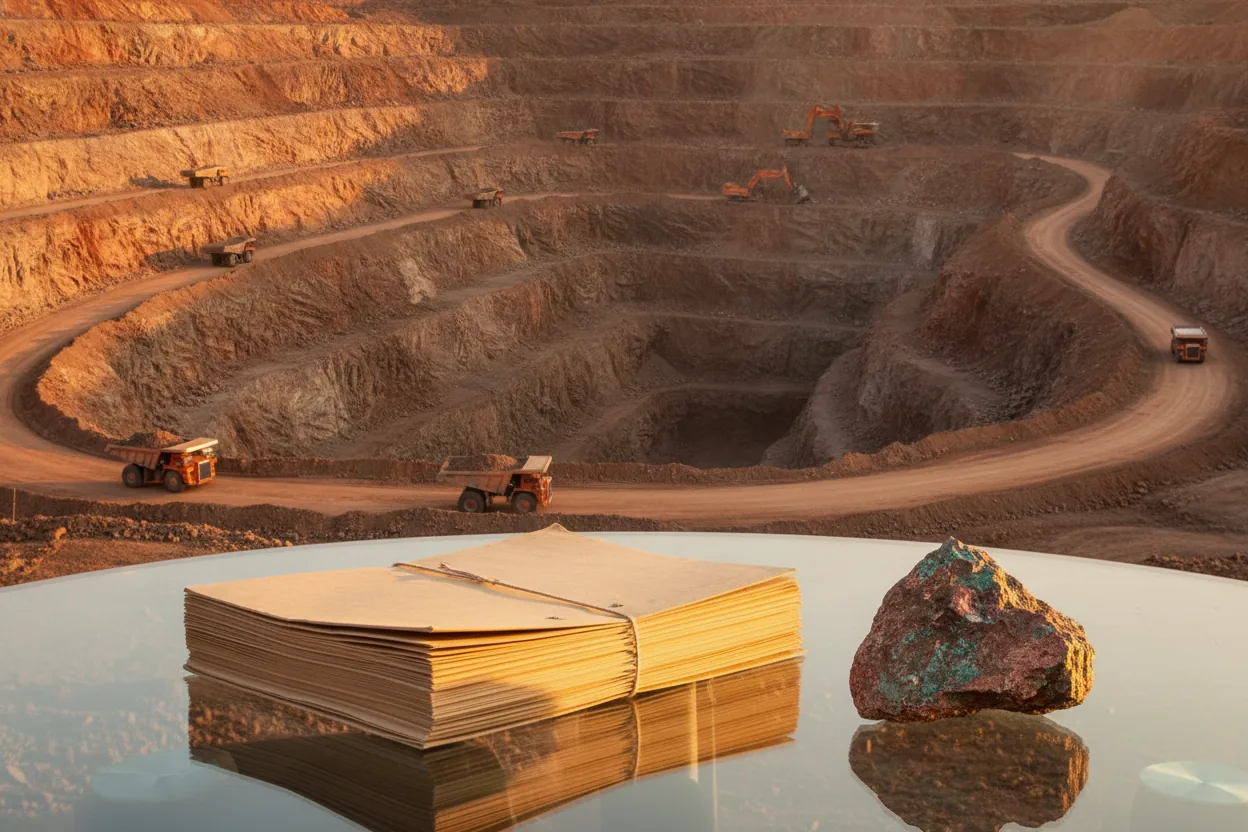
90% is the margin a royalty company can post financing the same ore body where the operating miner clears 50% on a good year. Retail investors are told buying miners gets them exposure to the copper and lithium the energy transition needs. What they actually get is a company that absorbs every diesel bill, labor dispute, and tailings cost before the royalty holder collects a dollar off the top, first in line, no shovel ever touched. That structural gap, and the fact that a royalty payment stays fixed even when a miner discovers three more veins on the same concession decades later, is why these firms trade at premium multiples the miners never see. The question is whether that premium buys clean transition-metals exposure or just a pricier way to own the same risk.
The clean energy transition needs copper, silver, lithium, and a long list of critical minerals at a scale the mining industry has never been asked to deliver before. Retail investors keep looking for exposure through miners and get geology risk, labor disputes, and diesel price spikes instead. Royalty and streaming companies solve a real structural problem in mining finance, and in solving it they built one of the more durable business models in the entire natural resources sector. The mechanics aren't new, but the metals they're now financing, copper for grid buildout, silver for solar panels, lithium for batteries, put this model squarely inside the eco investment conversation whether the label fits comfortably or not. The rest of this post works through what that premium actually buys, and what it doesn't.
See How a Royalty Actually Gets Paid
Margin Gap: Royalty Firms vs Operating Miners
Who Actually Captures the Profit Per Dollar of Revenue
|
Royalty / Streaming Firm 75 to 90% Margin, no operating costs |
Operating Miner ~50% Margin in a strong year |
The gap: Miners pay diesel, labor, and tailings costs before profit. Royalty holders take their cut off the top, first in line, no shovel touched.
Source: Article: 90% Margins: Why Royalty Firms Beat Miners in 2026's Metals Boom
A royalty or streaming deal starts with a mining company that needs capital before a mine produces a single ounce. Instead of issuing debt or diluting shareholders further, it sells a slice of future production, or a percentage of revenue, to a specialized finance company. That buyer never operates the mine, never touches a shovel, never absorbs a diesel bill. It just waits for the metal or the cash to show up.
- Franco Nevada built a portfolio spanning gold, silver, and energy assets across dozens of countries without operating a single mine directly.
- Wheaton Precious Metals structures stream agreements where it prepays a portion of a mine's development cost in exchange for a fixed percentage of future silver or gold output, often at a locked in price per ounce far below spot.
- Top tier royalty and streaming companies post margins in the 75 to 90% range, even in a strong commodity price environment.
- The best operating miners tend to post margins well below that, even in years when gold prices hit record highs.
- A stream deal can represent a modest share of a mine's equity value while still capturing a disproportionately large share of that mine's operating income, because the stream carries none of the miner's cost structure.
The gap between those margin ranges is the entire thesis. A miner pays for diesel, labor, tailings management, and equipment breakdowns before it sees a dollar of profit. A royalty holder skips all of it and takes its cut off the top. That asymmetry isn't a temporary market condition. It's a permanent feature of how the contracts are written, and it explains why royalty companies trade at premium multiples to the miners whose production backs them.
That margin gap explains why the royalty holder gets paid more per dollar of revenue. It doesn't explain how much revenue that royalty ends up covering over the life of a mine. That second question is where the model gets interesting.
Track Where the Free Upside Goes
How a Royalty Deal Gets Paid: From Capital to Cash
The Royalty and Streaming Mechanic
Step 1: Miner needs capital before a mine produces a single ounce
Step 2: Miner sells a slice of future production or revenue instead of issuing debt or diluting shares
Step 3: Royalty firm prepays part of development cost, locks in a fixed percentage or price per ounce
Step 4: Mine produces metal or cash, royalty firm collects its cut off the top, no operating costs absorbed
Step 5: Payment stays fixed even if the miner discovers new veins on the same concession decades later
Source: Article: 90% Margins: Why Royalty Firms Beat Miners in 2026's Metals Boom
The detail that gets underplayed in most retail coverage of this sector is what happens after the deal closes. A royalty or streaming payment gets fixed at the moment of signing, tied to a specific concession or area of interest. But mining exploration doesn't stop once the check clears. Miners keep drilling, keep expanding known deposits, keep finding new mineralization on the same land package for years or decades afterward.
- The royalty company typically pays zero additional dollars when a miner extends the life of a mine through further exploration on the same royalty area.
- Decades can pass between the original royalty agreement and new discoveries on the same concession, all captured under the original terms.
- Copper projects in particular tend to expand in scope over their lifecycle as electrification demand pulls more marginal ore into economic range, stretching royalty life without any renegotiation.
- Sandstorm Gold Royalties and other mid sized royalty firms have built entire growth narratives around exactly this dynamic: layering new royalty purchases on top of existing ones that keep expanding on their own.
This is the mechanism that turns a royalty portfolio into something close to a call option with no expiration and no additional premium. The investor who bought the royalty company's stock isn't just betting on the original mine plan. They're getting free lottery tickets on every future drill result the operating miner produces, funded entirely out of the miner's own exploration budget. A retail investor chasing lithium or copper miners directly is betting on exploration success and cost control at the same time. An investor in the royalty company holding a stream against that same deposit is betting on exploration success alone, none of the cost exposure attached. That's a materially different risk profile, and the market has historically priced it that way through higher multiples on royalty company earnings.
That pricing is the part worth sitting with. If the market has already built the margin advantage and the free optionality into the share price, the question isn't whether the model is good. It's whether an investor buying in today still gets paid for that advantage, or just hands the money back to the seller at the door. That's what the costs below need to answer.
Weigh the Real Costs Before Buying the Story
Cost Exposure: What Each Party Absorbs
Risk and Cost Comparison by Business Model
Source: Article: 90% Margins: Why Royalty Firms Beat Miners in 2026's Metals Boom
None of this makes royalty and streaming companies a clean substitute for direct ESG exposure to the energy transition, and the framing matters here. These companies finance gold and silver production just as often as copper or lithium, and gold mining carries its own environmental footprint that doesn't disappear because the balance sheet sits one layer removed from the pit. An investor buying Franco Nevada or Wheaton Precious Metals for critical minerals exposure has to actually check the portfolio composition, because gold and silver royalties often still dominate revenue even at companies expanding into battery and grid metals.
- Portfolio concentration in precious metals versus critical minerals varies a lot across royalty companies and shifts every year as new deals close.
- Counterparty risk is real. If the operating miner goes bankrupt or the mine floods, the royalty holder's claim on future production can be delayed or impaired, even though it never ran the mine.
- Premium valuations are the price of admission. Royalty companies routinely trade at higher price to cash flow multiples than the miners underlying their revenue, which means the market has already priced in much of the structural advantage described above.
- ESG scoring for royalty companies is inconsistent across rating providers. Some frameworks score the finance company on its own minimal footprint, others push through the environmental profile of the underlying mines, and you get very different answers depending on which one you're reading.
The honest way to frame this sector for a Long Buy reader isn't as a hidden shortcut around mining risk. It's a different allocation of the same risk, priced by a market that's had decades to figure out how much that difference is worth. A retail investor who understands the margin structure, the free optionality on exploration upside, and the counterparty exposure that remains even without operating control can evaluate these products on their actual mechanics rather than on the marketing pitch that royalty investing means clean exposure to the metals the energy transition needs. It rarely means that cleanly. What it does mean is a business model built to extract a specific, measurable premium from every dollar of capital a miner needs to bring a critical mineral project into production. That premium, already priced into the stock, is the real product being sold: not a shortcut around risk, but a different bill for the same risk, due at purchase instead of at the mine.