37.6%. That's how much collision repair costs can climb on vehicles loaded with sensors and driver assistance tech, and it's a number the EV growth story conveniently leaves out while touting fuel savings and lower maintenance. The clean transportation pitch sells falling battery costs, down from over $1,200 per kilowatt hour in 2010 to roughly $115 to $140 today, but insurers are quietly pricing a different reality into 2026 rate filings. If the manufacturing cost curve is improving while the ownership cost curve is worsening, which number is actually driving your ESG fund's returns?
An auto insurance trend piece about Nebraska hailstorms and Omaha traffic patterns doesn't sound like eco investing material. But strip away the local color and you find a mechanism that every EV investor, every battery supply chain analyst, and every ESG fund holding Tesla, Rivian, or BYD needs to understand: the total cost of ownership for electrified, sensor dense vehicles is quietly rising, and insurance premiums are the clearest signal of that shift showing up in real dollars. The clean transportation transition was sold on fuel savings and lower maintenance. The repair and insurance data tells a messier story, and it starts with the battery itself.
Why Repair Severity Is the Real Battery Story
The Hidden Repair Cost Spike
Source: Article: EV Sensors Are Quietly Driving Up Your Insurance Costs
Everyone watching the EV investment thesis fixates on battery cell costs, which have fallen dramatically, from over $1,200 per kilowatt hour in 2010 to somewhere in the $115 to $140 per kilowatt hour range in 2025 pack pricing, depending on chemistry and supplier. That decline is real and it matters. But falling production cost is only half the ownership equation. The other half is what happens after a moderate collision, and that number has been moving the wrong way.
A lithium ion battery pack doesn't need to be destroyed to become a total loss. In many documented insurance cases, even minor damage near the battery enclosure triggers a full pack replacement, because manufacturers and insurers can't easily verify the structural integrity of individual cells after impact. Estimates suggest replacement packs for mainstream EVs commonly run into the tens of thousands of dollars installed, with some luxury models reportedly costing even more, though exact figures vary widely by manufacturer and aren't consistently disclosed. A vehicle that cost $45,000 new can become uneconomical to repair after what would have been a fender bender on a gas powered car ten years ago. Nobody's saying abandon the EV thesis here. What this does is separate the manufacturing cost curve, which is genuinely improving, from the total cost of ownership curve, which insurers are now pricing more aggressively than automakers advertise. Tesla, Rivian, and Lucid rarely disclose average post collision battery replacement rates in investor materials. That silence tells you something on its own.
Verdict: the battery cost curve investors track on slide decks and the battery cost curve insurers price into premiums are diverging, and the gap between them is where undisclosed risk lives.
The Sensor Tax Nobody Priced Into the ETF
Battery Cost Curve: Falling Fast, Then Flattening
Source: Article: EV Sensors Are Quietly Driving Up Your Insurance Costs
The battery is only one part of what makes these vehicles expensive to fix. The other part sits in the sensor array wrapped around it, and it shows up in a very different corner of the portfolio. Clean energy and EV focused funds such as KARS, DRIV, and thematic sleeves inside broader ESG products like ICLN hold positions across automakers, sensor manufacturers, and battery suppliers simultaneously. That structure looks diversified. Really it's a bet that the entire sensor heavy vehicle architecture stays economically viable at scale, and the insurance data raises a real question about that assumption.
Consider the mechanics. A modern advanced driver assistance system relies on a network of components that must work in precise physical alignment:
- Forward facing radar units
- Windshield mounted cameras
- Ultrasonic parking sensors
- Lidar modules on higher trim levels
- Onboard calibration computers, which is where things get expensive fast
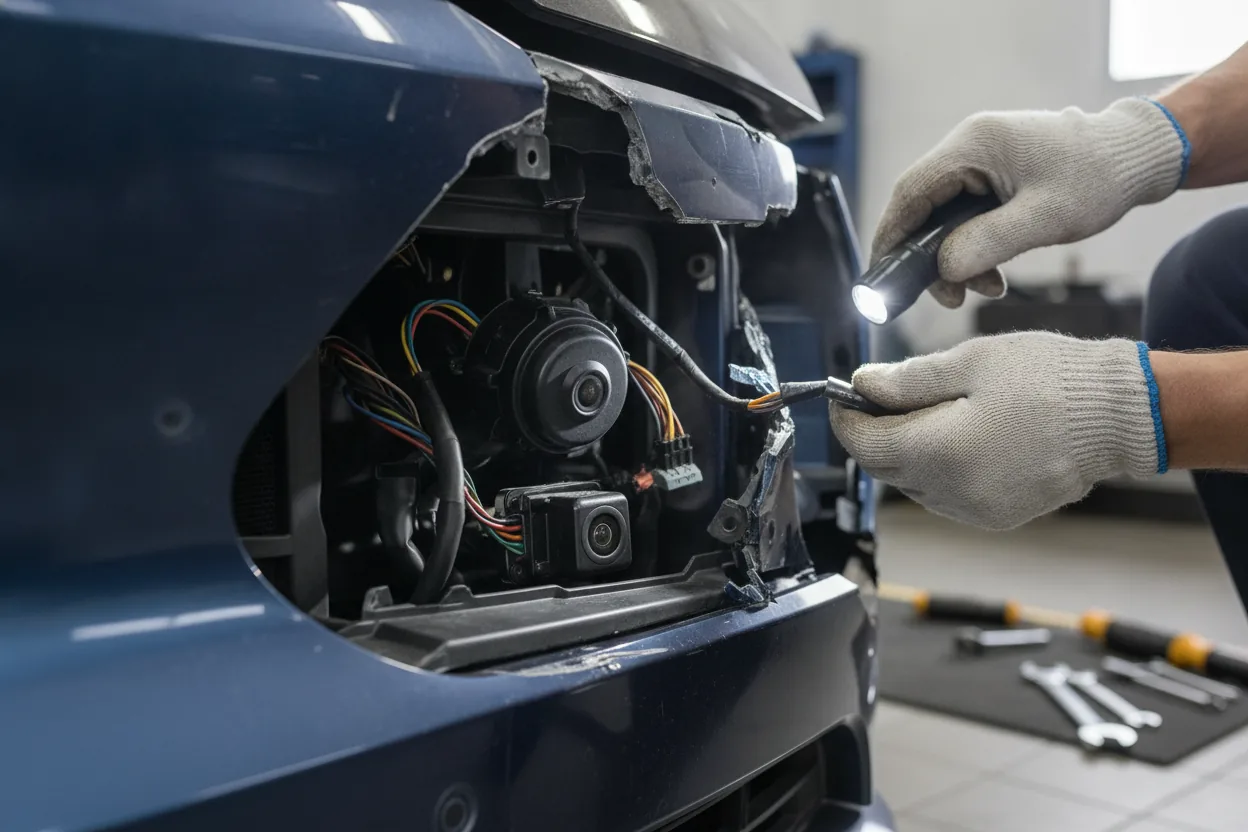
Replace a bumper on a vehicle with this architecture and you're not just swapping plastic. You're triggering a diagnostic and recalibration process that, according to some analysts and repair shop estimates, can add a meaningful multiple to what used to be a far simpler and cheaper repair, a pattern repair shops and insurers have been documenting consistently through 2025 and into 2026. Each of these components is a separate point of failure and a separate line item once a claim gets filed, which is why repair estimates have stopped resembling the simple parts and labor math of a decade ago.
That cost gets absorbed somewhere. Right now it's landing on insurance premiums, which is why loss cost data feeding into 2026 rate filings across the Midwest and elsewhere shows severity increases outpacing frequency decreases. Fewer accidents, but each one costs more to close. For automakers and suppliers, that's a demand signal dressed up as a cost problem: recalibration equipment, diagnostic software licensing, and certified repair networks are becoming a business line in their own right. Bosch, Continental, and Aptiv sit at the center of that shift, supplying the sensor and calibration hardware that both creates the repair complexity and profits from solving it.
Verdict: the sensor suppliers win regardless of what happens to insurance premiums, because they get paid on the way in during manufacturing and on the way out during repair. That makes them a more durable position than the automakers whose margins absorb the volatility in between.
Regional Risk Pricing Previews Climate Adjusted Underwriting
How a Minor Collision Becomes a Battery Total Loss
Source: Article: EV Sensors Are Quietly Driving Up Your Insurance Costs
Sensor repair costs explain why claims are more expensive nationwide. Regional weather patterns explain why some states feel that expense far sooner than others. The focus on Nebraska hail damage is a small case study in something much larger: property and casualty insurers are recalibrating regional risk models faster than most retail investors are tracking, and vehicle sensor density is now a variable in that recalibration alongside weather severity. Hail belts across Nebraska, Kansas, and Texas have always produced higher comprehensive claims. What's changed is that hail damage on a sensor equipped windshield now carries a calibration bill on top of the glass replacement, compounding a weather risk that climate models already show intensifying in frequency across the central United States.
This matters for ESG and climate risk investors because auto insurance underwriting is one of the most responsive, high frequency signals of climate adjusted pricing anywhere in financial markets. Property insurers pull back from coastal Florida or wildfire zones in California over years. Auto insurers reprice hail risk in a single annual filing cycle. Watching how Progressive, State Farm, and regional Midwest mutual insurers adjust comprehensive coverage pricing in hail prone states gives investors a faster read on climate risk repricing than waiting for reinsurance renewal season.
There's a second order effect worth naming directly, and it hasn't been verified with a hard industry wide figure, so treat this as an observed tendency rather than a statistic: anecdotal reporting from repair networks suggests hail damage claims on ADAS equipped vehicles are taking longer to close, because certified calibration capacity hasn't scaled as fast as sensor equipped vehicle fleets have grown. If that bottleneck is real and persistent, it becomes a structural cost embedded in loss ratios for years, not a one time adjustment.
Verdict: auto insurance repricing is the fastest available proxy for climate risk repricing in the entire financial system. Investors who ignore it in favor of slower moving property insurance signals are missing the leading indicator, not the lagging one.
What Insurance Data Reveals About Ownership Cost Models
Battery replacement costs, sensor repair complexity, and regional climate exposure aren't three separate stories. They're three inputs feeding the same total cost of ownership model, and that model is the one clean transportation forecasts have gotten wrong. Every EV adoption forecast used by clean energy funds and automaker investor decks assumes a total cost of ownership advantage over internal combustion vehicles, built on fuel savings and reduced maintenance. Insurance has historically been treated as a minor line item in those models. That assumption is aging badly in real time, and it deserves the same scrutiny investors apply to battery degradation curves or charging infrastructure buildout timelines.
Data from insurance rate filings in 2025 and 2026 shows comprehensive and collision premiums on EVs running meaningfully higher than comparable gas vehicles in several state markets, a gap driven directly by the repair severity and calibration cost dynamics described above. Some of that gap will narrow as certified repair networks scale and calibration becomes standardized rather than manufacturer specific. Some of it won't, because sensor heavy architecture is a permanent design choice, not a temporary transition cost.
Insurance cost trends function as an early warning system for adoption friction that consumer surveys and sales data won't capture for another year or two. A consumer who discovers their EV insurance premium runs notably higher than their previous gas vehicle's premium is a consumer whose total cost of ownership math just got worse, quietly, without a single headline about slowing EV sales.
Verdict: the green transition in personal transportation is real, the cost curve on manufacturing is real, and the insurance cost curve moving in the opposite direction is just as real. The honest total cost of ownership picture sits somewhere between the optimistic automaker slide and the alarmed insurance rate filing, and nobody selling either document has an incentive to show you that midpoint. The 37.6% repair severity increase this piece opened with isn't a footnote to the EV growth story. It's the missing half of it, and the fund manager who can't cite their own portfolio's exposure to that number hasn't finished the math.