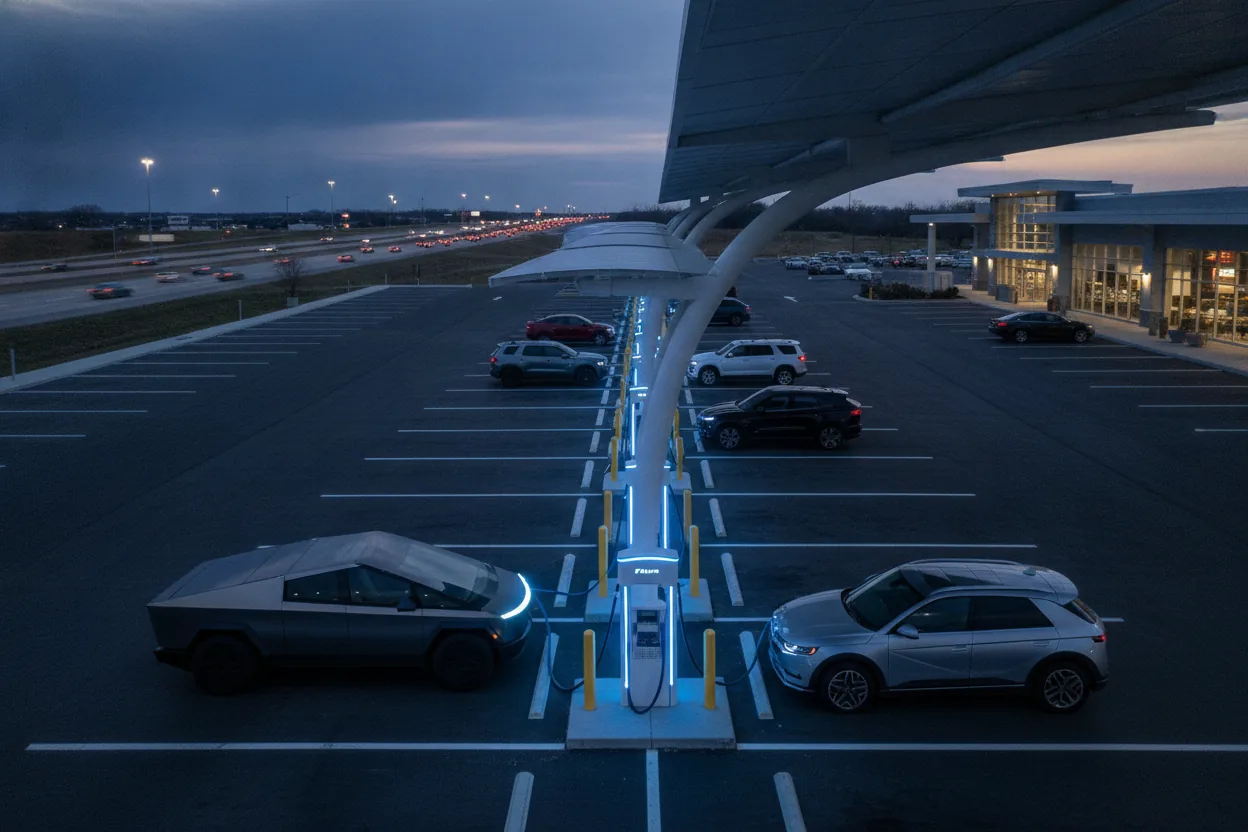
Pilot Flying J's coast-to-coast fast-charging network
Range anxiety has been the single most cited reason drivers delay switching to an EV. The question worth asking right now is whether Pilot Flying J's highway fast-charging network, which has crossed 300 locations across 44 U.S. states with chargers rated at up to 350 kW, finally makes that concern obsolete.
- The network has crossed 300 charging locations, all positioned along interstate and major highway routes for long-distance travel coverage
- Pilot Flying J travel centers span 44 U.S. states plus Canadian provinces, giving the network one of the broadest geographic footprints of any single operator
- Chargers are rated at 350 kW, fast enough to add significant range in the 20-30 minute window a driver typically spends at a travel center stop. That's not a coincidence. It's the whole design.
- The company has partnered with General Motors and other automakers for direct charging access integration into vehicle navigation systems
- Pilot Flying J's travel centers see over 1.4 million customer visits per day across the network, which means the built-in user base for charging services is already enormous
Putting fast chargers at highway travel centers rather than standalone charging plazas is just smart design. Drivers combine a natural rest stop with a charging session, the perceived wait shrinks, and range anxiety stops being the dealbreaker it once was. For EV owners outside dense urban areas where home charging is easy and abundant, a highway-anchored network like this directly expands where electric driving is actually practical. There's now a physical network with genuine highway reach. That's the most concrete argument against range anxiety the market has produced to date.
Why the 300-location milestone matters right now
That highway-anchored footprint hit a verified threshold in July 2026, and the timing matters beyond the round number. Pilot Flying J's confirmed crossing of the 300-location mark has drawn serious attention from the EV infrastructure sector, arriving alongside a broader set of industry moves that are reshaping how drivers think about long-distance electric travel. The milestone lands precisely when vehicle-to-grid and vehicle-to-everything (V2X) technology is accelerating: Hyundai's simultaneous unveiling of its AllDayEnergy global V2X energy service signals that automakers are now building grid-interactive features into vehicles designed to use exactly this kind of fast-charging infrastructure. Both sides of the equation are maturing at once, which doesn't happen often.
- Pilot Flying J's expansion has been tracked and confirmed by electrive.com, energytech.com, and Electric Cars Report in July 2026, establishing the 300-location count as a verified network milestone
- Hyundai's AllDayEnergy V2X service, announced the same week, allows compatible vehicles to draw from and return energy to the grid, adding a sustainability dimension to fast-charging stops that goes well beyond simple range replenishment
- The U.S. Department of Energy's National Electric Vehicle Infrastructure (NEVI) program has designated highway corridors as priority buildout zones, and Pilot Flying J's footprint lines up directly with those federally mapped corridors
- Competing networks including Tesla Supercharger and Electrify America have both faced reliability and expansion challenges through 2025 and 2026, making Pilot Flying J's steady physical-location growth a notable contrast
- Long-haul trucking electrification is accelerating in parallel, with Class 8 electric trucks from Freightliner and Kenworth now requiring the high-power charging infrastructure that Pilot Flying J's 350 kW stations can actually deliver
A verified 300-location network, V2X-capable vehicles entering the mainstream market, and active federal corridor mapping converging in the same month makes July 2026 a real inflection point for highway EV charging in North America. Range anxiety was the practical objection. Pilot Flying J's milestone, backed by federal corridor alignment and automaker integration, is the practical answer. For individual drivers and fleet operators alike, the decision to go electric is no longer a question of feasibility. It's a question of preference.