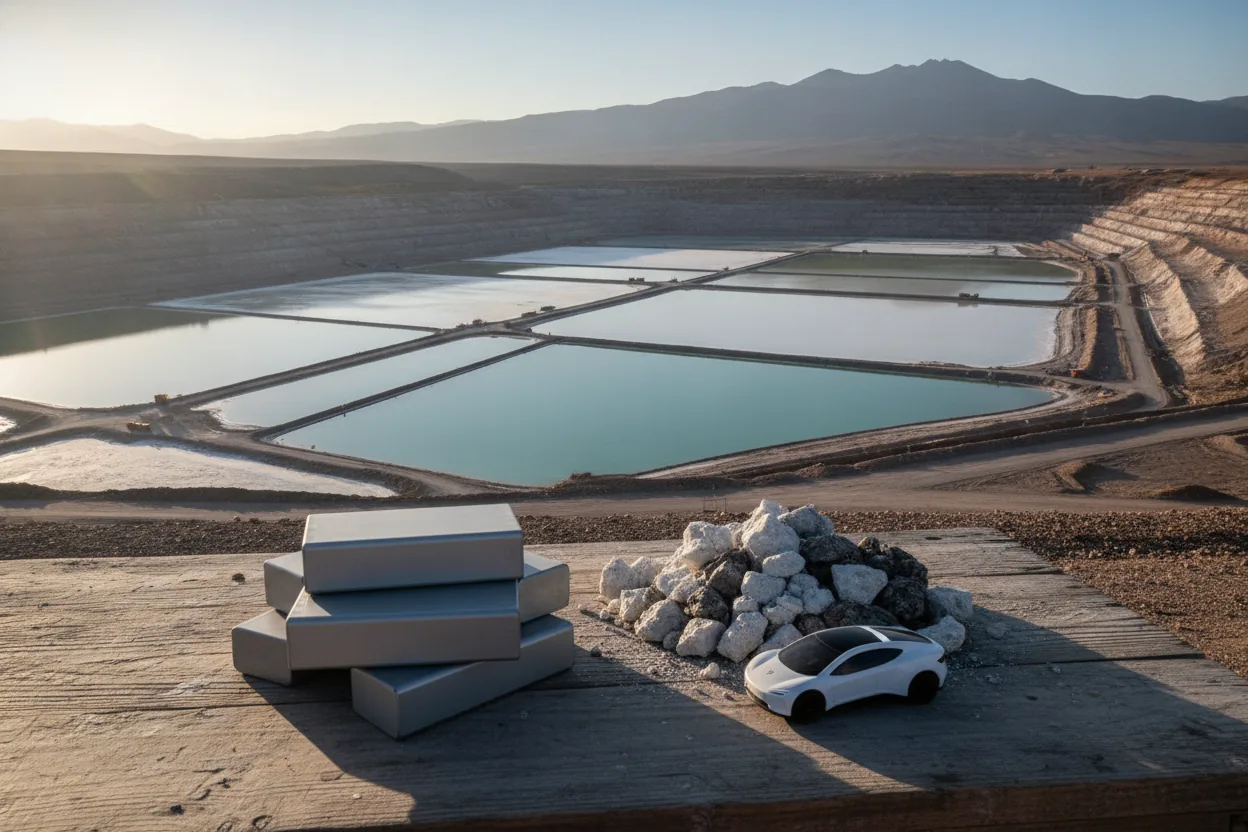
Albemarle traded well below current levels in early 2025 and has climbed substantially since, a run built entirely on the word deficit. The Global X Lithium ETF that investors buy for pure commodity exposure holds Tesla, Panasonic, and Samsung SDI alongside the miners, so the ticker promises lithium while the wrapper delivers a diversified EV bet. The deficit story is credible. Whether the vehicle you buy to trade it actually gives you that deficit, or something else wearing the same label, is the question that matters.
That pitch isn't fiction. But the mechanics behind it are shakier than the headline suggests. A commodity swinging from glut to shortage doesn't automatically turn the equity exposure to that commodity into a clean trade. It turns it into a leveraged bet on a chain of assumptions, several of which have already broken once this decade.
Lithium demand growth is real and durable. The stock vehicles investors use to access it carry structural risks that have nothing to do with how many batteries get built, though. Figuring out where the deficit story ends and the financial engineering begins is the clearest edge retail investors have in this sector right now.
Where the 2026 Deficit Numbers Actually Come From
Global X Lithium ETF: What the Ticker Actually Holds
Pure Lithium Exposure vs. Actual ETF Composition
What Investors Expect
Lithium Miners
SQM, Albemarle, pure commodity plays
What the ETF Delivers
EV Bet
Tesla, Panasonic, Samsung SDI mixed in
Result: the ticker promises commodity exposure but the wrapper delivers a diversified EV industry bet.
Source: Article analysis, Global X Lithium ETF holdings description
Sociedad Química y Minera, the Chilean producer known as SQM, has been explicit about its 2026 positioning. Management expects demand to outpace supply over the long term and has spent the past two years expanding production capacity in the Salar de Atacama specifically to capture share once that tightening arrives. Albemarle, the North Carolina based giant with operations spanning Nevada's Silver Peak to Western Australia's Greenbushes, tells a similar story: long term demand driven by stationary storage and EV adoption, with continued investment in early stage projects to meet volume growth analysts expect later this decade.
The supply side math is less speculative than it sounds. Lithium prices fell sharply from their 2022 peak to a much lower level by mid 2024, a decline steep enough to force marginal producers in Australia and Africa to idle capacity or delay expansions outright. That kind of price collapse tends to produce the same outcome eventually: it removes supply that was only ever economic at higher prices, which sets up the next tightening cycle almost mechanically.
Harder to verify, and worth flagging rather than papering over, is the precise size of the 2026 deficit itself. Different analyst shops produce different tonnage gaps depending on assumptions about Chinese EV penetration, battery energy storage system buildout, and how quickly idled Australian spodumene mines restart once prices recover. Treat the deficit as a directional pattern, confirmed by capacity discipline across the industry, rather than a single hard number anyone should trade around.
The direction is credible. The magnitude is a forecasting exercise dressed up as a fact. That distinction matters because the next question is where the demand side of that forecast is actually coming from, and the answer has changed since the last price cycle.
Battery Storage Has Rewritten the Demand Equation
How the 2026 Lithium Deficit Sets Up Mechanically
From 2022 Price Peak to 2026 Supply Squeeze
Step 1: 2022 Peak
Lithium prices hit cycle high
Step 2: Mid 2024
Sharp price collapse to much lower levels
Step 3: Capacity Idled
Marginal Australian and African producers delay or idle supply
Step 4: Producers Expand
SQM and Albemarle invest to capture future share
Step 5: 2026 Deficit
Demand outpaces supply, tightening cycle begins
Source: Article analysis of supply side price collapse and recovery cycle
A grid scale battery storage facility in Texas's ERCOT market doesn't care about range anxiety, charging infrastructure, or Tesla's quarterly delivery numbers. It cares about arbitraging power prices between peak and off peak hours, and that use case has become a lithium demand driver in its own right, separate from the EV narrative that dominated the last cycle.
Stationary storage, abbreviated BESS in the industry, now represents a demand pool that doesn't rise and fall with Chinese consumer sentiment or U.S. EV tax credit politics. Utilities procuring storage capacity sign multi year contracts tied to grid reliability mandates, not consumer purchase decisions. That matters because the 2024 to 2025 demand scare in lithium markets was almost entirely an EV story: slower than expected EV adoption in the U.S., price wars in China, and automakers like Ford and GM scaling back EV production targets. BESS demand kept growing through that entire period.
Lithium demand has partially decoupled from EV sentiment. That's the single biggest structural change in this market since the 2022 price spike, and investors pricing lithium stocks purely as an EV proxy are working from an outdated model.
That improved demand picture doesn't automatically pass through to the stocks investors actually buy, though. The next problem isn't supply or demand at all. It's how the equity vehicles themselves are built.
The ETF Wrapper Tells a Different Story Than the Ticker
EV Demand vs. Battery Storage Demand: Two Different Drivers
Why the 2026 Story Differs From the Last Cycle
| Dimension | EV Demand (Last Cycle) | Battery Storage (BESS) |
|---|---|---|
| Driven By | Consumer purchase decisions | Grid reliability mandates |
| Contract Type | Retail sales, subject to incentives | Multi year utility contracts |
| Key Risk Factor | Chinese price wars, U.S. tax credit politics | Largely insulated from consumer sentiment |
| 2024 to 2025 Demand Scare | Almost entirely responsible | Largely unaffected |
Source: Article analysis of EV versus BESS demand dynamics
The Global X Lithium and Battery Tech ETF, ticker LIT, holds roughly 40 names and charges an expense ratio near 75 basis points. That sounds reasonable until you notice what sits inside the wrapper: alongside pure lithium miners like Albemarle and SQM, the fund holds Tesla, Panasonic, and Samsung SDI at meaningful weights. An investor buying LIT expecting concentrated lithium exposure is actually buying a diversified bet on battery supply chains and EV manufacturers, with commodity producers as a minority of the actual weighting.
This isn't a flaw unique to LIT. It's how thematic ETFs get built across clean energy investing generally: a fund manufacturer assembles a basket broad enough to be marketable and liquid, names it after the theme currently generating search traffic, and collects fees on assets that may only partially reflect the pure play exposure the name implies. You're paying the fee for the story, not strictly for the commodity.
Direct equity exposure through Albemarle or SQM avoids the dilution problem but introduces single company risk that a basket is specifically designed to smooth over. Albemarle's balance sheet carried meaningful net debt through the 2023 to 2024 price collapse, and the company issued mandatory convertible preferred shares in 2024 to shore up liquidity, a move that diluted existing shareholders while the stock was trading well below its highs. That's not a company failing. That's a company behaving the way commodity producers behave in a cyclical trough, and it's the risk investors accept in exchange for full exposure to the recovery.
Neither structure is wrong. Both extract a cost, just different kinds, and recognizing which cost applies to which vehicle is the actual decision an investor makes when they click buy. Both of those structures, basket and single stock, get priced by investors reading Chinese demand signals from outside the market that actually sets them. That outside variable is the next piece of the puzzle.
Chinese EV Policy Is the Variable No Brokerage Account Can Hedge
BYD sold more fully electric vehicles globally than Tesla did across several quarters in 2024 and 2025, and Chinese EV penetration now exceeds 50% of new car sales in some monthly readings, according to the China Passenger Car Association. That single market drives a disproportionate share of global lithium demand, which means the 2026 deficit forecasts are really a bet on Beijing's industrial policy continuing uninterrupted.
Weaker U.S. EV sales encouraging automakers to discontinue models would tighten the demand picture further, not loosen it, because American manufacturers pulling back simply shifts the center of gravity toward China even more completely. Sit with that for a second, it's counterintuitive. A retreat in U.S. EV demand doesn't necessarily hurt lithium stocks. It can concentrate the trade's dependency on a single geography that retail investors have no visibility into and no ability to hedge through normal brokerage accounts.
Chinese lithium carbonate futures trading on the Guangzhou Futures Exchange already function as the de facto global price benchmark, so pricing power for a commodity mined in Chile, Australia, and Nevada increasingly gets set by sentiment in a market most retail investors cannot directly access. Price discovery happening somewhere you can't trade isn't a new problem in commodities. Oil benchmarks have lived with this dynamic for decades. It's a newer wrinkle for a sector marketed primarily on the strength of the Western energy transition narrative.
The deficit thesis for 2026 is only as durable as policy continuity in a market where Western investors are reading the outcome from outside the room. That dependency is also why the stocks have already moved so far ahead of confirmed data, which is the final piece of this picture.
The Recovery Trade Is Pricing Certainty It Hasn't Earned
Lithium equities in late 2025 and into 2026 have rallied well ahead of any confirmed physical deficit, which is standard behavior for cyclical commodity stocks. Markets price the turn before it shows up in quarterly shipment data, and investors buying Albemarle or SQM today aren't buying today's earnings. They're buying the expectation of 2026 and 2027 earnings that depend on price recovery actually materializing on the timeline analysts expect.
A few things could delay that timeline beyond what current enthusiasm assumes. Idled Australian spodumene capacity could restart faster than expected once prices tick up. Chinese lepidolite production, long considered a higher cost marginal source, could prove more resilient than modeled. U.S. tariff and EV credit policy shifts could reduce North American demand growth, and BESS procurement could slow if utility capital budgets tighten under higher interest rates.
None of this represents a collapse scenario. It represents the normal friction of a commodity recovery that the market has already started pricing as a sure thing. The gap between a probable recovery and a guaranteed one is exactly where lithium equities tend to overshoot in both directions, first down in 2023 and 2024, now potentially up into 2026.
Lithium demand fundamentals have genuinely improved, and the stationary storage story gives the sector a second growth engine that didn't exist at the same scale during the last cycle. That part of the pitch holds up. The leap from a credible deficit to a clean trade doesn't. The deficit, if it arrives on schedule, gets captured unevenly by producers, diluted inside ETF baskets carrying unrelated holdings, and filtered through a Chinese pricing mechanism that retail investors read about rather than participate in directly. The ticker and the wrapper aren't telling the same story, and the investor who buys Albemarle expecting a pure deficit trade is taking on single company and geopolitical risk that the LIT ETF buyer doesn't see either, just priced differently. Knowing which risk you're actually holding, not whether the deficit is real, is what separates a position from a bet in this sector going into 2026.