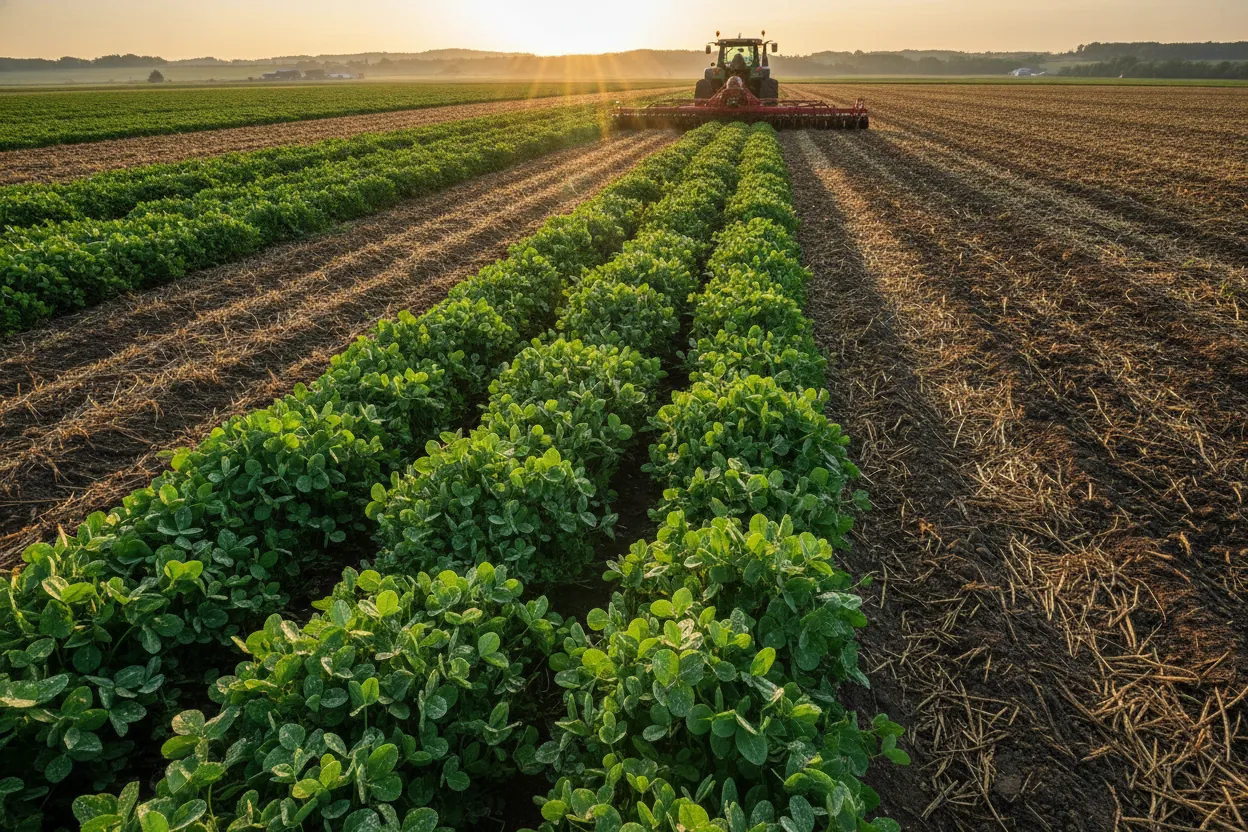
What Changes in the Soil When Farming Goes Regenerative
Buying food labeled "regenerative" feels like a meaningful choice. But does it actually pull carbon out of the atmosphere, or is the word just doing marketing work? A study in the journal Nature found that if 75% of the world's farmland switched to regenerative practices, global greenhouse gas emissions could drop by up to 23.2 billion tons per year. That's a big enough number to make a grocery run feel like it matters beyond your own health, but only if "regenerative" on a label actually means no-till, cover cropping, or rotational grazing, and not just a word someone in marketing liked.
- No-till farming skips the plow, which keeps organic matter intact and avoids the CO2 release that happens when buried carbon suddenly meets oxygen.
- Cover cropping plants legumes and other species between main growing seasons. They fix nitrogen, hold topsoil in place, and keep adding organic matter instead of leaving fields bare.
- Regenerative grazing moves herds the way wild animals once moved across land, which pushes grasses to grow more diverse and root systems to dig deeper, carrying carbon down with them.
- Agroforestry mixes trees into cropland, so carbon ends up stored both underground and in the wood itself.
- The Rodale Institute found that if the world adopted regenerative practices broadly, they could sequester more than 100% of current annual CO2 emissions, which is a genuinely startling claim once you sit with it.
None of these practices need the others to work. Farmers rarely stick to just one, though, so the real question is what happens once you stack them.
Combining Practices Multiplies the Carbon Effect
A 2023 study in Frontiers in Sustainable Food Systems tested seven regenerative practices and found that stacking them beats any single method for belowground carbon storage. On arable land, pairing cover crops with no-till increased belowground carbon more than either practice alone. The same pairing worked on woody perennial land too, and pushed the numbers even higher there. The logic makes sense once you see it: no-till protects the carbon already locked in the soil, while cover crops keep adding new organic matter on top of it. The two effects stack instead of competing for credit.
- Belowground carbon storage rose when farmers combined cover crops and no-till on arable land, based on the study's findings.
- Woody perennial land saw an even bigger gain from that same pairing, though I can't confirm the exact margin over the arable number.
- Planting two cover crops together, one legume and one non-legume, added further gains on arable land in the same study.
- The European Union has set 2030 soil health targets, with soil organic carbon sequestration as one of the benchmarks it's tracking.
- The Journal of Soil and Water Conservation found that farmers using regenerative practices sequestered 2.2 times more carbon than conventional farmers did.
These numbers only matter at scale. The question this post opened with, whether a grocery choice can actually move anything, comes down to how much farmland adopts these combined methods and whether a shopper standing in a store can even tell.
Does Choosing Regenerative Food Actually Move the Needle
Buying from farms and brands that disclose no-till or cover-crop practices funds the exact mechanisms above: protected organic matter, year-round root systems, less CO2 escaping from disturbed soil. That 23.2 billion ton figure from Nature only becomes real person by person if buyers can actually tell which products come from farms doing this work.
- 23.2 billion tons is the potential annual emissions cut if 75% of global farmland went regenerative, per Nature.
- USDA research found that reducing tillage on US cropland lowers soil erosion and increases carbon retention, something you can actually look for on a label or a farm's website.
- 2.2x is the sequestration multiplier regenerative farms hit over conventional ones in the Journal of Soil and Water Conservation study, and it's worth holding any "regenerative" claim up against that number.
- Force of Nature and similar suppliers now publish sourcing data tied to specific practices instead of vague sustainability language, which is the direction this whole label needs to go.
- Ask about legume cover crops specifically. They fix nitrogen and build organic matter faster than non-legume varieties on their own.
Choosing regenerative-sourced food won't single-handedly fix atmospheric carbon. It funds the specific soil mechanisms, undisturbed organic matter, deeper root systems, diverse grazing, that produce the 2.2x sequestration figure above. So the answer to the question this post opened with is narrow, not sweeping: one grocery choice doesn't move the needle by itself, but it supports the methods that would move it if adopted at the scale Nature describes. The useful move is asking suppliers directly which of the three practices, no-till, cover cropping, or rotational grazing, they actually use. The word "regenerative" by itself tells you almost nothing about real sequestration rates.