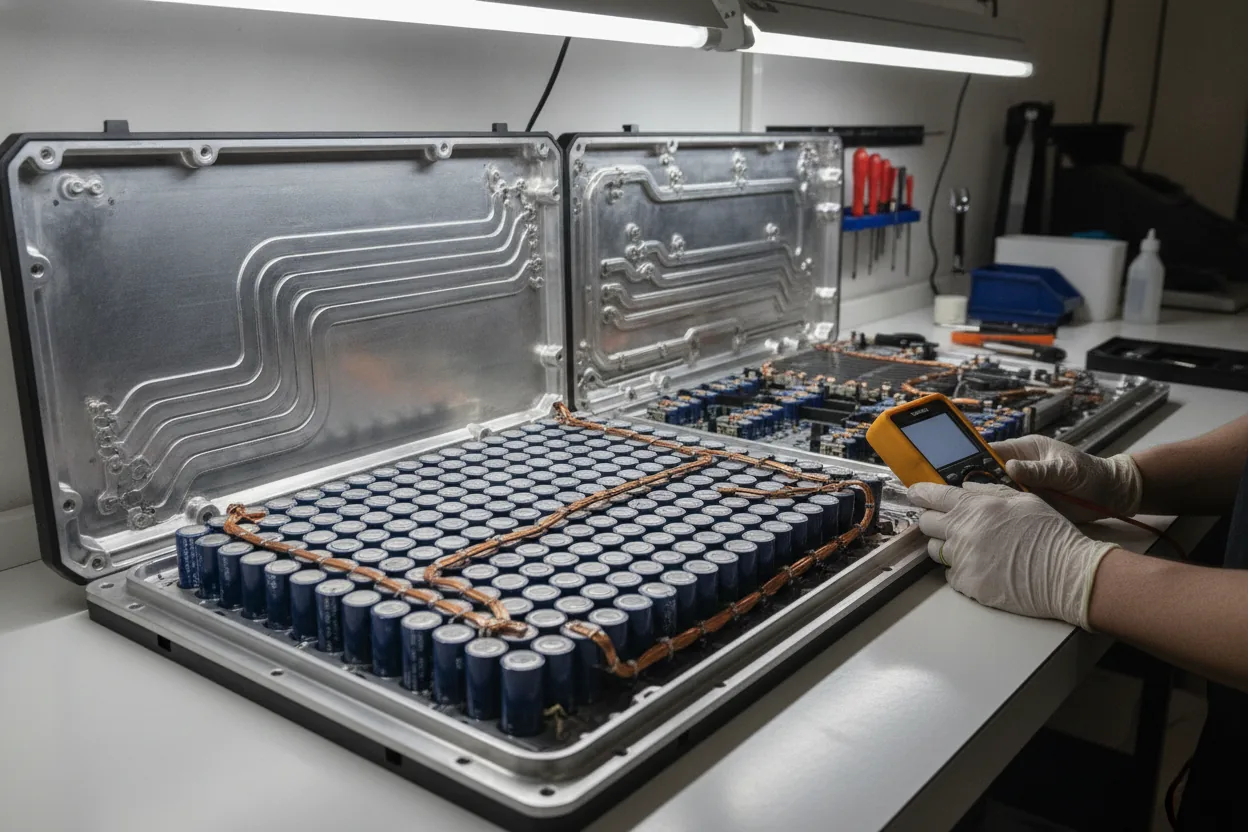
EV battery warranties protect against capacity loss past a specific threshold
Say your range has dropped noticeably after a few years. Is that covered? Most coverage of EV battery warranties skips the actual number: Tesla and Volkswagen only replace a pack once it falls below 70% of its original capacity, and Nissan replaces Leaf packs once they drop under 75% capacity, no matter how much range a driver feels they've already lost. That gap between what an owner notices and what a manufacturer will actually pay to fix is what determines whether a used or aging EV still has real protection left.
- Tesla replaces battery packs that fall below 70% of original capacity while under warranty.
- Volkswagen applies the same 70% threshold to the ID.4.
- Nissan sets the bar a bit higher for the Leaf, replacing packs once they drop under 75% capacity.
- 8 years or 100,000 miles is the federal minimum coverage window for traction batteries in the United States.
- State of health (SOH) is the metric manufacturers use to measure remaining capacity against the original rating.
Normal, gradual degradation that stays above the threshold isn't covered, even if a driver notices reduced range year over year. What counts as "noticeably worse" to an owner and what counts as "warranty-eligible" to a manufacturer are two different lines. So who sets that line, and is it changing?
How California's 2026 rule changes the minimum capacity a battery must retain
The federal floor above isn't the only standard in play. Starting with the 2026 model year, California requires EV batteries to retain at least 70% of their range for 10 years or 150,000 miles, tighter than the federal floor most automakers have used until now. Models from 2026 onward must be designed to hold at least 80% capacity across that same window. CARB has set precedents before that other states eventually adopted, so this threshold could end up as the wider baseline rather than a regional exception.
- 70% for 10 years or 150,000 miles is the new CARB requirement for 2026 model year EVs.
- 80% retention becomes the design standard for 2030 models and beyond under the same rule.
- CARB has a track record here. Other states tend to follow its emissions and battery standards once they're set.
- 12V auxiliary batteries stay outside this rule, since they fall under the standard vehicle warranty, not the traction battery warranty.
- Thermal management systems are covered under some warranties too, since overheating accelerates capacity loss independent of mileage.
For an owner today, the capacity threshold that triggers a free replacement isn't fixed forever. It depends on the model year, the state of registration, and the specific terms the manufacturer attaches. So once a battery actually drops below that line, what happens next?
What a replacement actually involves once SOH drops below the threshold
If a battery's SOH drops below the stated threshold, whether that's the 70% federal standard or the tighter CARB rule, the manufacturer typically repairs or replaces the pack at no cost while the vehicle is still within the time or mileage window. Replacement doesn't necessarily mean a brand new pack. Some automakers install refurbished or remanufactured units instead.
- Dealers run an SOH diagnostic to confirm capacity loss before approving any warranty work.
- Refurbished or remanufactured packs are sometimes installed instead of new units, which still satisfies warranty terms.
- Dashboard range estimates are affected by driving habits, climate, and recent charging patterns, not just actual pack capacity.
- Ask the dealer for a battery health report directly. It's a far more reliable way to confirm real degradation than trusting the dashboard.
Owners who suspect degradation should ask for documentation rather than trust the range readout alone. But what about someone who didn't buy the car new? Does any of this protection carry over?
Used EV buyers inherit whatever warranty time is left, not a fresh clock
Buyers of used EVs face a related but separate question: does the remaining warranty transfer to a new owner? Most manufacturer battery warranties are transferable, since they're tied to the vehicle's VIN rather than the original purchaser, but the clock keeps running from the original in-service date.
- Buy at year 4, and only the remaining time or mileage on the original 8-year or 100,000-mile clock applies, not a new period.
- Build date should be checked against current mileage to calculate exactly how much coverage is left.
- Prior degradation claims on the vehicle's history are worth requesting before buying used.
- VIN-based transfer means the warranty follows the car, not the person who originally bought it.
So does a driver's sense of lost range match what a manufacturer will actually pay to fix? Usually not. The threshold is fixed, often 70%, and everything else, model year, state of registration, resale timing, only changes how much of that window is left. A used EV buyer who checks the build date, current mileage, and prior degradation claims before buying isn't just being cautious. It's the only way to know whether the warranty protection on a given car is still real or already expired.