What EV Charging Costs and Why the Gap Between Options Matters
Charging the same EV at home costs roughly $694 per year, but relying on DC fast chargers for the same miles runs the annual bill to $2,043, nearly three times higher and enough to wipe out every fuel-cost advantage that made the EV appealing in the first place. Before you buy or lease, figure out which charging tier will actually define your ownership, because that answer matters as much as the sticker price.
- Level 1 home charging: a standard 120-volt outlet with no installation cost beyond the cord that ships with most EVs, making it the lowest-barrier entry point for new EV owners.
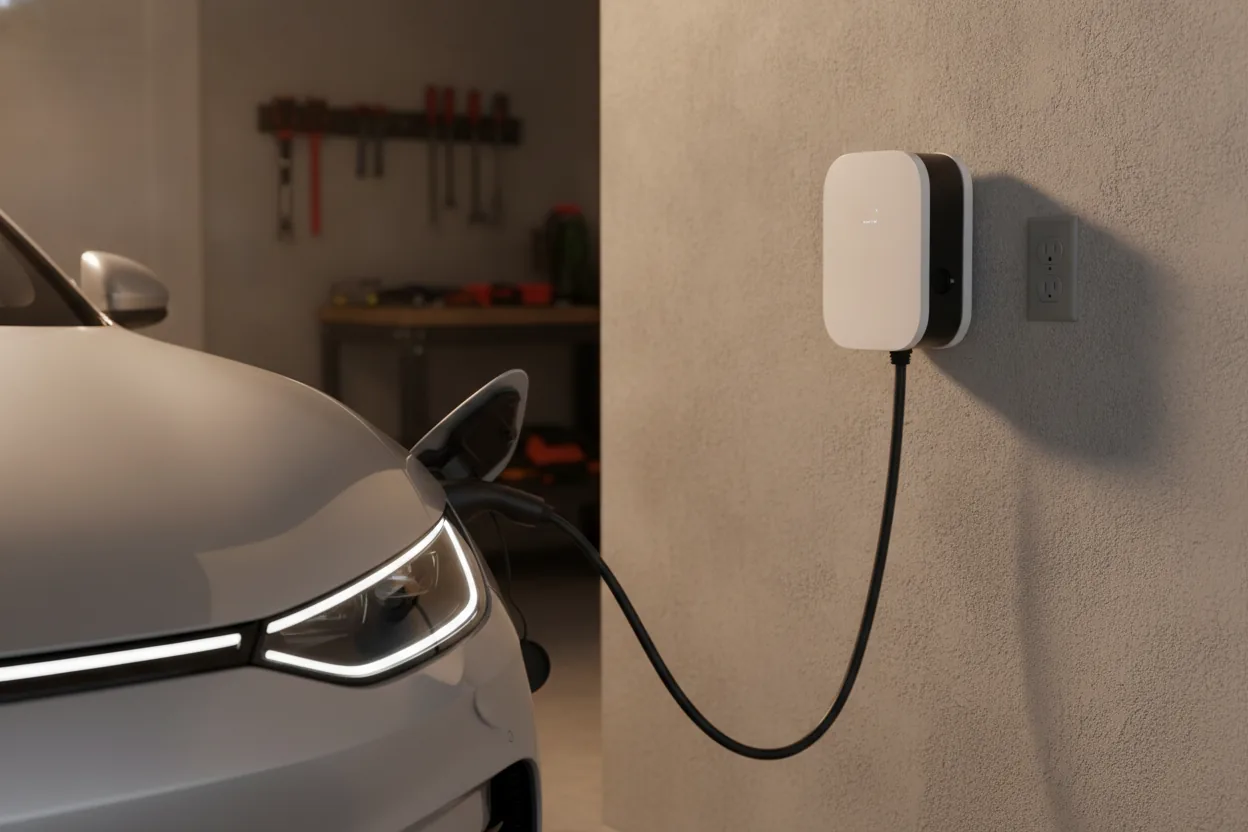
- Level 2 home charging: a 240-volt outlet and a dedicated EVSE unit that delivers a full charge overnight, covering the daily driving needs of most U.S. households on a single residential electricity rate.
- Level 2 public stations: an average of roughly $0.25 per kWh across most U.S. networks, already a 39% premium over the national residential average of $0.18 per kWh.
- DC fast chargers: average $0.53 per kWh in many markets. AAA puts the national public charging average at approximately $0.42 per kWh as of October 2025, which blends Level 2 and fast-charge sites together.
- Lifecycle emissions: EVs produce fewer emissions per mile than a combustion engine, even on coal-heavy grids, across all three charging tiers.
The sustainability case holds regardless of where you charge. The cost case is a different story. Drivers who lean primarily on public DC fast charging can end up spending more on energy each month than some hybrid owners spend on gasoline, which makes charging habits as consequential a decision as the vehicle itself. For budget-conscious buyers, the charging tier you commit to is effectively a second price tag on the car.
The Real Numbers: Annual and Monthly Costs Across Every Charging Scenario
Those tier differences translate into specific dollar figures that make the stakes concrete. Using a 72 kWh battery, close to the average pack size across mainstream EVs sold in the U.S., and the national residential electricity rate of $0.18 per kWh, a full home charge costs $13. For somewhere around 13,000 to 14,000 miles annually, which is what typical U.S. drivers cover, home charging totals roughly $694 per year, or about $0.05 per mile. Shift that same driver to public Level 2 stations at $0.25 per kWh and annual costs climb to approximately $964. Move them entirely to DC fast charging at $0.53 per kWh and the annual bill hits $2,043. KBB data fills in the monthly picture: charging 338 kWh per month at the U.S. household average of $0.1932 per kWh runs about $65 per month at home, compared to roughly $169 per month at a public DC fast charger priced at $0.50 per kWh.
- Home charging annual cost: approximately $694 for 13,489 miles at $0.18/kWh, or $0.05 per mile, the lowest fueling cost available to any passenger vehicle class.
- Public Level 2 annual cost: approximately $964 for the same mileage at $0.25/kWh, a $270 premium over home charging that compounds across a typical 5-to-8-year ownership period.
- DC fast charge annual cost: approximately $2,043 for the same mileage at $0.53/kWh, more than double the cost of public Level 2 and nearly three times what home charging costs.
- Gas comparison: EnergySage pegs average gasoline costs at $0.13 per mile. Home EV charging at $0.05 per mile cuts per-mile fuel costs by more than half. Public DC fast charging at $0.13 per mile erases that advantage entirely.
- Monthly home charging cost: roughly $61 per month based on EnergySage estimates, versus $132 per month for a comparable gasoline vehicle and up to $169 per month for a driver living off DC fast chargers.
Regional electricity rates move every figure above. Louisiana ratepayers around $0.12/kWh compress home-charging costs further, while Hawaii above $0.38/kWh can push home charging close to what public Level 2 costs elsewhere. Time-of-use plans from many U.S. utilities offer discounted overnight rates well below the standard residential rate, and for average-mileage drivers that difference meaningfully shrinks the annual home-charging bill. Drivers without reliable home charging access, apartment renters without dedicated parking being the clearest example, face a structurally higher cost of EV ownership and need to factor that into the total cost of ownership calculation before committing to a vehicle or lease term. For those buyers, the gap between a $694 annual charging bill and a $2,043 one is the most consequential number in the entire purchase decision. Which brings it back to the question this post opened with: the charging tier you rely on daily determines whether an EV actually saves you money, and for apartment dwellers without dedicated parking, the honest answer may be that it does not.