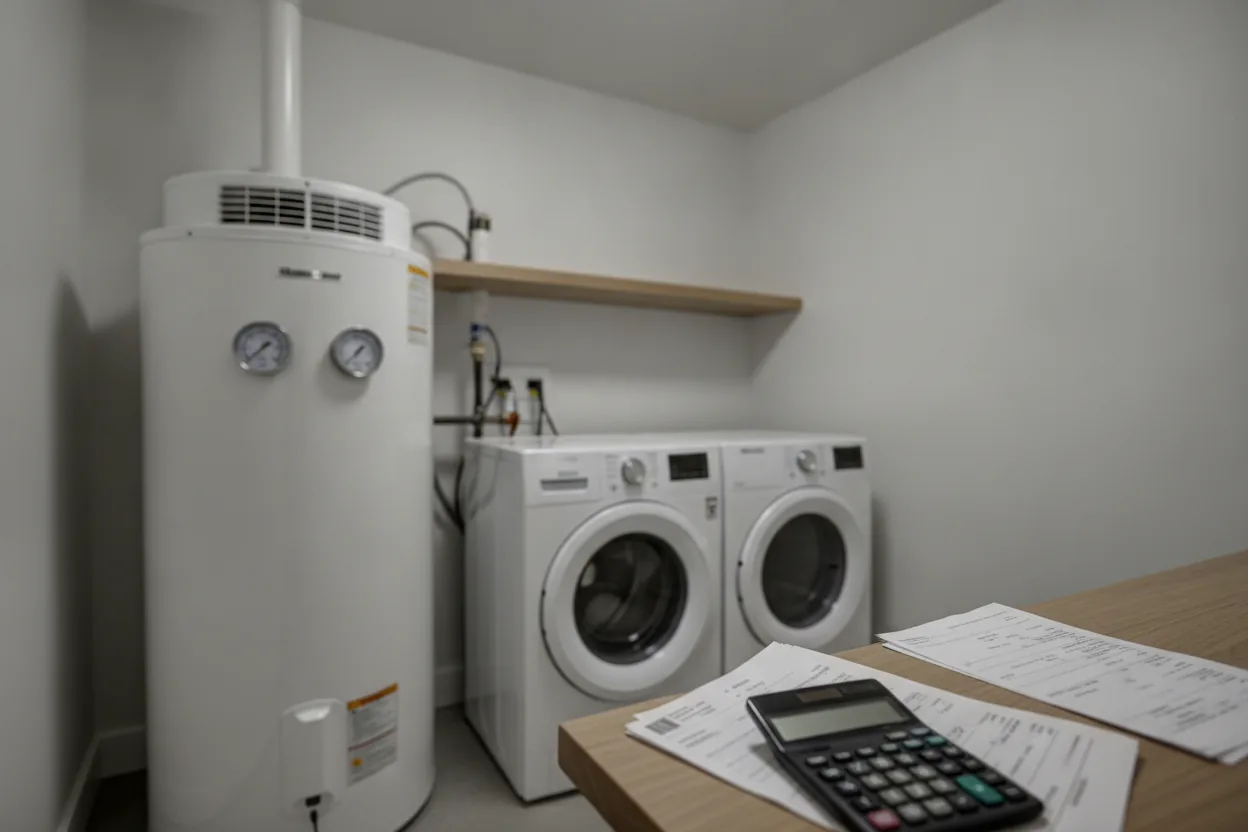
A Family of Four in a 3-Bedroom House Explains the Math
A conventional electric water heater costs a family of four roughly $550 more per year to run than an ENERGY STAR heat pump model. Still, that heat pump unit carries a noticeably higher price tag at checkout, at least by some estimates. So which number actually wins over the life of the appliance: the sticker shock now, or the savings later?
A heat pump water heater doesn't make heat by running electricity through a coil. It pulls ambient heat out of the surrounding air and moves it into the tank, basically a refrigerator running backward. That's why these units end up roughly four times more efficient than conventional electric ones. Less energy in, same hot water out.
Water heating eats up a huge chunk of energy in a typical home, usually trailing only space heating and cooling. Widely cited figures show this technology cuts that draw significantly, and a reduction that size ripples through total household energy use. Less demand per household means less strain on the grid, and lower emissions tied to it, especially in regions still leaning on fossil fuel plants for part of their electricity mix.
For the household in this example, the efficiency gain isn't marginal or theoretical. It's the difference between running one of the least efficient appliances in the house and one of the most efficient electric options on the market, and that gap is exactly why the savings numbers below hold up across income levels and regions.
Household Size Determines Exactly How Much You Save
That efficiency gain turns into different dollar amounts depending on how many people live in the house. ENERGY STAR ran the numbers assuming an electricity rate of 14.6 cents per kWh, an incremental HPWH cost of $1,503, and a 13-year appliance lifespan. The results scale directly with household size, since bigger households simply use more hot water:
- 2-person household: 1,880 kWh saved annually, $270 saved per year, payback in 5.5 years, $2,050 saved over the unit's lifetime.
- 3-person household: 2,820 kWh saved annually, $410 saved per year, payback in 3.7 years, $3,830 saved over the unit's lifetime.
- 4-person household: the biggest winner here: 3,760 kWh saved annually, $550 saved per year, payback in just 2.7 years, and $5,610 saved over the unit's lifetime.
Rewiring America's independent analysis lands in a similar range, estimating $80 to $230 in annual savings depending on the household and region, with the median conventional water heater costing $230 a year to run versus $90 for a heat pump model. The gap between ENERGY STAR's numbers and Rewiring America's comes down to differences in climate, local electricity rates, and how much hot water a household actually uses, but both point the same direction: bigger household, bigger savings, and a payback period measured in single-digit years instead of decades.
A two-person household weighing whether the upfront cost is worth it should expect a payback closer to five and a half years. For a family of four, that payback shrinks to under three years, and every year after that is pure savings back in the household budget.
Federal Tax Credits Are Cutting the Upfront Cost Right Now
Those payback periods already look short on paper, and federal incentives shrink them further before a household even factors in the annual savings. The Inflation Reduction Act offers a 30 percent tax credit on heat pump water heaters, capped at $2,000 per year, for households that install an ENERGY STAR certified model. On a typical HPWH installation, that credit can knock a meaningful chunk off the $1,503 incremental cost ENERGY STAR uses in its payback math, shortening an already short window even further.
Low- and moderate-income households get an even steeper discount. The Electrification Rebates program under the IRA covers 50 to 100 percent of HPWH costs, up to $1,750, depending on income eligibility. For households that qualify, a multi-year payback can turn into savings that start almost immediately, since the upfront gap between a heat pump unit and a standard electric tank narrows dramatically, or vanishes outright.
Water heaters don't last forever. A standard electric resistance tank typically lasts around 6 years before it needs replacing, while HPWHs come with longer warranties tied to lifespans of 10 years or more. That means most households will face a replacement decision at some point no matter what, and doing it proactively, before the old unit fails and forces a rushed same-day swap, is when these federal incentives actually matter. Wait for a failure, and you'll likely grab whatever unit the plumber has on the truck, which is usually the cheapest conventional model, not the one eligible for a tax credit.
Anyone planning a water heater replacement in the next year or two has a direct financial reason to check IRA eligibility before the old unit dies, not after.
Why the National Scale Adds Weight to an Individual Choice
Zoom out from any single household's tax credit, and the same math, repeated millions of times, adds up to a national-scale shift. ENERGY STAR lays out the counterfactual plainly: if every electric water heater sold in the United States were an ENERGY STAR certified heat pump model, national energy cost savings would reach about $8 billion a year. That's not a household number. That's an entire market shifting toward one appliance category.
The emissions side is just as concrete. ENERGY STAR puts the greenhouse gas reduction at roughly 150 billion pounds annually, which the agency equates to pulling more than 14 million vehicles off the road. That comparison turns a fairly unglamorous appliance swap, a water heater sitting in a basement or closet, into something with climate impact on the scale of a mid-sized country's entire vehicle fleet.
No single household replacing one water heater moves that national number on its own. But the aggregate savings and emissions figures only exist because millions of individual households run the same calculation this post just walked through: weigh the $400 to $600 annual cost of a conventional electric tank against the $104 to $160 cost of a heat pump model, factor in a tax credit or rebate, and land on a payback period short enough to make the switch a fairly easy call.
Which brings the math back to the question this post opened with: sticker shock now, or savings later. The winners are clear. Households with hot water demand from a family of three or four see the fastest payback and the largest absolute savings, and low-income households eligible for the Electrification Rebates get the most upfront relief. The people who gain least are those in very small households with low hot water use and no rebate eligibility, where payback stretches closer to six years. Even there, the unit still saves money over its lifetime, just more gradually. The upfront number only wins if the appliance never gets replaced, and since every water heater eventually does, the savings later end up outweighing the sticker shock now for nearly every household that actually runs the math.