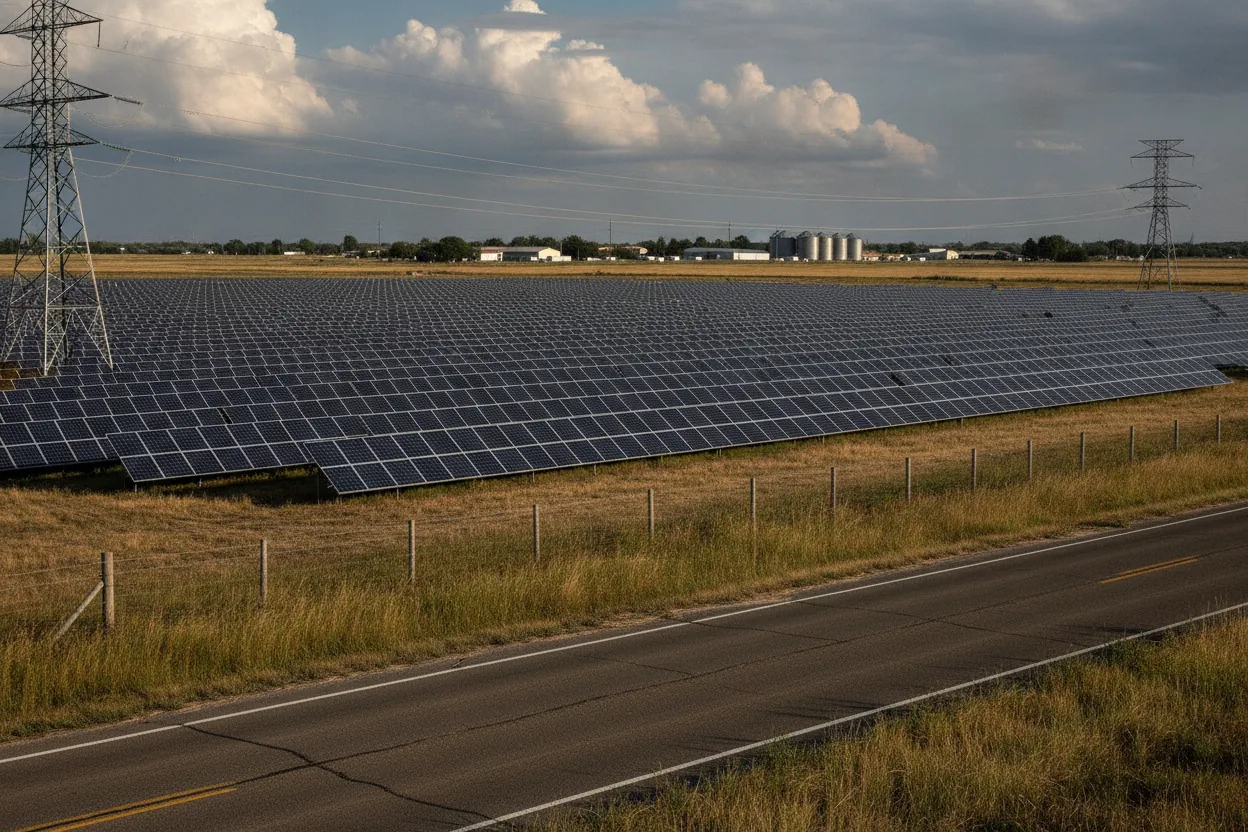
The Battle Over Where Clean Energy Gets Built
The US added roughly 50 gigawatts of new solar capacity in 2024. Impressive, sure. But over 2,700 gigawatts of proposed projects are still sitting in interconnection queues, and a significant chunk of that backlog isn't stuck because the technology failed or the costs don't pencil out. It's stuck because of local siting rules. The real question for anyone tracking clean energy investment isn't how much capacity has been announced. It's which states are actually rewriting the rules to let projects move.
- The US added roughly 50 gigawatts of new solar capacity in 2024, yet interconnection queues still hold over 2,700 gigawatts of proposed projects nationwide, a significant share blocked partly by local siting barriers.
- More than 30 states have adopted or are actively considering state-level siting preemption laws that allow renewable projects to bypass restrictive county ordinances under specific conditions.
- Ohio's HB 6 rollback and New York's Accelerated Renewable Energy Growth and Community Benefit Act are two high-profile examples of states restructuring who holds final siting authority for large-scale clean energy projects.
- The most common local weapon against utility-scale development is the setback requirement, the mandated gap between a solar array or wind turbine and a property line. Some counties have pushed setbacks so far that they function as an outright ban without technically being one.
- Battery storage projects face a separate layer of siting scrutiny tied to fire safety codes, with NFPA 855 serving as the baseline standard that many jurisdictions apply inconsistently.
The tension here is genuine. Community input on land use matters, and nobody should pretend otherwise. But there's a difference between managing real safety concerns and writing ordinances specifically designed to kill renewable projects. When rules do the latter, the cost isn't abstract: it's delayed decarbonization at a regional and national scale. If you follow solar and wind deployment numbers, siting reform deserves at least as much attention as grid capacity figures. Approved capacity means very little without a workable path to construction.
The 2026 Reform Landscape and What the Latest Report Confirms
A July 2026 report covered by SolarQuarter surfaced something genuinely counterintuitive. The number of restrictive clean energy bills introduced at the state level surged during the 2026 legislative session, which sounds alarming. But the bills that actually passed tell a different story. The majority of states that enacted new siting legislation moved in a reform-friendly direction. The spike in restrictive introductions reflects organized local opposition that has gotten sharper and more tactically sophisticated since 2022. The outcomes, though, suggest that opposition hasn't translated into legislative wins at the scale its proponents hoped for.
- The 2026 SolarQuarter-cited report found that reform-oriented siting bills outpaced restrictive bills in terms of enacted legislation across US states during the first half of 2026.
- States in the Midwest and Southeast, traditionally slower to adopt renewable-friendly siting rules, accounted for a notable share of the new reform activity tracked in the report.
- Restrictive bill introductions spiked in at least 15 states, often leaning on agricultural land preservation arguments and viewshed protections rather than framing opposition as anti-renewable outright.
- Several states moved to create single-agency permitting windows for projects above a certain megawatt threshold, cutting down the number of separate local approvals a developer has to chase before breaking ground.
- The report's findings sit alongside a notable global data point: India's NTPC REL awarded Bondada Engineering an order in July 2026 for the country's largest vanadium flow battery project at 100 MWh, a signal that grid-scale storage investment is accelerating globally at the exact moment US siting frameworks for storage are being stress-tested.
That NTPC REL vanadium flow battery project is worth pausing on. Storage faces the same siting friction as generation, and a 100 MWh installation in India shows the scale at which storage is now being planned globally. That makes US siting rules for storage facilities a progressively higher-stakes question, not a peripheral one. The overall picture from the 2026 report is that state legislatures are, on balance, choosing to push clean energy deployment forward through structural reform rather than handing the keys to restrictive local ordinances. For developers, landowners, and communities living near proposed sites, that's a consequential shift in where the power to decide actually sits.