Estimates suggest lithium demand from battery energy storage systems could grow around 55% in 2026, following what analysts describe as a similarly sharp jump the year before. The signal is real. But the ETFs retail investors use to access this trade were built around EV demand, carry expense ratios of 75 to 85 basis points, and may be pointed at the wrong part of the value chain entirely. The BESS surge is specifically a demand surge for lithium carbonate, sourced from brine operations. Yet thematic funds simultaneously hold hydroxide-focused miners, early-stage explorers, and downstream manufacturers whose fortunes have little to do with carbonate prices. The demand story checks out. Whether the products designed to capture it actually deliver that exposure is the question the growth figures alone cannot answer.
The dominant narrative around lithium has been the EV story. Every analyst deck from 2021 to 2024 framed lithium as a proxy trade on electric vehicle penetration. That frame is now incomplete. BESS deployment, driven by grid-scale storage buildouts in the US, China, and parts of the EU, has become a demand driver large enough to reshape the supply calculus on its own terms. The lithium market is no longer a single-thesis commodity.
What makes this shift analytically significant is the difference in procurement behavior between EV manufacturers and grid storage developers. EV makers buy lithium through offtake agreements tied to vehicle production schedules. Grid storage developers buy to match grid contracts, capacity auction timelines, and renewable intermittency profiles. Different demand curves, different lead times, and they do not move in sync. That desynchronization matters more than the headline growth figures.
The investment products built around this thesis, from miners on the ASX to ETFs like LIT (Global X Lithium and Battery Tech ETF) and BATT (Amplify Lithium and Battery Technology ETF), were largely designed when EV demand was the primary engine. The BESS acceleration is now stress-testing those product structures in ways most retail investors have not priced in. A fund weighted toward lithium carbonate producers and cathode manufacturers will behave differently now that storage demand is pulling from a different part of the value chain.
How BESS Demand Actually Moves Lithium Markets
Lithium Carbonate Price Trend: Peak to Correction (China Spot, USD per Tonne)
Lithium Carbonate Price Trend: Peak to Correction (China Spot, USD per Tonne)
Source: Article estimates and analyst data
Source: Article estimates and analyst data cited in article
Grid-scale BESS projects predominantly use lithium iron phosphate chemistry, known as LFP. This is a deliberate choice: LFP cells tolerate more charge cycles, carry lower thermal risk, and have a cost per kilowatt hour that has fallen far enough to make multi-hour storage projects financially viable at grid scale. The LFP share of grid storage installations in China has been above 90% for several years. In the US, LFP adoption for utility storage crossed a similar threshold more recently, as domestic integrators moved away from NMC chemistry for stationary applications.
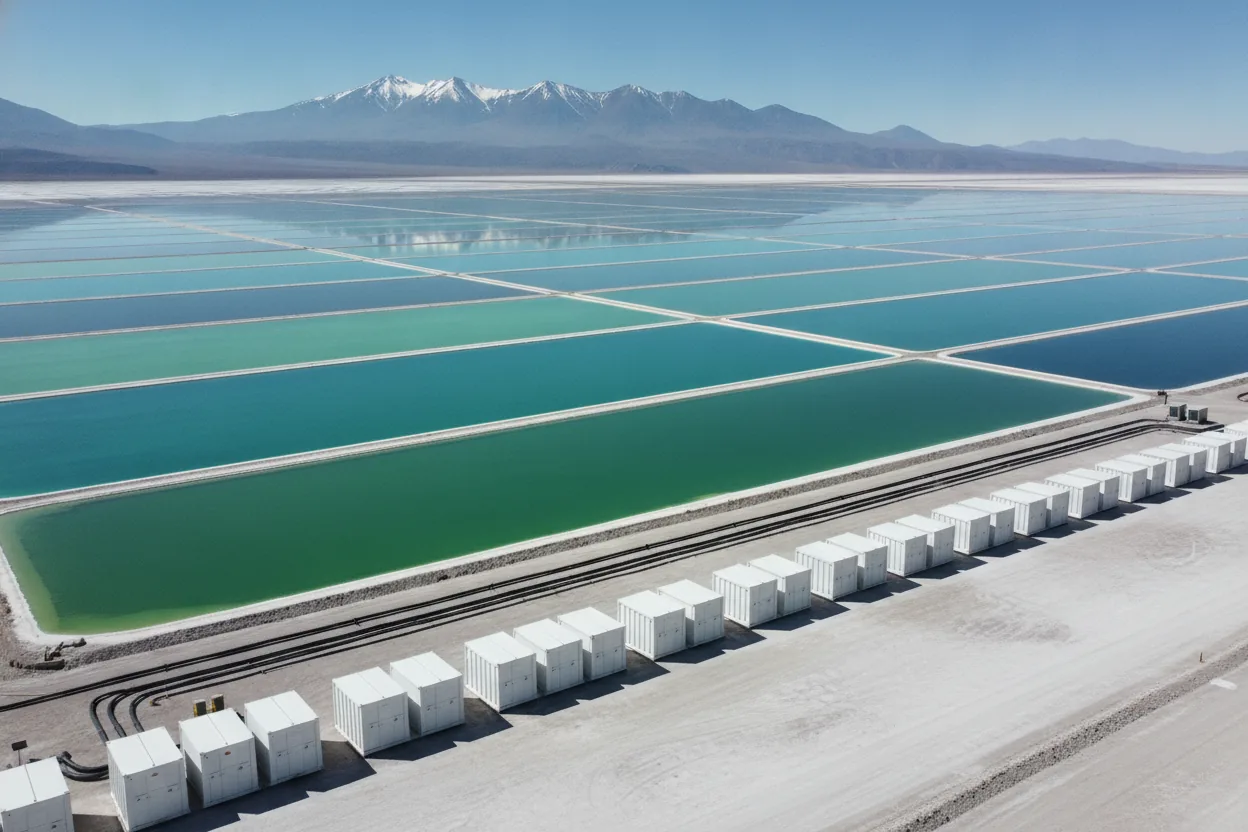
LFP uses lithium carbonate as its primary lithium input, not lithium hydroxide. This distinction is not a chemical footnote. Lithium carbonate and lithium hydroxide trade at different prices, are produced through different refining processes, and are sourced from different upstream assets. Hard rock spodumene from Australia typically routes to hydroxide production for high-nickel EV cathodes. Brine operations in the Lithium Triangle, spanning Chile, Argentina, and Bolivia, produce carbonate as their primary output. A structural BESS demand surge for LFP is therefore a demand surge specifically for carbonate, and specifically favorable for brine-based producers.
Spot prices for lithium carbonate have remained well below their 2022 peak. At that peak, carbonate touched roughly 74,000 USD per tonne in China. By mid-2025, prices had corrected sharply, with carbonate trading in ranges that made many hard rock operations economically marginal. The BESS demand acceleration in 2026 is the first structural catalyst large enough to argue that the bottom of that correction cycle has passed. Whether spot prices have fully reflected this is a live question: the lag between demand data and price discovery in specialty chemicals is longer than most equity investors assume.
The mechanism worth watching is inventory behavior at Chinese cathode manufacturers. China produces the overwhelming majority of global LFP cathode material, and those manufacturers build or draw down carbonate inventory based on project pipeline visibility. When grid storage order books extend, manufacturers accumulate. When visibility compresses, they draw down. That inventory cycle, not spot demand, is typically what drives short-term lithium carbonate price movements. The 55% BESS demand growth figure is directional, not a precise forecast. It does not tell you the timing. For brine producers in Chile with low operating costs and contracted offtake, the direction alone is enough to distinguish them from hard rock operators still waiting for the cycle to clear.
Reading the Product Structures Around This Trade
LFP vs NMC Battery Chemistry: Key Differences for Investors
LFP vs NMC Battery Chemistry: Key Differences for Investors
Source: Article analysis and industry data
| Dimension | LFP (Lithium Iron Phosphate) | NMC (Nickel Manganese Cobalt) |
|---|---|---|
| Primary Lithium Input | Lithium Carbonate | Lithium Hydroxide |
| Primary Source | Brine operations (Lithium Triangle: Chile, Argentina, Bolivia) | Hard rock spodumene (Australia) |
| Primary Application | Grid-scale BESS storage | High-nickel EV cathodes |
| China Grid Storage Share | Above 90% | Below 10% |
| Thermal Risk | Lower | Higher |
| ETF Exposure Alignment | Underweighted in LIT, BATT | Overweighted in LIT, BATT |
Note: LIT and BATT were designed around EV demand and may not accurately reflect BESS-driven carbonate demand.
Source: Article analysis, industry data cited in article
Retail investors accessing the lithium BESS theme through ETFs are buying a product structure that introduces at least three layers of friction between the demand signal and the return. The first is index methodology. LIT, for example, tracks the Solactive Global Lithium Index, which includes not only miners but also battery manufacturers and EV-adjacent companies. A BESS demand surge that is bullish for carbonate producers can be partially diluted by index exposure to hydroxide-focused miners or downstream companies whose margins are compressed by the same lithium cost inflation. The demand tailwind and the cost headwind can live in the same fund.
The second friction layer is the fee structure. Lithium-themed ETFs typically carry expense ratios between 59 and 75 basis points. That is not extraordinary by thematic ETF standards, but it is meaningful when held against the volatility profile of the underlying assets. Lithium miners historically move at two to three times the magnitude of the commodity price itself, because they carry operating leverage, jurisdiction risk, and balance sheet structure that amplifies price swings in both directions. A fund charging 75 basis points to deliver that kind of exposure is collecting a fixed fee in exchange for asymmetric risk. The math is not obviously favorable to the holder in the early or declining phases of a commodity cycle.
The third friction layer is the gap between the commodity thesis and the equity thesis. A lithium carbonate price recovery driven by BESS demand is bullish for producers with low-cost brine operations and contracted offtake. It is less clearly bullish for developers still in construction, early-stage explorers with no production, or refiners operating on thin processing margins. Most thematic ETFs hold all of these categories simultaneously, because index construction favors liquidity and market cap over operational specificity. The demand signal is real. The product's ability to translate that signal into return depends on which companies happen to qualify for the index at any given rebalance date. Investors who understand this friction are better positioned to interpret ETF performance divergence from the underlying commodity move than those who treat the fund as a clean carbonate proxy.
Where the Structural Tension Sits in 2026
Lithium Demand from BESS: Growth Trajectory and Demand Source Mix
Lithium Demand from BESS: Growth Trajectory and Demand Source Mix
Source: Analyst estimates cited in article (indexed to 2024 baseline = 100 units)
Source: Analyst estimates cited in article
The BESS acceleration is happening against a backdrop of lithium supply that was significantly overbuilt between 2021 and 2024. Australian hard rock producers expanded aggressively during the price spike. Chilean brine capacity investments approved at 60,000 USD per tonne carbonate look different at 15,000 USD. Several producers cut or suspended output in 2024 and early 2025. The supply correction was real but uneven: low-cost brine producers in Chile absorbed the downturn more comfortably than high-cost hard rock operations that came online near the top of the cycle.
The tension in 2026 sits between a genuine demand acceleration and a supply base that has not fully rationalized. BESS growth adds a new demand vector that was not fully modeled in 2022-era supply expansion plans. A 55% increase in a single end-use segment, however significant, does not automatically translate to price recovery if curtailed supply can be restarted faster than new demand is absorbed. Restart economics for idled hard rock operations are more favorable than greenfield development economics, which means supply response to any price recovery can arrive relatively quickly.
There is also a geopolitical layer that retail investors consistently underestimate. US tariff policy on Chinese battery products and the Inflation Reduction Act's domestic content requirements have created a bifurcated market for BESS deployment. Projects qualifying for IRA battery storage tax credits need to meet sourcing thresholds that effectively restrict LFP cathode from Chinese manufacturers. This is pushing US BESS developers toward either non-Chinese LFP supply chains or alternative chemistries, neither of which is fully operational at scale as of mid-2026. The demand number is global. The accessible supply for US-domiciled projects is structurally constrained by policy in ways that the commodity price alone does not reflect.
The carbon angle is quieter but carries weight. Large-scale BESS deployment is what makes high renewable penetration grids function without frequency instability. Storage is the enabling infrastructure for intermittent generation, which means the BESS buildout is functionally necessary for the grid decarbonization targets that underpin carbon credit pricing assumptions in several regulated markets. The BESS demand story and the carbon market story are not parallel tracks. They are the same system, viewed from different entry points. Whether that systemic interdependence ever resolves into a coherent pricing signal across both asset classes remains genuinely open, but producers sitting at the carbonate end of the LFP supply chain are structurally better placed to benefit from both the storage buildout and any carbon-linked policy tailwinds than the ETF structures currently available to retail investors are designed to capture.