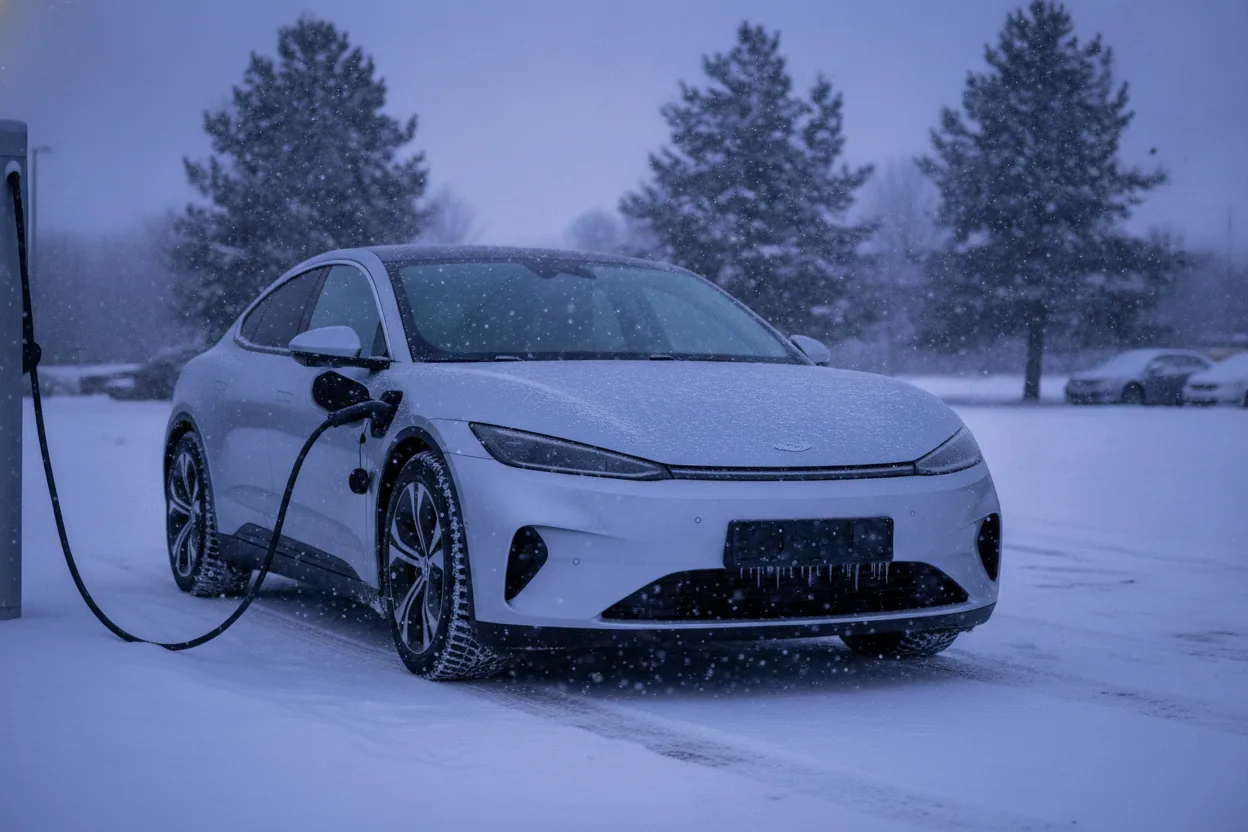
What's happening inside an EV battery when it's cold
AAA ran the numbers in May 2026 and found EVs lose 39.0% of their driving range at 20°F compared to 75°F. That's a steep drop, way more than what a gas-only vehicle loses in the same cold. So if you're eyeing an EV's window-sticker range before winter sets in, how much of that number can you actually trust? Not much, it turns out.
- EVs lose 39.0% of their driving range at 20°F compared to 75°F, according to AAA's testing.
- MPGe (miles per gallon equivalent) drops 10.4% for EVs in the same cold-weather conditions.
- Hybrids only lose 23% of their fuel economy at 20°F. Gas-electric drivetrains just handle cold better.
- Recurrent Auto surveyed 30,000 electric cars and found vehicles at 32°F retain about 78% of their ideal-temperature range.
- Gas-only vehicles lose a much smaller slice of their range at 20°F by comparison, nowhere near the hit an EV takes.
The gap between EVs and gas vehicles in cold weather isn't some defect baked into electric drivetrains. It comes down to how each one stores and delivers energy, full stop. For anyone comparing a used EV listing's advertised range to what they'll actually get in January, that 39% figure is the number that matters most, not the sticker.
Which raises the obvious next question: why does cold hit EVs so much harder than gas vehicles, and what should that change about how you shop or drive one?
Why this matters for anyone shopping or driving an EV today
Two separate things are going on here, and knowing both explains why some EVs shrug off winter better than others. First, the battery's internal chemistry slows down when it's cold, so it simply can't deliver as much usable energy at any given moment. Second, the car burns extra energy heating the cabin, and in a lot of models, warming the battery pack itself before it can even charge or discharge efficiently. That second step is called battery conditioning, and it's not optional in freezing weather.
- Newer EVs increasingly rely on heat pumps instead of resistive heaters, which cuts the energy cost of warming the cabin.
- 2026-era models come with better battery encasement and insulation, so less heat escapes the pack when it's freezing out.
- Heat isn't free either: EVs lose 8.5% of range and 10.4% of MPGe at 95°F from cabin cooling demands.
- Hybrids again come out ahead in hot weather too, losing just 12.0% fuel economy at 95°F.
- Precondition the car while it's still plugged in. Let it warm the battery and cabin using grid power instead of draining the pack once you're on the road.
None of this makes EVs a bad bet in cold climates. It just means the number on the window sticker is a best-case scenario, not a promise. AAA's 39% cold-weather figure is the real-world ceiling you should plan around, not the rosier 78% retention Recurrent found at a milder 32°F. If you're shopping for an EV somewhere with actual winters, treat the sticker range as the ceiling, budget for roughly 20 to 40% less in freezing temps, and put heat pumps and preconditioning near the top of your checklist if you'll be driving through real cold on a regular basis.